Spatial Audio & Immersive Music for Industrial: EBM, Aggrotech & Dark Electro
Spatial9 Team · · 9 min read
Part of the series Spatial audio and immersive music by genre.
Key takeaways
- In a spatial industrial mix the kick and bass sequence stay locked in the centre, while a distorted vocal, synth stabs, snare, metal hits, a noise wall, samples and a cold reverb surround the listener.
- The distorted vocal and harsh synths work best on separate sides in industrial, because sounds that share a frequency range mask each other less when they arrive from different directions.
- Industrial gets its immersion from width and texture rather than a huge room, so noise sits behind and above while a short, hard reverb keeps the metal hits sharp.
- The industrial immersion profile scores width 5, height 3, movement 3, low-end focus 4 and space 3 out of 5.
Industrial music began in the UK in the mid-1970s, named after Industrial Records, the label set up by Throbbing Gristle, with groups such as Cabaret Voltaire in Sheffield pushing the same ideas. Early industrial was built from tape loops, found sounds, noise and confrontational spoken samples. In the 1980s it moved towards the dancefloor with sequencers and drum machines, and later fed into industrial rock, industrial metal and harder strands of techno. The sound is concrete and physical: a hard kick, a repeating sequenced bassline, metal struck like percussion, distorted or shouted vocals, harsh synth stabs, and layers of noise and sampled speech. Industrial has always been about texture and pressure, which is why space matters so much. In stereo those textures pile up into one dense block. In 3D they can surround the listener like a factory floor. This guide covers how spatial audio for industrial works, where to place each element and how to make an immersive industrial mix. For the basics, see what spatial audio is.
Why industrial works in spatial audio
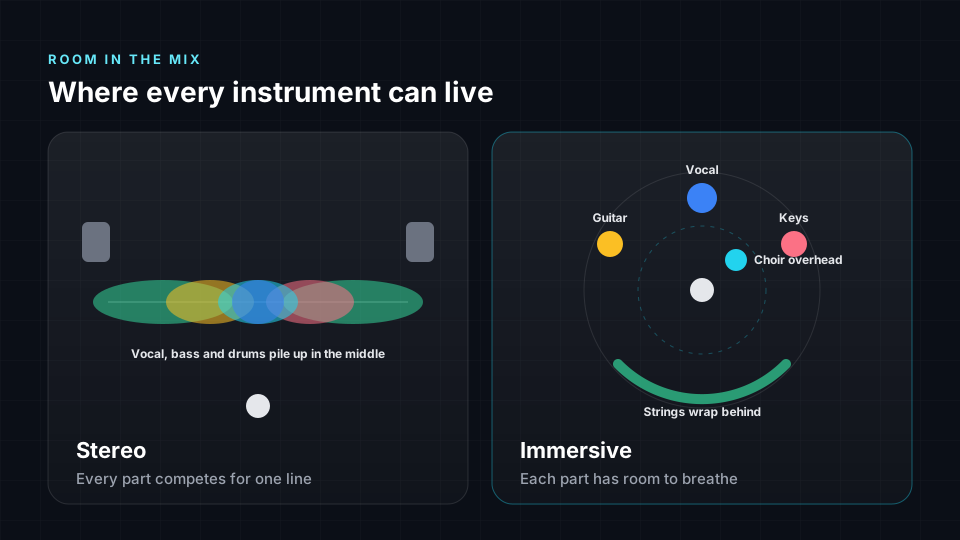
Industrial tracks stack many hard sounds in the same range: distorted vocals, buzzing synths, clanging metal and noise. In stereo, those layers fight for the same narrow space and the mix turns to mush, or gets squashed to stay loud. Spatial audio gives each layer its own direction, so the noise can be huge without burying the vocal or the groove.
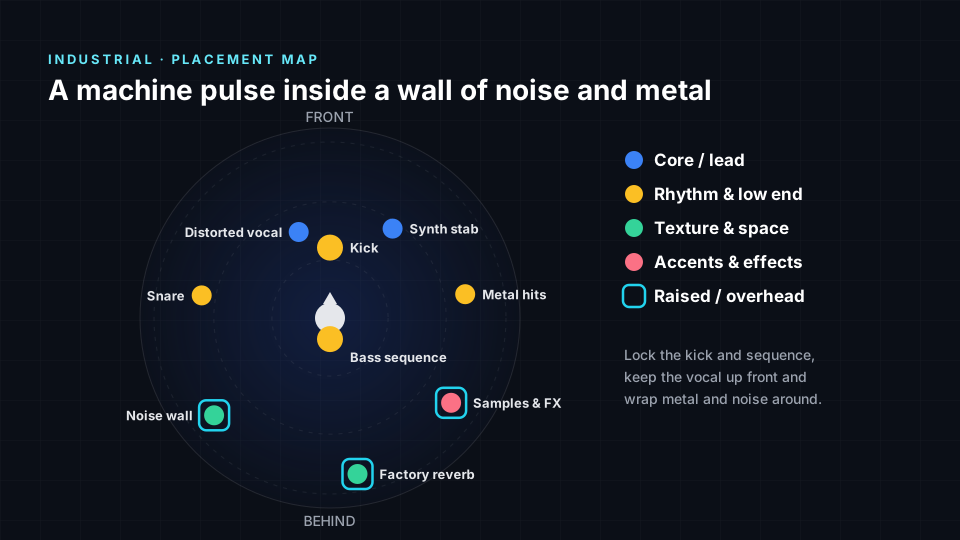
The rule: a locked machine pulse, a hostile room around it. The kick and bass sequence never move, while metal, noise and samples press in from every side.
Immersive music for industrial: what listeners hear
- A pulse you feel in your chest. The kick and sequenced bass stay solid and centred.
- Metal all around. Clangs and hits ring out from the sides instead of one flat line.
- A voice that cuts through. The distorted vocal stays in front, even inside heavy noise.
- A cold, hard room. Noise and reverb rise behind and above like a factory hall.
Where to place each element in an industrial mix
| Element | Position | Height | Why it works |
|---|---|---|---|
| Kick | Front centre | Ear level | Hard, mechanical pulse |
| Bass sequence | Centre | Ear level | The driving engine of the track |
| Distorted vocal | Front left | Ear level | Aggressive and readable |
| Synth stab | Front right | Ear level | Harsh harmony away from the vocal |
| Snare | Left | Ear level | Heavy backbeat with its own space |
| Metal hits | Right, moving | Ear level | Clanging percussion that shifts |
| Noise wall | Behind left | Raised | Pressure without masking the vocal |
| Samples & FX | Behind right, moving | Raised | Sampled voices and machine sounds |
| Factory reverb | Behind | Raised | Cold, hard space |
The psychoacoustics behind industrial placement
Every position in the table above follows how the ear and brain locate sound. Here is the reason behind the main choices for industrial.
- Kick and bass sequence stay centred. The ear finds almost no direction in frequencies below roughly 80 to 100 Hz, so the low part of an industrial bass sequence gains nothing from being spread. Keeping it centred and mono keeps the machine pulse heavy and steady on any system. Any distorted upper harmonics can be widened slightly without moving the root.
- Vocal and synth stab on separate sides. Two sounds that share a frequency range mask each other far less when they arrive from different directions. This is spatial release from masking. Distorted vocals and buzzing synths both live in the upper mids, so splitting them keeps the words readable without making the synths quieter.
- Noise behind, rhythm in front. The brain groups sounds into separate streams by direction, pitch and timing. This is auditory stream segregation, described by Bregman. Putting the noise wall behind and above lets the listener hear it as one surrounding layer, while the kick, snare and metal hits stay a clear rhythmic stream in front.
- Metal hits stay sharp in a reverb. When a sound and its reflections arrive close together, the brain fixes its position by the first arrival. This is the precedence effect. A metal hit on the right keeps its place even when the factory reverb throws its tail around the room.
The immersion profile for industrial
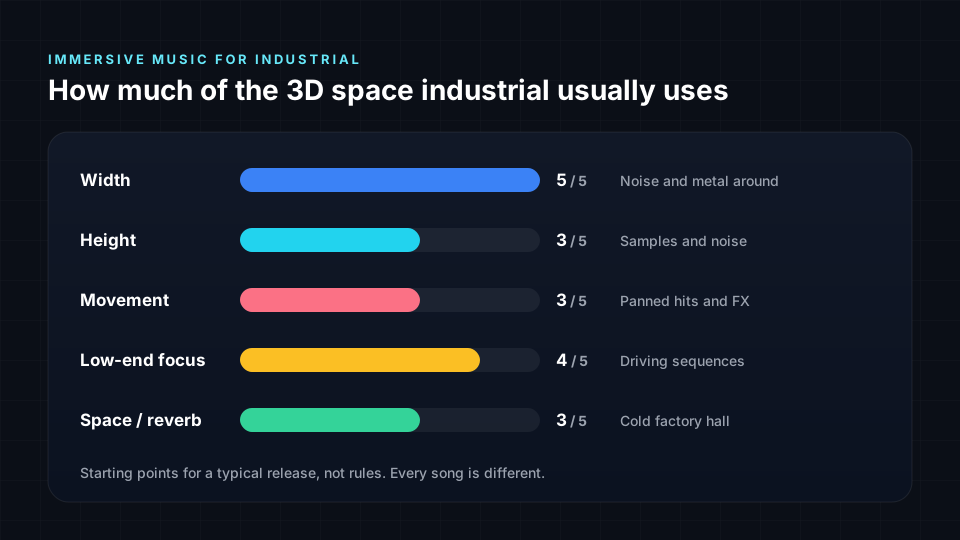
Width is at maximum because noise, metal and samples can fill every direction around the listener. Low-end focus is high because the kick and the bass sequence drive everything. Height, movement and space sit in the middle. The noise and samples rise above the listener, and some hits move, but the groove is mechanical and repetitive, and a huge reverb would blur the hard edges industrial depends on.
Tips for an immersive industrial mix
- Keep the sequence mono. The bass line must hit the same from every direction.
- Spread the noise, not the groove. Width belongs to noise and metal, not the kick and bass.
- Give the vocal a clear lane. Keep it in front and move clashing synths to the opposite side.
- Use movement as punctuation. Let a metal hit or sample fly past at key moments, not all the time.
- Keep the room hard. A short, bright, metallic reverb suits industrial better than a long hall.
Industrial styles: EBM, aggrotech and dark electro
The core placement still applies to every industrial style: kick and bass sequence locked in the centre, vocal in front, noise and metal around the listener. What changes is how much melody there is, how harsh the vocal is and how much room the track needs.
EBM
Electronic body music grew out of Belgium and Germany in the early 1980s, mixing industrial noise with punk energy and sequenced synth bass. It is built on a repeating, martial bassline, a straight drum machine beat and shouted, commanding vocals. In a spatial mix the sequence is the star, so keep it mono, centred and dry with the kick. Place the vocal close in front and slightly raised so it commands the room. EBM is sparse, so use fewer surrounding layers: one or two synth lines at the sides and a short, hard reverb behind are enough.
Aggrotech
Aggrotech is a harsher, more club-oriented style from the 2000s, sometimes called hellektro. It pairs heavily distorted, often pitched-down vocals with hard four-to-the-floor beats and bright, trance-influenced synth leads. In 3D the challenge is keeping the distorted vocal and the lead synth apart. Put the vocal front centre and the lead slightly raised at front right, then spread arpeggios and pads wide around the sides. Keep the kick very centred and use risers overhead to lift the drops. Space stays fairly tight.
Dark Electro
Dark electro developed in the late 1980s and 1990s, taking industrial into horror-film territory with layered synths, distorted or processed vocals, eerie samples and slower, heavier grooves. It suits a larger room than other industrial styles. Place cinematic samples and pads behind and above, and let whispered or processed vocal layers circle slowly at the sides. Keep the main vocal in front so the lyrics survive the atmosphere. A longer, darker reverb behind the listener adds dread without blurring the kick.
Closely related styles such as industrial rock, industrial metal and futurepop follow the same pattern, with a locked low end and either more guitars or more melody on top.
How to make immersive industrial from stereo
Spatial9 can create spatial audio from a stereo track in a few steps:
- Upload your stereo master or your stems.
- Spatial9's AI separates and places each part, locking the kick and bass sequence and sending metal, noise and samples around you.
- Preview it in binaural on headphones.
- Export Eclipsa Audio, ADM, binaural or Ambisonics.
- Publish a video. Create a YouTube-ready video with your immersive audio and publish it directly.
For related guides, read spatial audio for hard techno and spatial audio for electro. Every guide is listed in spatial audio and immersive music by genre.
Frequently asked questions
Does this guide cover EBM, aggrotech and dark electro?
Yes. EBM centres on a mono, driving bass sequence with a commanding vocal close in front. Aggrotech separates a distorted vocal from bright lead synths and spreads arpeggios wide. Dark electro uses a larger, darker room with samples and pads behind and above. All three keep the kick and bass sequence locked in the centre.
Can I make an industrial mix in Dolby Atmos or Eclipsa Audio?
Yes. The placements in this guide work for both. Spatial9 exports ADM, the standard file used by Dolby Atmos studios, as well as Eclipsa Audio for YouTube, so one immersive industrial mix covers both. If you plan to release the Atmos version on Apple Music, build it from your original stems or multitracks, because Apple does not accept Atmos made from a finished stereo master. See where to publish spatial audio. You may also hear this called a 3D industrial mix or industrial in spatial audio.
Is spatial audio good for industrial?
Yes. Industrial is dense and texture-driven, and spatial audio gives noise, metal and distorted synths their own directions, so the track hits harder and stays clearer at the same time.
How is industrial different from hard techno in spatial audio?
Industrial is usually slower and more song-based, with a vocal that must stay in front and readable. Hard techno is faster and loop-driven, so it needs an even tighter room. Industrial can take a little more space and more sampled textures behind the listener.
Where should noise layers go in immersive industrial?
Behind and above the listener, spread wide. That way the noise surrounds the track and adds pressure, while the vocal and the rhythm stay clear in front.
Can I convert a finished industrial track to spatial audio?
Yes. Spatial9 uses AI to generate an immersive mix from a stereo master and exports it as Eclipsa Audio, ADM, binaural or Ambisonics.
Does immersive industrial work on normal headphones?
Yes. The mix is rendered binaurally, so the surrounding noise and the centred machine pulse work on any regular headphones.
Dolby and Dolby Atmos are trademarks of Dolby Laboratories. Spatial9 is not affiliated with or endorsed by Dolby Laboratories.
Sources
- Blauert, J. (1997). Spatial Hearing: The Psychophysics of Human Sound Localization, revised edition. MIT Press. Low-frequency, elevation, distance and motion cues.
- Mills, A. W. (1958). On the minimum audible angle. Journal of the Acoustical Society of America, 30(4), 237-246.
- Hebrank, J. and Wright, D. (1974). Spectral cues used in the localization of sound sources on the median plane. Journal of the Acoustical Society of America, 56(6), 1829-1834.
- Bronkhorst, A. W. (2000). The cocktail party phenomenon: a review of research on speech intelligibility in multiple-talker conditions. Acta Acustica united with Acustica, 86, 117-128.
- Litovsky, R. Y., Colburn, H. S., Yost, W. A. and Guzman, S. J. (1999). The precedence effect. Journal of the Acoustical Society of America, 106(4), 1633-1654.
- Barron, M. and Marshall, A. H. (1981). Spatial impression due to early lateral reflections in concert halls. Journal of Sound and Vibration, 77(2), 211-232.
- Neuhoff, J. G. (1998). Perceptual bias for rising tones. Nature, 395, 123-124.
- Bregman, A. S. (1990). Auditory Scene Analysis: The Perceptual Organization of Sound. MIT Press.
Step inside the machine
Upload a track to Spatial9 and hear metal and noise close in around a locked machine pulse in minutes. Then export it or publish it straight to YouTube.