
Spatial Audio & Immersive Music for Downtempo: Chill Out, Balearic & Psybient
Spatial9 Team · · 9 min read
Part of the series Spatial audio and immersive music by genre.
Key takeaways
- In a spatial downtempo mix the kick and warm bass stay centred, while vocal, guitar and keys spread across the front and sides and pads, echoes and field recordings sit behind and above.
- Placing mid-range parts such as vocal, guitar and keys on different sides keeps them clear, an effect known as spatial release from masking.
- Movement in downtempo should be slow and gentle, carried by drifting delay echoes and percussion rather than by the main parts.
- The downtempo immersion profile scores width 5, height 4, movement 3, low-end focus 3 and space 4 out of 5.
Downtempo grew out of the 1990s, when chill-out rooms at UK clubs and raves, the Balearic sound of Ibiza and slowed-down hip-hop beats came together into music made for listening rather than peak-time dancing. Artists such as Kruder & Dorfmeister, Thievery Corporation and Bonobo helped shape it, and the style has stayed popular on lounge playlists, sunset sessions and late-night radio. The sound is unhurried: a soft kick and loose drums somewhere between about 80 and 110 BPM, a warm round bassline, jazzy keys or nylon guitar, a breathy vocal or sampled phrase, dub-style delays, lush pads and often a field recording of rain, waves or a city at night. Downtempo is all about mood, and mood depends on space. A dry, narrow mix sounds flat, while a wide, gently moving one feels like a place. This guide covers how spatial audio for downtempo works, where to place each element and how to make an immersive downtempo mix. For the basics, see what spatial audio is.
Why downtempo is ideal for spatial audio
Downtempo leaves room between its parts. The tempo is slow, the arrangements are open and the details are meant to be heard: a guitar note that rings out, a delay that repeats into the distance, a bird call behind the beat. In stereo, all of this lives on a thin line between two speakers. In an immersive mix it can surround the listener, so the track becomes an environment rather than a picture of one.
The rule: a calm centre, a warm room that breathes. Kick and bass stay still and steady, while echoes, percussion and textures drift slowly around the listener.
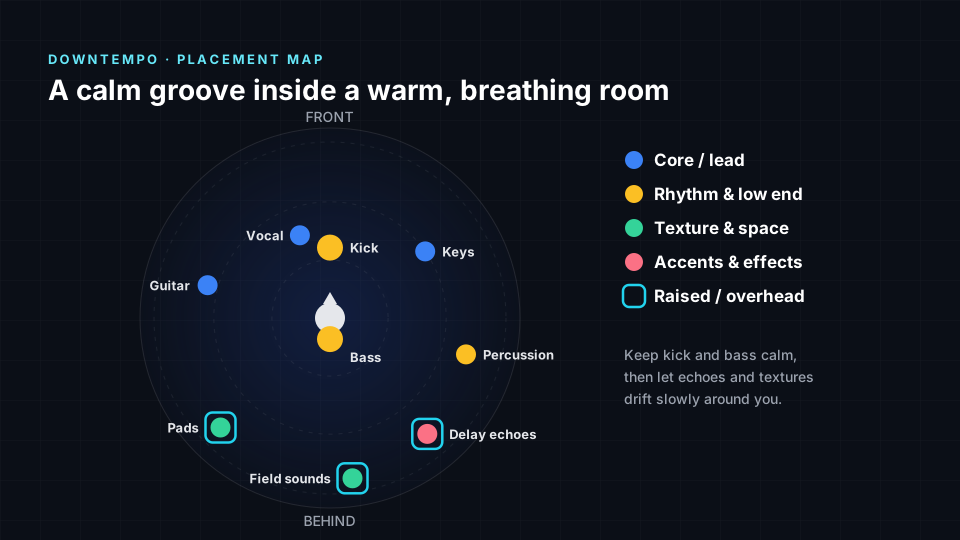
Immersive music for downtempo: what listeners hear
- A groove that never pushes. The kick and bass sit softly in the middle, steady and warm.
- Instruments close enough to touch. Vocal, guitar and keys are spread across the front like musicians in a small room.
- Echoes that wander off. Delays repeat and drift slowly behind the listener before they fade.
- A world around the beat. Pads and field recordings surround and rise above, like rain or sea air.
Where to place each element in a downtempo mix
| Element | Position | Height | Why it works |
|---|---|---|---|
| Kick | Front centre | Ear level | Soft, steady pulse |
| Bass | Centre | Ear level | Warm and grounded on every system |
| Vocal | Front left of centre | Ear level | Intimate and easy to follow |
| Guitar | Left | Ear level | Natural, like a player beside you |
| Keys | Front right | Ear level | Balances the guitar across the front |
| Percussion | Right, moving | Ear level | Gentle, shifting detail |
| Delay echoes | Behind right, moving | Raised | Repeats that drift away |
| Pads | Behind left | Raised | Lush, wrap-around harmony |
| Field sounds | Behind | Raised | A sense of place around the beat |
The psychoacoustics behind downtempo placement
Every position in the table above follows how the ear and brain locate sound. Here is the reason behind the main choices for downtempo.
- Kick and bass stay centred. The ear finds almost no direction in frequencies below roughly 80 to 100 Hz, so the low end of a downtempo track gains nothing from being spread. Keeping it centred and mono keeps the groove warm and steady on headphones, laptops and large speakers alike.
- Vocal, guitar and keys on different sides. Downtempo vocals, nylon guitar and electric piano all share the mid range. Sounds that arrive from different directions mask each other far less, an effect called spatial release from masking, so separating them keeps every line clear without heavy EQ.
- Delay echoes behind and above. When a sound and its repeats arrive close together, the brain places it by the first arrival. This is the precedence effect. A guitar phrase or vocal line stays in place at the front, while its dub-style echoes are free to drift behind the listener.
- Pads and field sounds around the listener. Sound arriving from the sides and behind soon after the direct sound gives a strong feeling of envelopment, as Barron and Marshall showed for early lateral reflections. Spreading pads and ambience around the listener turns a quiet track into a space you sit inside.
The immersion profile for downtempo
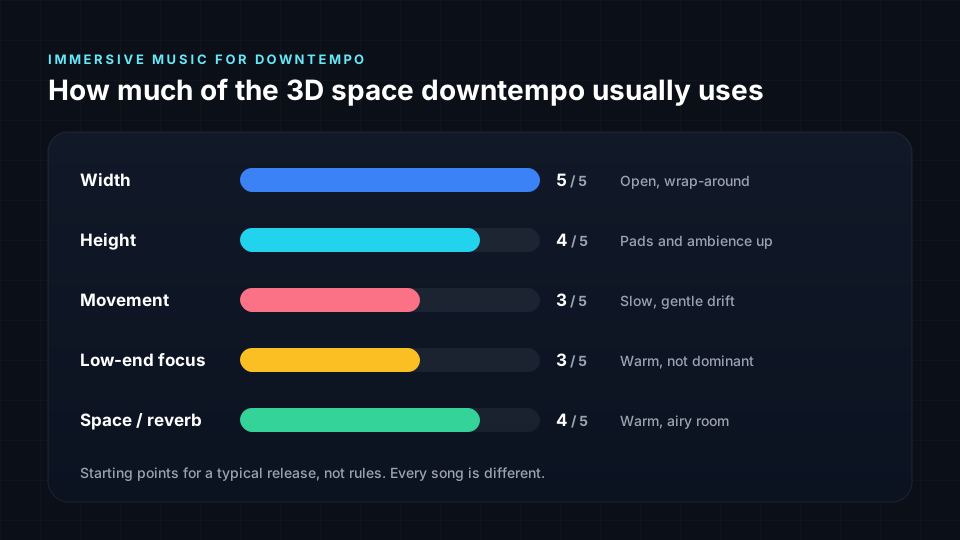
Width is at maximum because downtempo arrangements are open and the instruments benefit from being spread all the way around. Height is high because pads, field recordings and echoes sit naturally above the listener. Movement is moderate: delays and percussion drift, but nothing should fly around the head and break the calm. Low-end focus stays in the middle, because the bass is warm and important but rarely the main event, unlike in club genres.
Tips for an immersive downtempo mix
- Keep the groove still. Kick and bass should never move, so the listener can relax into the track.
- Move slowly or not at all. Let echoes and percussion drift over bars, not beats.
- Keep the vocal close. A breathy downtempo vocal works best near the front and fairly dry.
- Give field recordings room. Rain, waves or city sounds belong behind and above, at a low level.
- Leave gaps. Downtempo is sparse, so let some directions stay quiet and let the reverb fill them.
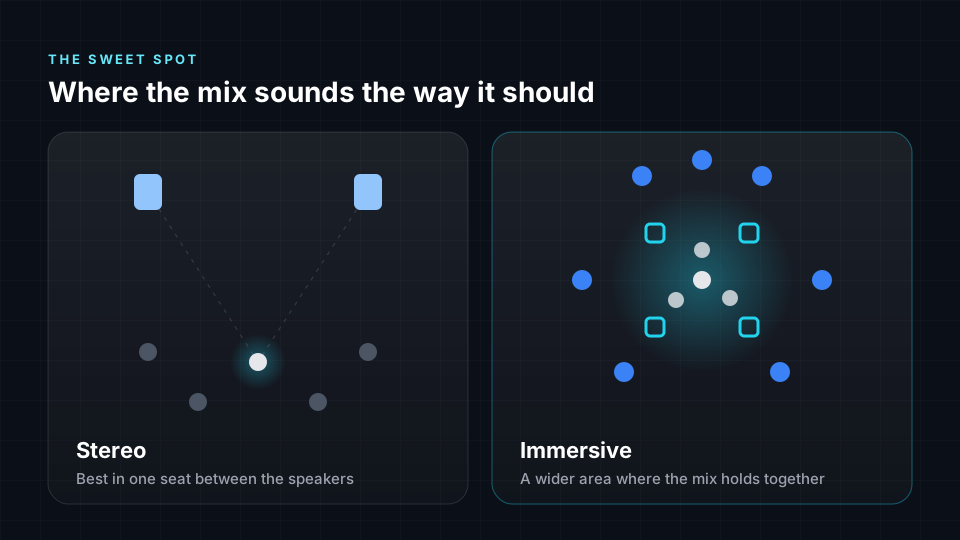
Downtempo styles: chill out, balearic and psybient
The core placement holds for every downtempo style: kick and bass centred, instruments at the front and sides, texture behind and above. What changes is the mood, how much movement the track can carry and how deep the space should feel.
Chill Out
Chill out takes its name from the chill-out rooms of late 1980s and 1990s raves and clubs, where DJs played slower, softer music between dancefloor sets. It is often the most relaxed form of downtempo, with lush pads, soft beats, gentle vocals and sampled textures. In spatial audio, wrap the pads widely around and above the listener and keep the beat light and centred. Vocals sit front and close. Movement should be minimal: let the space itself do the work, with long reverbs and slow swells rather than moving objects.
Balearic
Balearic music comes from the open-minded DJ culture of Ibiza in the 1980s, which mixed pop, rock, disco, jazz and world music at sunset and through the night. Balearic downtempo is warm and sunny, with acoustic guitar, percussion, piano and sometimes a brass or flute line. Place the acoustic guitar to one side and piano to the other, like a band on a terrace. Hand percussion can circle slowly at the sides. Keep the reverb natural and outdoor rather than cavernous, and add sea or crowd ambience low and behind.
Psybient
Psybient, also called psychill or psychedelic ambient, grew out of the chill-out areas of psytrance festivals and parties. It combines slow, deep grooves with detailed synth textures, ethnic instruments, spoken samples and psychedelic effects. It is the most spatial of the three styles. Keep the bass and kick heavy and centred, then let filtered arpeggios, bubbling effects and delays move freely around and above the listener. Layer pads at different heights so the room seems to open upwards. Psybient can carry more movement than other downtempo, but keep it smooth.
Related styles such as lounge and nu jazz follow the same idea.
How to make immersive downtempo from stereo
Spatial9 can create spatial audio from a stereo track in a few steps:
- Upload your stereo master or your stems.
- Spatial9's AI separates and places each part, keeping the kick and bass centred and spreading vocal, instruments, echoes and atmosphere around you.
- Preview it in binaural on headphones.
- Export Eclipsa Audio, ADM, binaural or Ambisonics.
- Publish a video. Create a YouTube-ready video with your immersive audio and publish it directly.
For related guides, read spatial audio for trip hop and spatial audio for ambient. Every guide is listed in spatial audio and immersive music by genre.
Frequently asked questions
Does this guide cover chill out, balearic and psybient?
Yes. Chill out uses wide, enveloping pads with very little movement. Balearic places guitar, piano and percussion around the listener like a band on a sunny terrace, with natural outdoor reverb. Psybient keeps a heavy centred groove and lets synth textures and effects move freely around and above.
Can I make a downtempo mix in Dolby Atmos or Eclipsa Audio?
Yes. The placements in this guide work for both. Spatial9 exports ADM, the standard file used by Dolby Atmos studios, as well as Eclipsa Audio for YouTube, so one immersive downtempo mix covers both. If you plan to release the Atmos version on Apple Music, build it from your original stems or multitracks, because Apple does not accept Atmos made from a finished stereo master. See where to publish spatial audio. You may also hear this called a 3D downtempo mix or downtempo in spatial audio.
Is spatial audio good for downtempo?
Yes. Downtempo is slow, open and full of detail, and spatial audio gives every instrument, echo and texture its own place in a warm, wide room. The calm pace also means listeners have time to notice where each sound is.
How is downtempo different from trip hop in spatial audio?
Downtempo is usually lighter and warmer, with more acoustic instruments, pads and natural space spread widely around the listener. Trip hop is darker and heavier, with dusty hip-hop drums, deep bass and a smoky, closer room, so its mix stays narrower and more focused on the vocal and the beat.
Where should field recordings go in immersive downtempo?
Behind and above the listener, at a low level. Rain, waves or city ambience work best as a quiet layer that surrounds the music without competing with the vocal or instruments at the front.
Can I convert a finished downtempo track to spatial audio?
Yes. Spatial9 uses AI to generate an immersive mix from a stereo master and exports it as Eclipsa Audio, ADM, binaural or Ambisonics.
Does immersive downtempo work on normal headphones?
Yes. The mix is rendered binaurally, so the warm groove, drifting echoes and surrounding textures work on any regular headphones.
Dolby and Dolby Atmos are trademarks of Dolby Laboratories. Spatial9 is not affiliated with or endorsed by Dolby Laboratories.
Sources
- Blauert, J. (1997). Spatial Hearing: The Psychophysics of Human Sound Localization, revised edition. MIT Press. Low-frequency, elevation, distance and motion cues.
- Mills, A. W. (1958). On the minimum audible angle. Journal of the Acoustical Society of America, 30(4), 237-246.
- Hebrank, J. and Wright, D. (1974). Spectral cues used in the localization of sound sources on the median plane. Journal of the Acoustical Society of America, 56(6), 1829-1834.
- Bronkhorst, A. W. (2000). The cocktail party phenomenon: a review of research on speech intelligibility in multiple-talker conditions. Acta Acustica united with Acustica, 86, 117-128.
- Litovsky, R. Y., Colburn, H. S., Yost, W. A. and Guzman, S. J. (1999). The precedence effect. Journal of the Acoustical Society of America, 106(4), 1633-1654.
- Barron, M. and Marshall, A. H. (1981). Spatial impression due to early lateral reflections in concert halls. Journal of Sound and Vibration, 77(2), 211-232.
- Neuhoff, J. G. (1998). Perceptual bias for rising tones. Nature, 395, 123-124.
- Bregman, A. S. (1990). Auditory Scene Analysis: The Perceptual Organization of Sound. MIT Press.
Let the room slow down
Upload a downtempo track to Spatial9 and hear your echoes, pads and textures drift around a calm, warm groove in minutes. Then export it or publish it straight to YouTube.