Spatial Audio & Immersive Music for Electro: Detroit Electro, Miami Bass & Electro-Funk
Spatial9 Team · · 9 min read
Part of the series Spatial audio and immersive music by genre.
Key takeaways
- In a spatial electro mix the 808 kick and synth bass stay tight in the centre, while the vocoder vocal, synth lead, snare and clap, cowbell and percussion, hats, laser zaps and pads surround the listener.
- Electro clap and cowbell hits work best on opposite sides, because sounds that share a frequency range mask each other less when they arrive from different directions.
- Short, dry electro drum machine hits are easy to locate, so fixed positions let the listener follow the syncopated pattern as separate interlocking parts.
- The electro immersion profile scores width 4, height 3, movement 4, low-end focus 4 and space 3 out of 5.
Electro grew up in New York and Detroit in the early 1980s, when hip-hop and funk producers picked up drum machines and synthesizers and took inspiration from the electronic pop of Kraftwerk. Records such as "Planet Rock" by Afrika Bambaataa and the Soulsonic Force in 1982 and Cybotron's early Detroit releases set the template. The sound is mechanical and funky: Roland TR-808 drums in broken, syncopated patterns rather than a straight four to the floor, a rubbery synth bass, robotic vocoder vocals, bright synth riffs, cowbell and handclaps, and sci-fi zaps and lasers. Electro later fed into hip-hop, Miami bass and Detroit techno, and it has lived on as an underground sound ever since. Every part in electro is short and dry, so placement is clear and precise. This guide covers how spatial audio for electro works, where to place each element and how to make an immersive electro mix. For the basics, see what spatial audio is.
Why electro works in spatial audio
Electro is made of short, separate machine sounds: a kick, a clap, a cowbell, a zap, a vocoder phrase. In stereo they all sit on one flat line. In an immersive mix each hit can come from its own direction, so the syncopated pattern becomes a groove you can follow around the room. Because the sounds are dry and percussive, they are also easy to locate, which makes the placement feel sharp rather than washed out.
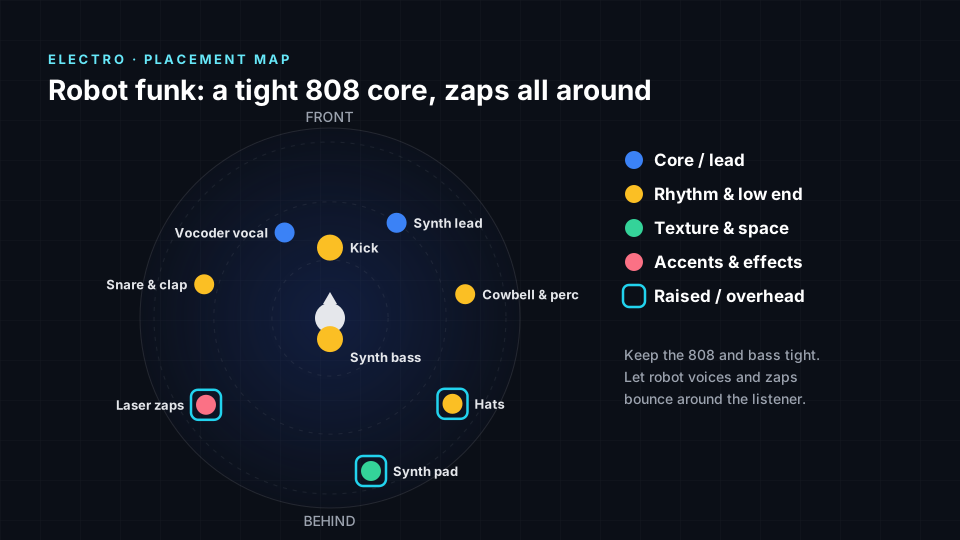
The rule: a tight 808 core, a playful machine around it. Kick and bass stay locked, while zaps, percussion and the lead do the moving.
Immersive music for electro: what listeners hear
- A robot voice right in front. The vocoder sits close and slightly off centre.
- Drum machine hits from every side. Claps, cowbell and percussion each get their own place.
- Lasers that fly overhead. Zaps and sci-fi effects sweep behind and above.
- A tight, funky low end. The 808 kick and synth bass stay centred and punchy.
Where to place each element in an electro mix
| Element | Position | Height | Why it works |
|---|---|---|---|
| Kick | Front centre | Ear level | The syncopated 808 pulse |
| Synth bass | Centre | Ear level | Rubbery, steady funk |
| Vocoder vocal | Front left | Ear level | Robotic and close |
| Synth lead | Front right, moving | Ear level | The hook, gently shifting |
| Snare & clap | Left | Ear level | Crisp backbeat |
| Cowbell & perc | Right | Ear level | Answers the clap across the room |
| Hats | Behind right | Raised | Fast, ticking top end |
| Laser zaps | Behind left, moving | Raised | Sci-fi effects flying past |
| Synth pad | Behind | Raised | Cold, spacey air |
The psychoacoustics behind electro placement
Every position in the table above follows how the ear and brain locate sound. Here is the reason behind the main choices for electro.
- Kick and synth bass stay centred. The ear finds almost no direction in frequencies below roughly 80 to 100 Hz, so the 808 low end gains nothing from being spread. Keeping it centred and mono keeps the syncopated electro groove tight on any system, from club speakers to a car.
- Vocoder and lead just off centre in front. We locate sounds most precisely straight ahead, where the minimum audible angle is smallest, as Mills measured. Small offsets in front are enough to separate the vocoder from the synth lead while both stay in clear focus.
- Clap and cowbell on opposite sides. Sounds that share a frequency range mask each other far less when they arrive from different directions. This is spatial release from masking. Bright clap and cowbell hits compete in the upper mids, so splitting them left and right keeps the pattern crisp.
- Short hits as separate streams. The brain groups sounds into streams by pitch, timbre and direction, as Bregman described. Giving each drum machine voice a fixed place lets the listener follow the syncopated electro pattern as a set of interlocking parts.
The immersion profile for electro
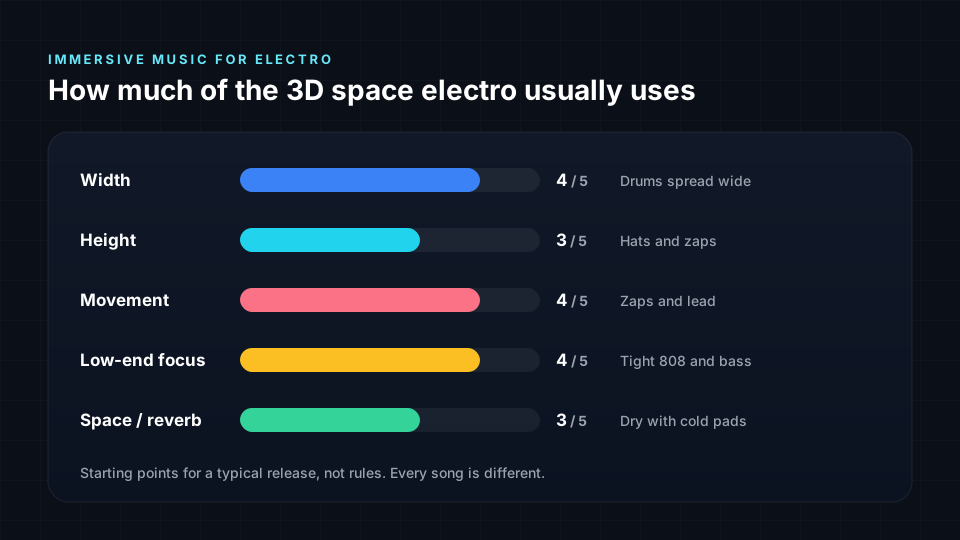
Width and movement are high because the drum machine voices spread around the listener and the zaps and lead move. Low-end focus is strong because the 808 kick and synth bass drive the groove. Height and space stay moderate: electro is dry and punchy, and only the pads and effects need a cooler, more open room above.
Tips for an immersive electro mix
- Keep the 808 and bass mono. The low end must punch the same from every direction.
- Give each drum voice a home. Fixed positions make the syncopation easy to follow.
- Let the effects fly. Laser zaps and sweeps are the best parts to move.
- Keep the vocoder close. The robot voice should feel dry and present, not far away.
- Use reverb sparingly. Save space for pads and effects so the drums stay tight.
Electro styles: Detroit electro, Miami bass and electro-funk
The core placement still applies to every electro style: kick and bass centred, robot voices in front, drum machine hits and effects around the listener. What changes is how heavy the low end is, how dark the mood is and how much space the track needs.
Detroit Electro
Detroit electro runs from the early Cybotron records to the darker, more futuristic sound of the 1990s underground. It is often instrumental, colder and more conceptual, with sci-fi themes and deep, minor-key synths. In a spatial mix this style can take more space and height than the rest. Place pads and arpeggios raised and wide, let effects drift slowly behind, and keep the drums dry and precise at ear level. The kick and bass stay centred, but the room above them can feel like deep water or deep space.
Miami Bass
Miami bass grew out of electro in South Florida in the mid 1980s, with long, booming 808 kick drums, faster tempos, chanted call and response vocals and party energy. The 808 boom is the centre of everything, so keep it mono and in the middle, and leave plenty of headroom around it. Spread chants and crowd shouts wide around the front and sides, put claps and hats on opposite sides, and keep the room fairly dry so the boom stays clean. Height can stay low. This is a style for car systems as much as clubs.
Electro-Funk
Electro-funk is the early 1980s blend of funk band ideas with drum machines, synth bass and vocoders, close to the first wave of New York electro. It has more musicianship on top: synth chords, funky riffs, sung or rapped vocals and backing vocals. Place the lead vocal in front centre, backing vocals and vocoder harmonies slightly to the sides, and synth chords wide at ear level. Keep the movement gentle and groove-based, and let only the occasional effect swing overhead.
Later revivals and offshoots, such as electro-influenced breaks, follow the same pattern, with a tight centre and playful effects around the listener.
How to make immersive electro from stereo
Spatial9 can create spatial audio from a stereo track in a few steps:
- Upload your stereo master or your stems.
- Spatial9's AI separates and places each part, keeping the 808 and bass centred and spreading robot voices, drum machine hits and zaps around you.
- Preview it in binaural on headphones.
- Export Eclipsa Audio, ADM, binaural or Ambisonics.
- Publish a video. Create a YouTube-ready video with your immersive audio and publish it directly.
For related guides, read spatial audio for hip-hop and spatial audio for techno. Every guide is listed in spatial audio and immersive music by genre.
Frequently asked questions
Does this guide cover Detroit electro, Miami bass and electro-funk?
Yes. Detroit electro uses colder, wider pads and more height for its sci-fi mood. Miami bass centres a booming 808 and spreads chants and claps around a dry room. Electro-funk adds vocals, synth chords and backing voices placed in front and to the sides. All three keep the kick and bass locked in the centre.
Can I make an electro mix in Dolby Atmos or Eclipsa Audio?
Yes. The placements in this guide work for both. Spatial9 exports ADM, the standard file used by Dolby Atmos studios, as well as Eclipsa Audio for YouTube, so one immersive electro mix covers both. If you plan to release the Atmos version on Apple Music, build it from your original stems or multitracks, because Apple does not accept Atmos made from a finished stereo master. See where to publish spatial audio. You may also hear this called a 3D electro mix or electro in spatial audio.
Is spatial audio good for electro?
Yes. Electro is built from short, dry machine sounds that are easy to locate, so spatial audio can place each one clearly and turn the syncopated groove into something you can follow around the room.
How is electro different from electro house in spatial audio?
Electro uses broken, syncopated 808 patterns, vocoders and a drier room, so the mix is about precise placement of individual hits. Electro house is a four to the floor house style with big distorted leads and drops, so it relies more on wide, moving synths and large build-ups.
Where should the vocoder go in immersive electro?
In front, close and slightly off centre, at ear level. A dry, present vocoder keeps the robot character, while harmonies or doubled parts can spread a little wider to the sides.
Can I convert a finished electro track to spatial audio?
Yes. Spatial9 uses AI to generate an immersive mix from a stereo master and exports it as Eclipsa Audio, ADM, binaural or Ambisonics.
Does immersive electro work on normal headphones?
Yes. The mix is rendered binaurally, so the flying zaps and the tight, centred 808 work on any regular headphones.
Dolby and Dolby Atmos are trademarks of Dolby Laboratories. Spatial9 is not affiliated with or endorsed by Dolby Laboratories.
Sources
- Blauert, J. (1997). Spatial Hearing: The Psychophysics of Human Sound Localization, revised edition. MIT Press. Low-frequency, elevation, distance and motion cues.
- Mills, A. W. (1958). On the minimum audible angle. Journal of the Acoustical Society of America, 30(4), 237-246.
- Hebrank, J. and Wright, D. (1974). Spectral cues used in the localization of sound sources on the median plane. Journal of the Acoustical Society of America, 56(6), 1829-1834.
- Bronkhorst, A. W. (2000). The cocktail party phenomenon: a review of research on speech intelligibility in multiple-talker conditions. Acta Acustica united with Acustica, 86, 117-128.
- Litovsky, R. Y., Colburn, H. S., Yost, W. A. and Guzman, S. J. (1999). The precedence effect. Journal of the Acoustical Society of America, 106(4), 1633-1654.
- Barron, M. and Marshall, A. H. (1981). Spatial impression due to early lateral reflections in concert halls. Journal of Sound and Vibration, 77(2), 211-232.
- Neuhoff, J. G. (1998). Perceptual bias for rising tones. Nature, 395, 123-124.
- Bregman, A. S. (1990). Auditory Scene Analysis: The Perceptual Organization of Sound. MIT Press.
Step inside the machine
Upload a track to Spatial9 and hear your robot voices and laser zaps bounce around a tight 808 groove in minutes. Then export it or publish it straight to YouTube.