Spatial Audio & Immersive Music for Breakcore: Raggacore & Drill 'n' Bass
Spatial9 Team · · 9 min read
Part of the series Spatial audio and immersive music by genre.
Key takeaways
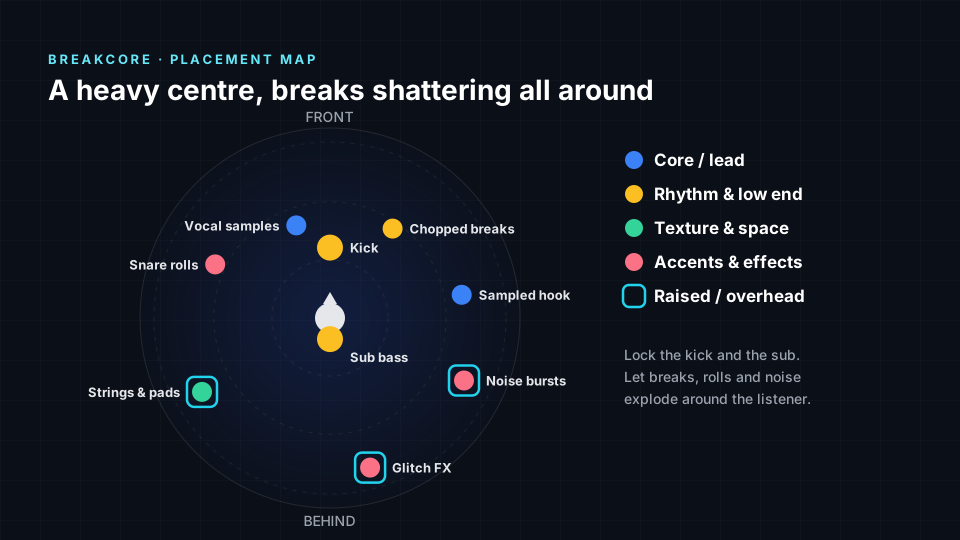
- In a spatial breakcore mix the kick and sub bass stay locked in the centre, while chopped breaks, snare rolls, vocal samples, noise, glitch effects and sampled strings are spread around the listener.
- Giving the main break and the snare rolls separate directions helps the brain hear them as two patterns, because auditory stream segregation uses direction as well as pitch and timing.
- Breakcore works best in a mostly dry room, since long reverb smears fast edits, so only pads and strings get a longer tail above the listener.
- The breakcore immersion profile scores width 5, height 4, movement 5, low-end focus 4 and space 2 out of 5.
Breakcore took shape in the mid to late 1990s, when producers in Europe and North America pushed jungle, hardcore and gabber to extremes. Scenes grew in cities such as Berlin, in the Netherlands, the UK and the US, spread through small labels, free parties and later the internet. Venetian Snares became one of its best known names. The sound is built on breakbeats, above all the Amen break, cut into tiny pieces and rearranged at high speed, often well above 160 BPM. Around them sit distorted kicks, heavy sub bass, ragga or film vocal samples, sudden noise, and sometimes tender sampled strings or pop hooks that collide with the violence. Because so much happens at once, stereo often turns breakcore into a wall of sound. Space lets each layer breathe. This guide covers how spatial audio for breakcore works, where to place each element and how to make an immersive breakcore mix. For the basics, see what spatial audio is.
Why breakcore needs a careful 3D mix
Breakcore is dense by design. A single bar can hold dozens of break edits, a snare roll, a vocal stab and a burst of noise. In stereo all of that fights for the same two speakers, and the detail that makes the programming impressive gets buried. In an immersive mix each layer can take its own direction, so the listener hears the edits as patterns rather than a blur.
The rule: a solid centre, controlled chaos around it. Kick and sub never move, while breaks, rolls and effects fly through the space, each with its own lane.
Immersive music for breakcore: what listeners hear
- Breaks that shatter around you. Chopped drums jump between the front and sides instead of piling up in the middle.
- A centre that holds. The kick and sub stay heavy and steady under the chaos.
- Beauty behind the noise. Sampled strings and pads hang above, so the emotional layer survives the distortion.
- Effects from unexpected places. Noise bursts and glitches arrive from above and behind.
Where to place each element in a breakcore mix
| Element | Position | Height | Why it works |
|---|---|---|---|
| Kick | Front centre | Ear level | Heavy anchor under the edits |
| Sub bass | Centre | Ear level | Weight that never wanders |
| Vocal samples | Front left | Ear level | Clear, close and readable |
| Chopped breaks | Front right, moving | Ear level | Edits you can follow |
| Snare rolls | Left, moving | Ear level | Rolls that sweep across |
| Sampled hook | Right | Ear level | Melody away from the breaks |
| Noise bursts | Behind right, moving | Raised | Shock from above |
| Strings & pads | Behind left | Raised | Emotional layer over the chaos |
| Glitch FX | Behind, moving | Raised | Surprises all around |
The psychoacoustics behind breakcore placement
Every position in the table above follows how the ear and brain locate sound. Here is the reason behind the main choices for breakcore.
- Kick and sub stay centred. The ear finds almost no direction in frequencies below roughly 80 to 100 Hz, so a breakcore sub gains nothing from being spread. Keeping it centred and mono keeps it heavy on any system, even when the distorted kick is hammering at high speed.
- Breaks and rolls in separate places. The brain groups sounds into streams by pitch, timing and direction. This is auditory stream segregation, described by Bregman. At breakcore tempos, fast hits from one place tend to fuse into one stream, so giving the main breaks and the snare rolls their own positions helps the ear hear two patterns instead of one smear.
- Vocal samples near the front. The smallest change in direction the ear can detect, the minimum audible angle, is finest straight ahead, as Mills showed. Small, quick edits on a vocal sample just left of centre are heard most precisely there, so the cut-up phrasing stays sharp.
- Noise and hook apart from the voice. Sounds that share a frequency range mask each other far less when they arrive from different directions. This is spatial release from masking. Distorted noise and a vocal sample both crowd the upper mids, so sending the noise up and behind keeps the voice readable.
The immersion profile for breakcore
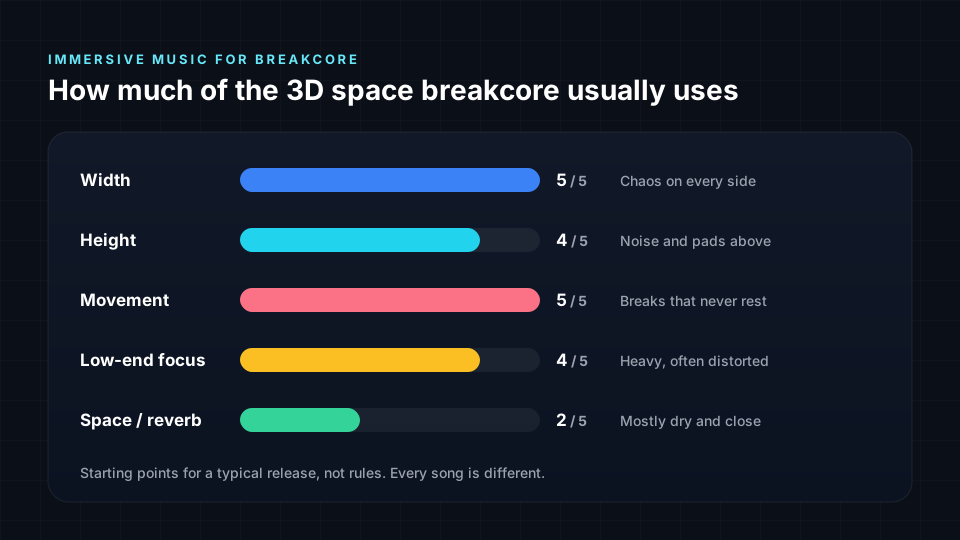
Width and movement are at maximum because the whole point of breakcore is relentless, detailed programming, and the edits need every direction they can get. Height is high too, since noise bursts, glitches and sampled strings break out above the listener. Low-end focus is high because distorted kicks and ragga-style subs carry the weight. Space stays low: long reverbs would wash the fast edits into mush, so the room is kept tight and dry, with only the pads and strings allowed a longer tail.
Tips for an immersive breakcore mix
- Keep the sub mono. The bass must hit the same from every direction, no matter how wild the breaks get.
- Give each break layer a lane. Main break, ghost edits and rolls should each own a direction.
- Move edits, not the anchor. Let breaks and effects travel while the kick stays put.
- Keep the room dry. Use short spaces on drums and save long reverb for strings and pads.
- Use height for contrast. Put the gentle layers above the noise so the extremes stay clear.
Breakcore styles: raggacore and drill 'n' bass
The core placement still applies to both styles: kick and sub in the centre, breaks and effects around. What changes is the role of the voice, the amount of melody and how much distortion fills the room.
Raggacore
Raggacore combines breakcore programming with ragga and dancehall vocals and heavy, often distorted bass. The voice becomes the main hook, so move the vocal sample closer to front centre and keep it dry and forward. The sub is even more important here and should sit firmly in the middle. Dub sirens and air horn style effects work well raised at the sides or behind, where they cut through without masking the MC. Breaks can still race around the front and sides, but keep them slightly behind the voice in level and distance.
Drill 'n' Bass
Drill 'n' bass grew up in the UK in the mid to late 1990s as a more cerebral, home listening take on jungle, with hyper-detailed programmed breaks, jazz-influenced bass lines and melodic synths. It is less distorted and more musical than most breakcore, so the mix can afford more space. Place the melodic bass slightly forward of centre while keeping its lowest frequencies mono, and let intricate drum edits move in a wide circle around the listener. Pads and chords can sit higher and wider, with a little more reverb than in classic breakcore.
Closely related styles include mashcore, which cuts breakcore together with mash-up samples from pop and film. The same rules apply: anchor the low end and give each sample its own direction.
How to make immersive breakcore from stereo
Spatial9 can create spatial audio from a stereo track in a few steps:
- Upload your stereo master or your stems.
- Spatial9's AI separates and places each part, locking the kick and sub and spreading the breaks, samples and noise around you.
- Preview it in binaural on headphones.
- Export Eclipsa Audio, ADM, binaural or Ambisonics.
- Publish a video. Create a YouTube-ready video with your immersive audio and publish it directly.
For related guides, read spatial audio for jungle and spatial audio for drum and bass. Every guide is listed in spatial audio and immersive music by genre.
Frequently asked questions
Does this guide cover raggacore and drill 'n' bass?
Yes. Raggacore puts a dry ragga vocal near front centre over a heavy, centred sub with sirens raised at the sides. Drill 'n' bass uses a more melodic, less distorted mix with detailed drum edits circling the listener and a little more space for pads and chords.
Can I make a breakcore mix in Dolby Atmos or Eclipsa Audio?
Yes. The placements in this guide work for both. Spatial9 exports ADM, the standard file used by Dolby Atmos studios, as well as Eclipsa Audio for YouTube, so one immersive breakcore mix covers both. If you plan to release the Atmos version on Apple Music, build it from your original stems or multitracks, because Apple does not accept Atmos made from a finished stereo master. See where to publish spatial audio. You may also hear this called a 3D breakcore mix or breakcore in spatial audio.
Is spatial audio good for breakcore?
Yes. Breakcore packs a huge amount of detail into every bar, and spatial audio gives each break, roll and sample its own direction, so the programming is easier to follow and less tiring to hear.
How is breakcore different from drum and bass in spatial audio?
Drum and bass usually has one main break pattern and a clean, powerful bassline, so the movement stays focused. Breakcore is faster, noisier and far more chopped, so it needs more lanes around the listener and a drier room to keep the edits clear.
Should the Amen break move in immersive breakcore?
Partly. Keep the main hits of the break near the front so the groove stays readable, and let edits, fills and ghost slices move around the sides. If every slice moves, the listener loses the rhythm.
Can I convert a finished breakcore track to spatial audio?
Yes. Spatial9 uses AI to generate an immersive mix from a stereo master and exports it as Eclipsa Audio, ADM, binaural or Ambisonics.
Does immersive breakcore work on normal headphones?
Yes. The mix is rendered binaurally, so the flying breaks and the heavy centre work on any regular headphones.
Dolby and Dolby Atmos are trademarks of Dolby Laboratories. Spatial9 is not affiliated with or endorsed by Dolby Laboratories.
Sources
- Blauert, J. (1997). Spatial Hearing: The Psychophysics of Human Sound Localization, revised edition. MIT Press. Low-frequency, elevation, distance and motion cues.
- Mills, A. W. (1958). On the minimum audible angle. Journal of the Acoustical Society of America, 30(4), 237-246.
- Bronkhorst, A. W. (2000). The cocktail party phenomenon: a review of research on speech intelligibility in multiple-talker conditions. Acta Acustica united with Acustica, 86, 117-128.
- Barron, M. and Marshall, A. H. (1981). Spatial impression due to early lateral reflections in concert halls. Journal of Sound and Vibration, 77(2), 211-232.
- Bregman, A. S. (1990). Auditory Scene Analysis: The Perceptual Organization of Sound. MIT Press.
Let the breaks fly
Upload a track to Spatial9 and hear your chopped breaks shatter around a heavy, steady centre in minutes. Then export it or publish it straight to YouTube.