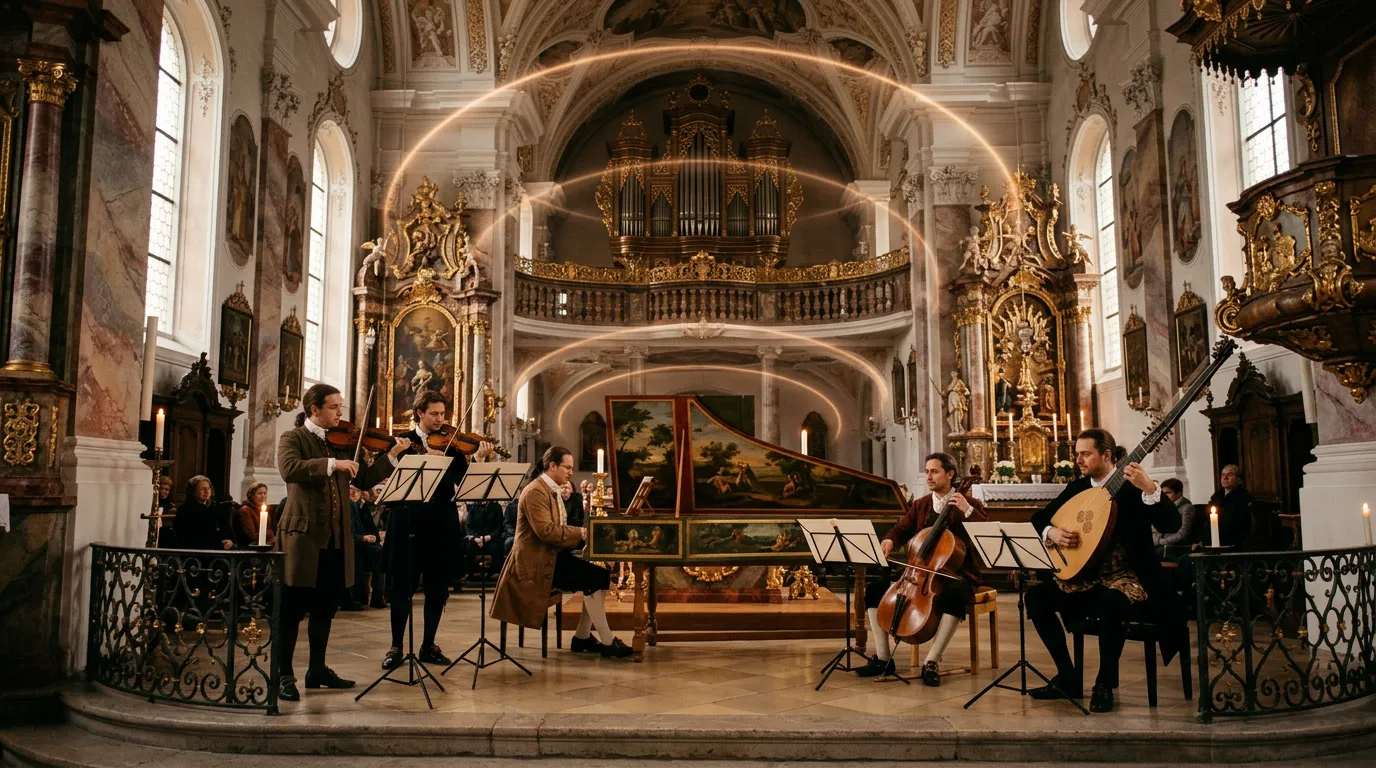
Spatial Audio & Immersive Music for Baroque Music: Renaissance, Early Music & Period Instruments
Spatial9 Team · · 10 min read
Part of the series Spatial audio and immersive music by genre.
Key takeaways
- In a spatial baroque music mix the soloist and the continuo stay centred, while the first and second violins sit on opposite sides and the violas, winds and gallery organ fan out around a wide front arc.
- Side reflections from a tall church or palace room make the ensemble feel wide and enveloping, an effect known as spatial impression from early lateral reflections.
- Baroque music was written for resonant rooms and seated players, so height and space matter far more than movement or a heavy low end.
- The baroque music immersion profile scores width 4, height 3, movement 1, low-end focus 1 and space 4 out of 5.
Baroque music is the European art music of roughly 1600 to 1750, from the first operas of Monteverdi to the deaths of Bach and Handel, taking in Purcell, Corelli, Vivaldi, Telemann and Rameau. Its foundation is the basso continuo: a bass line on cello, violone or bassoon, with a harpsichord, organ, theorbo or lute improvising chords from figured bass. Above it sit gut-strung violins and violas, recorders, baroque oboes, flutes and valveless natural trumpets. The forms include the concerto grosso, the solo concerto, the trio sonata, the dance suite, the fugue, the cantata and opera, with tempos from the slow sarabande to the quick gigue. Since the 1950s it has often been recorded on period instruments at a lower pitch, usually A = 415 Hz. Baroque music suits spatial audio because it was written for real rooms, from Venetian basilicas to palace chambers, and its independent lines are easier to follow from different places. This guide covers how spatial audio for baroque music works, where to place each element and how to make an immersive baroque music mix. For the basics, see what spatial audio is.
Why baroque music works in spatial audio
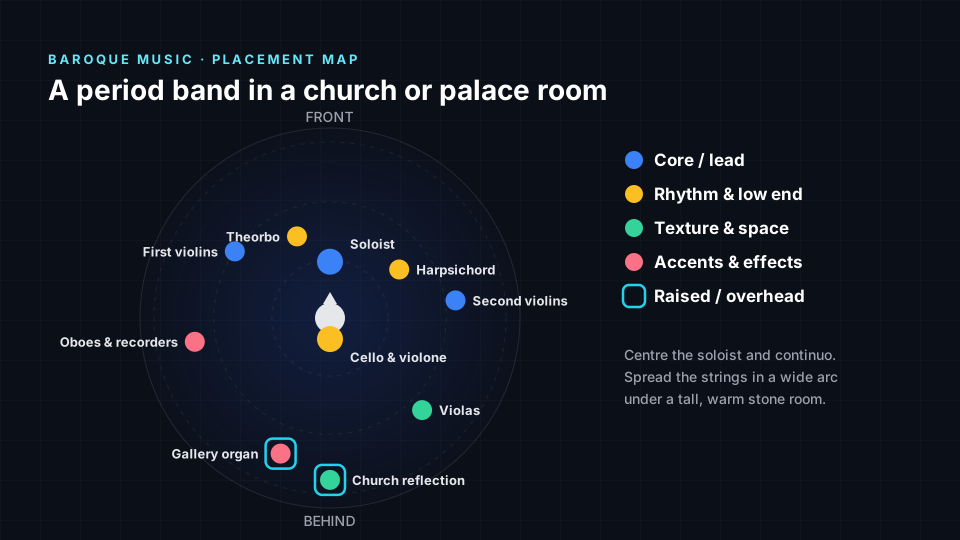
Baroque music is built from lines that talk to each other. A fugue passes its subject from voice to voice and a trio sonata sets two violins against each other over the continuo. In stereo these lines often merge into one block. In an immersive mix the continuo holds the centre, the violins split to either side and the winds and organ take their own places, so each line keeps its own direction inside a resonant room.
The rule: continuo in the centre, every line in its own place. Seat the ensemble in a wide, still arc in front of the listener, raise the organ and the room above them and never let the reverb cloud the counterpoint.
Immersive music for baroque music: what listeners hear
- A continuo you can see. The harpsichord and bass line sit together in the middle, steady and clear.
- Violins in conversation. First and second violins answer each other from opposite sides of the stage.
- Counterpoint you can follow. Each line of a fugue or trio sonata keeps its own direction.
- A tall, warm room. Stone vaults or a painted palace ceiling ring gently above the players.
Where to place each element in a baroque music mix
| Element | Position | Height | Why it works |
|---|---|---|---|
| Soloist | Front centre | Ear level | The singer or solo violin leads the piece |
| Cello & violone | Centre | Ear level | The continuo bass line under everything |
| Harpsichord | Front right of centre | Ear level | Continuo chords and bright plucked attack |
| Theorbo | Front left of centre | Ear level | Plucked continuo colour beside the bass |
| First violins | Left | Ear level | The leading upper line |
| Second violins | Right | Ear level | Answers the firsts from the other side |
| Violas | Right, further back | Ear level | Inner harmony between violins and bass |
| Oboes & recorders | Left, further back | Ear level | Wind colour doubling or answering the strings |
| Gallery organ | Behind left | Raised | Continuo and solo organ from a loft |
| Church reflection | Behind | Raised | A tall stone or palace room above the band |
The psychoacoustics behind baroque music placement
Every position in the table above follows how the ear and brain locate sound. Here is the reason behind the main choices for baroque music.
- The bass stays centred. The ear finds almost no direction in frequencies below roughly 80 to 100 Hz, so the deepest notes of the violone and organ gain nothing from being spread.
- Fugue voices kept apart. The brain groups sounds into streams by pitch, timing and direction. This is auditory stream segregation (Bregman). Giving each line its own place lets the ear follow a subject as it passes from violins to violas to bass.
- A room you feel around you. Reflections arriving from the sides soon after the direct sound make a space feel wide and enveloping. This is spatial impression from early lateral reflections (Barron and Marshall).
- An organ that sounds raised. The ear judges height from the way the outer ear shapes high frequencies. These are elevation spectral cues (Hebrank and Wright). Lifting the organ and the reverb tail places them in the gallery and the vault rather than on the floor.
The immersion profile for baroque music
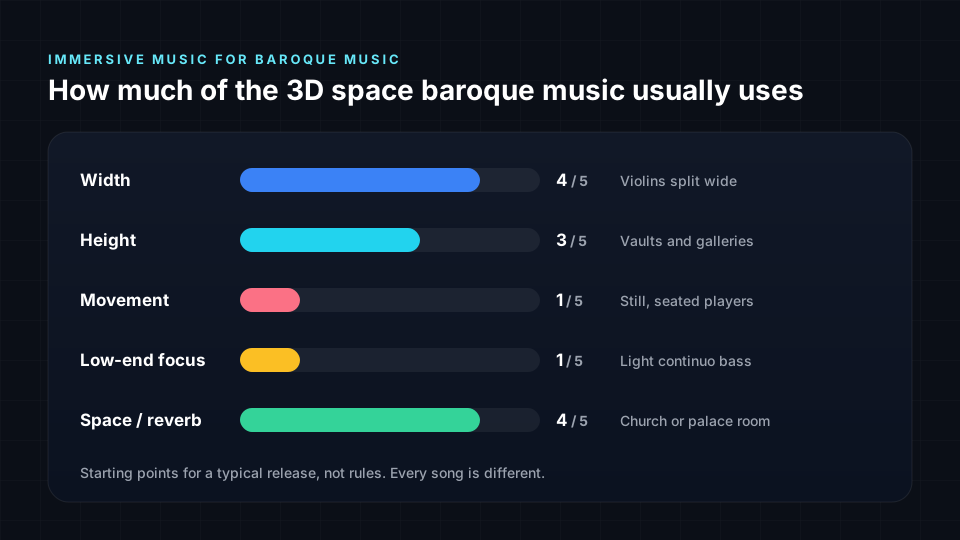
Width scores 4 because the violins sit on opposite sides and the winds and violas fan out widely. Height scores 3: churches and palaces have tall ceilings, and the organ often plays from a gallery. Movement scores 1, because the players are seated and the life comes from the counterpoint. Low-end focus scores 1, since the continuo bass is light. Space scores 4, because the music was written for resonant rooms.
Tips for an immersive baroque music mix
- Keep the continuo together in the centre. The bass line and chords are one unit, so never split them far apart.
- Seat the violins opposite each other. First violins left and seconds right make their dialogue easy to hear.
- Raise the organ and the room. A gallery organ and a lifted reverb tail give a church its height.
- Keep the reverb clear of fast passages. Long tails blur harpsichord runs and quick allegros.
- Keep every player still. Baroque music is played by a seated ensemble, so avoid moving effects.
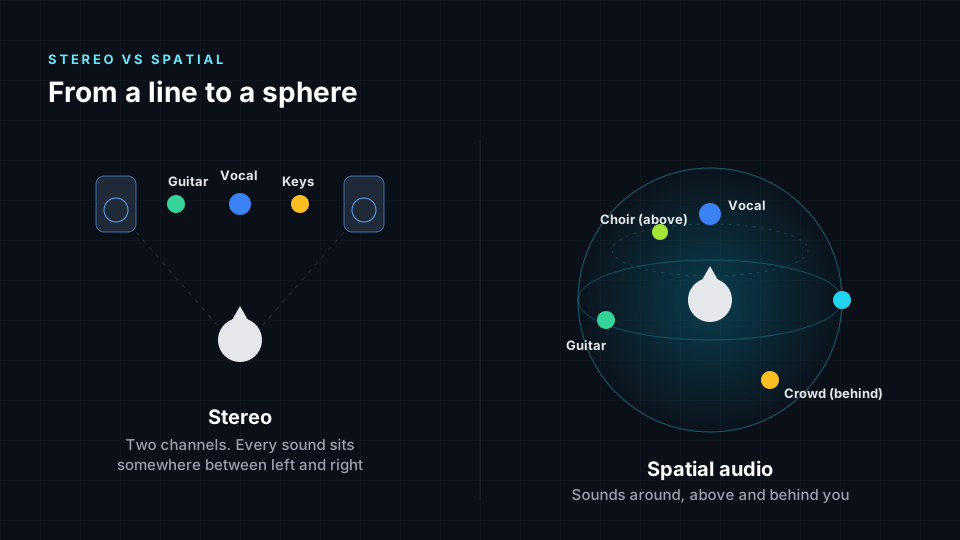
Baroque music styles: Renaissance, early music and period instruments
The core placement holds for every style in this guide: a central anchor, independent lines spread around a wide front arc and a real room above. What changes is the size of the group, the instruments and how resonant the space should be.
Renaissance
Renaissance music, roughly 1400 to 1600, centres on vocal polyphony by composers such as Josquin, Palestrina, Victoria and Byrd, alongside consorts of viols, recorders, lutes, shawms, cornetts and sackbuts. A whole consort uses one family of instruments, a broken consort mixes them. Each voice has equal weight, so place singers or players in an even arc rather than around a soloist, with a lute or bass viol near the centre. At St Mark's in Venice, Giovanni Gabrieli wrote for choirs and brass in separate galleries, so a polychoral piece can place each group on its own side, slightly raised. Give sacred music a tall church acoustic and dances a smaller hall.
Early Music
Early music is the umbrella name for medieval, Renaissance and baroque repertoire revived by specialists, from Hildegard of Bingen and troubadour songs to dances played on vielle, hurdy-gurdy, psaltery, harp, bagpipes and frame drums. Medieval groups are small and often play around a melody and a drone. Keep the melody at the centre, the drone just behind it and plucked and percussion instruments close on either side, in a stone chapel for sacred song or a drier hall for dances.
Period Instruments
Period instrument performance, also called historically informed performance, plays baroque and early classical music on the instruments of the time: gut strings, lighter bows, a harpsichord instead of a grand piano, natural trumpets and horns, at a lower pitch and with smaller forces. Keep the band compact: centre the continuo, seat the violins opposite each other, place the winds behind the strings and raise the trumpets and timpani at the back, in a palace room or medium-sized church.
Related styles such as the galant style and the early classical symphony follow the same idea: centre the bass and harmony, then spread the lines across a wide arc under a real room.
How to make immersive baroque music from stereo
Spatial9 can create spatial audio from a stereo track in a few steps:
- Upload your stereo master or your stems.
- Spatial9's AI separates and places each part, pulling the soloist, continuo, violins and winds apart even from older analogue or early digital recordings and seating them in a wide arc under a tall church or palace room.
- Preview it in binaural on headphones.
- Export Eclipsa Audio, ADM, binaural or Ambisonics.
- Publish a video. Create a YouTube-ready video with your immersive audio and publish it directly.
For related guides, read spatial audio for classical music and spatial audio for chamber music. Every guide is listed in spatial audio and immersive music by genre.
Frequently asked questions
Does this guide cover Renaissance, early music and period instruments?
Yes. Renaissance polyphony takes an even arc of equal voices. Early music centres a melody and drone with small instruments close by. Period instrument ensembles centre the continuo and split the violins.
Can I make a baroque music mix in Dolby Atmos or Eclipsa Audio?
Yes. The placements in this guide work for both. Spatial9 exports ADM, the standard file used by Dolby Atmos studios, as well as Eclipsa Audio for YouTube, so one immersive baroque music mix covers both. If you plan to release the Atmos version on Apple Music, build it from your original stems or multitracks, because Apple does not accept Atmos made from a finished stereo master. See where to publish spatial audio. You may also hear this called a 3D baroque music mix or baroque music in spatial audio.
Is spatial audio good for baroque music?
Yes. Baroque music is made of independent lines played in resonant rooms. Spatial audio gives each line its own direction inside a real church or palace.
Where should the harpsichord go in an immersive baroque music mix?
Just off centre, beside the cello and violone, at ear level. It belongs with the continuo bass, and a small angle keeps it clear of the violins.
Should the first and second violins be on opposite sides?
Usually, yes. Baroque writing often sets the two violin parts in dialogue, so placing them left and right lets the listener hear each phrase answered from the other side.
How much reverb does an immersive baroque music mix need?
More than most genres, but less than choral music. A church or palace room adds warmth and height, while fast harpsichord and violin passages still need to stay clear.
Does immersive baroque music work on normal headphones?
Yes. The mix is rendered binaurally, so the continuo, the violins and the church room work on any regular headphones.
Dolby and Dolby Atmos are trademarks of Dolby Laboratories. Spatial9 is not affiliated with or endorsed by Dolby Laboratories.
Sources
- Blauert, J. (1997). Spatial Hearing: The Psychophysics of Human Sound Localization, revised edition. MIT Press. Low-frequency, elevation, distance and motion cues.
- Mills, A. W. (1958). On the minimum audible angle. Journal of the Acoustical Society of America, 30(4), 237-246.
- Hebrank, J. and Wright, D. (1974). Spectral cues used in the localization of sound sources on the median plane. Journal of the Acoustical Society of America, 56(6), 1829-1834.
- Bronkhorst, A. W. (2000). The cocktail party phenomenon: a review of research on speech intelligibility in multiple-talker conditions. Acta Acustica united with Acustica, 86, 117-128.
- Litovsky, R. Y., Colburn, H. S., Yost, W. A. and Guzman, S. J. (1999). The precedence effect. Journal of the Acoustical Society of America, 106(4), 1633-1654.
- Barron, M. and Marshall, A. H. (1981). Spatial impression due to early lateral reflections in concert halls. Journal of Sound and Vibration, 77(2), 211-232.
- Neuhoff, J. G. (1998). Perceptual bias for rising tones. Nature, 395, 123-124.
- Bregman, A. S. (1990). Auditory Scene Analysis: The Perceptual Organization of Sound. MIT Press.
- Bukofzer, M. F. (1947). Music in the Baroque Era: From Monteverdi to Bach. W. W. Norton.
Step into the palace hall
Upload a track to Spatial9 and hear the continuo and violins fill a tall baroque room around you in minutes. Then export it or publish it straight to YouTube.