The History of Immersive Audio: The People, Papers and Ideas Behind 3D Sound
Spatial9 Team · · Updated · 18 min read
Key takeaways
- In 1881 Clément Ader let visitors in Paris hear the Opéra through two telephone receivers, one for each ear.
- Alan Blumlein filed the patent that defined stereo, British Patent 394,325, in December 1931.
- Michael Gerzon's 1973 paper "Periphony" laid out Ambisonics, the basis of the sound fields used by YouTube and Eclipsa Audio.
- Dolby Atmos premiered with Brave in 2012, and the royalty-free Eclipsa Audio format reached YouTube in 2025.
Every generation of audio engineers has tried to solve the same problem: recorded sound arrives from the wrong place. A singer stands in front of you, an orchestra spreads across a stage, rain falls from above, but for most of the twentieth century a recording came from a single box. The history of immersive audio is the history of people refusing to accept that.
This article tells that story through the people who did the work, the problems they were trying to solve and the documents they left behind: patents, papers and standards you can still read. If you want a shorter overview first, our Academy lesson From Mono to Immersive: A Short History of Spatial Audio covers the main eras in a few minutes.
Why people kept trying
Before the timeline, it helps to know what drove it. Six motivations appear again and again, and nearly every breakthrough served at least one of them.
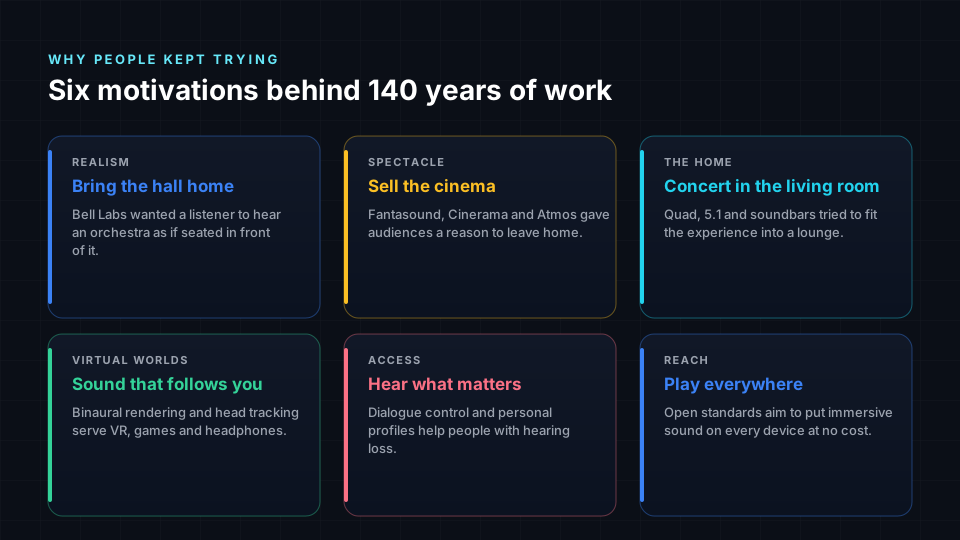
- Realism. The scientific goal: make a listener hear a performance as if they were there. This drove Bell Labs in the 1930s and the Ambisonics researchers in the 1970s.
- Spectacle. The commercial goal of cinema: give audiences an experience they cannot get at home. Fantasound, Cinerama, Dolby Stereo and Atmos were all, in part, reasons to buy a ticket.
- The home. Bringing that experience into the living room: the stereo LP, quadraphonic sound, 5.1 home cinema and soundbars.
- Virtual worlds. Sound that responds to where you are and where you look, for simulation, games, virtual reality and headphones.
- Accessibility. Letting listeners shape what they hear, such as raising dialogue above music and effects, which matters for people with hearing loss.
- Reach. Putting immersive sound on every device at no cost, the driving idea behind open, royalty-free formats.
Keep these in mind. They explain why some technically brilliant formats faded and why some simpler ones won.
The science that came first
People located sounds long before anyone could explain how. In 1907 the physicist John William Strutt, Lord Rayleigh, published his duplex theory in "On our perception of sound direction". He showed that we use two cues: the difference in arrival time between the ears for low frequencies, and the difference in level caused by the shadow of the head for high frequencies.
Rayleigh's work explained left and right. It did not explain how we tell front from back, or above from below. That required decades more research into the filtering effect of the outer ear, summarised in 1974 by Jens Blauert in Räumliches Hören, published in English as Spatial Hearing. It remains the standard reference. Every immersive format since has been, in one way or another, an attempt to deliver these cues to the ears, either through loudspeakers or through headphones, as we explain in headphone vs speaker spatial audio.
For a closer look at the psychoacoustics, see how MIT hacked human hearing.
1881: two telephones and an opera
The first public demonstration of spatial sound predates recorded music as most people know it. At the International Exposition of Electricity in Paris in 1881, the engineer Clément Ader placed pairs of telephone transmitters along the front of the stage at the Paris Opéra and connected them by line to rooms at the exhibition. Visitors held one receiver to each ear.
Because each ear heard a different transmitter, listeners perceived the singers moving across the stage. Contemporary accounts describe the effect as startling. Ader patented the idea, and from 1890 a subscription service, the Théâtrophone, carried performances to homes and hotels in Paris over the telephone network.
The Théâtrophone established the principle behind every binaural recording since: two signals, one per ear, can carry direction.
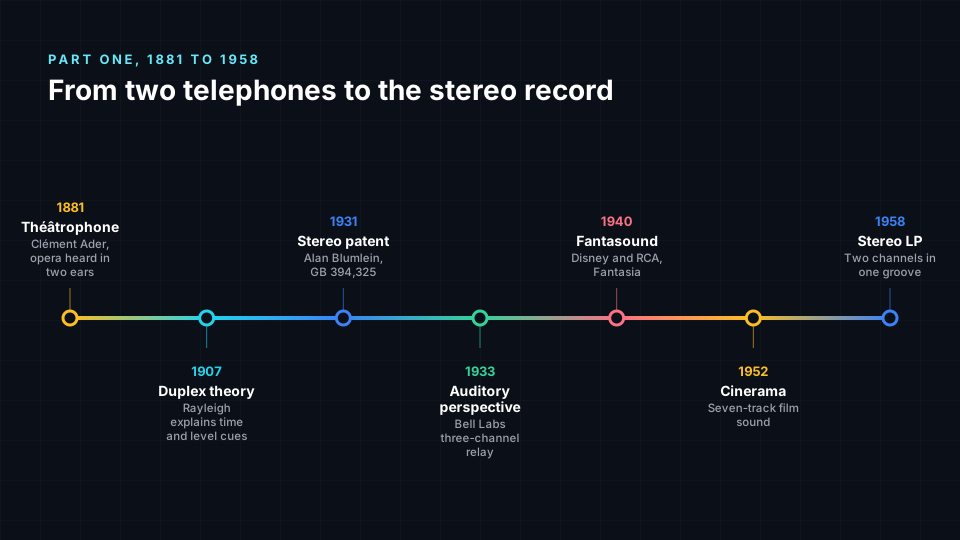
1931: Alan Blumlein invents stereo
Alan Dower Blumlein was an engineer at EMI in Hayes, England. According to a story often told by his colleagues, he was at the cinema with his wife when he complained that an actor's voice came from one loudspeaker while the actor moved across the screen. He set out to fix it.
On 14 December 1931 he filed a patent titled "Improvements in and relating to sound-transmission, sound-recording and sound-reproducing systems", granted as British Patent 394,325. It is one of the most important documents in audio. It describes:
- a pair of coincident directional microphones, now called a Blumlein pair, that captures direction as differences in level;
- the conversion of those signals for loudspeakers, so that level differences between two speakers create a phantom image between them;
- a method of cutting two channels into a single record groove, the basis of the 45/45 stereo groove adopted decades later;
- techniques now known as mid-side recording and shuffling.
Blumlein made experimental stereo recordings and films in the early 1930s, but EMI did not commercialise stereo at the time. He moved on to television and then radar. He died on 7 June 1942, aged 38, in the crash of a Halifax bomber during trials of the H2S airborne radar. Stereo records reached the public only in 1958, using his groove geometry.
1933: Bell Labs and auditory perspective
At the same time in the United States, Harvey Fletcher led research at Bell Telephone Laboratories into what the team called auditory perspective: reproducing an orchestra so that a listener could hear where each instrument was.
On 27 April 1933 Bell Labs relayed the Philadelphia Orchestra from Philadelphia to an audience at Constitution Hall in Washington, D.C., over telephone lines, using three microphone channels feeding three loudspeaker positions. The conductor Leopold Stokowski, a keen supporter of the work, operated the controls in Washington.
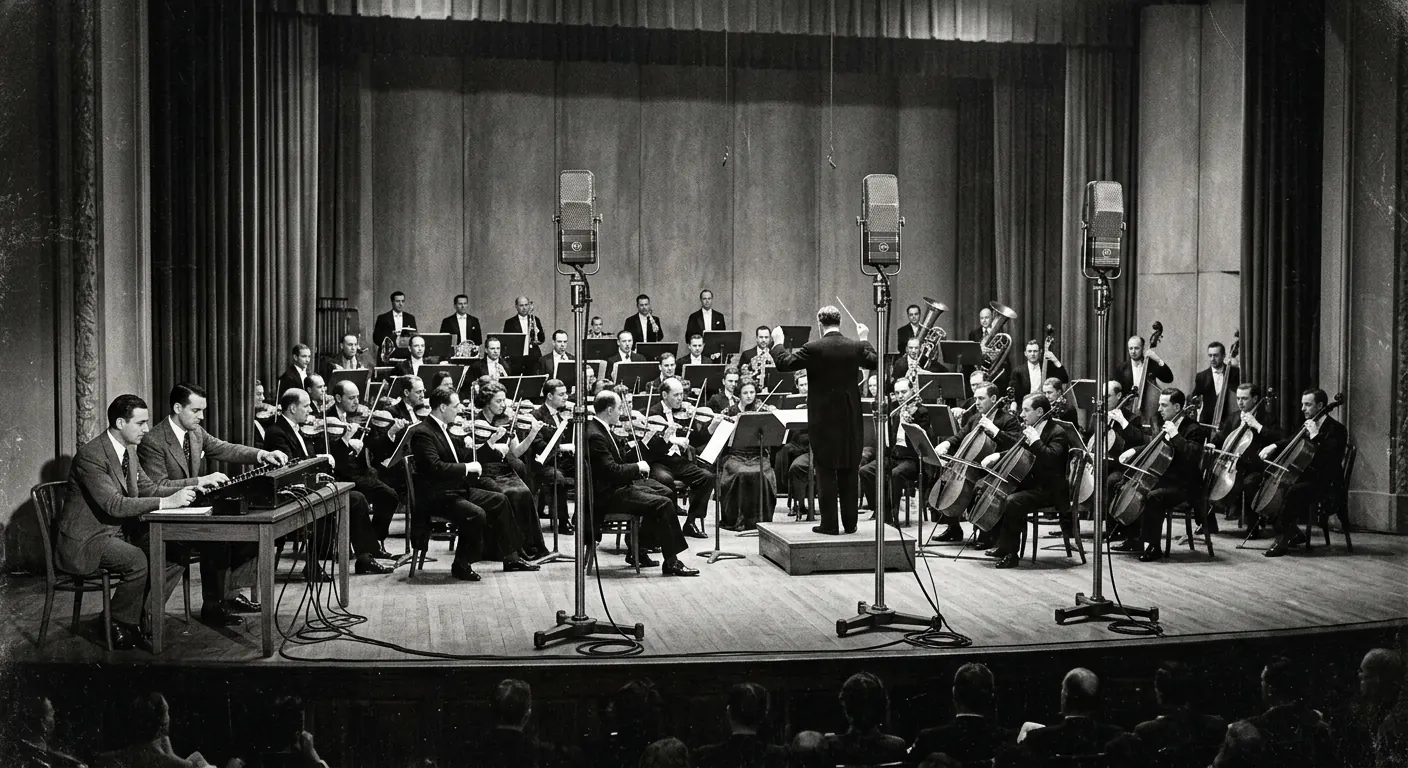
The work was published in 1934 as a symposium on "auditory perspective" in Electrical Engineering, reprinted in the Bell System Technical Journal. In "Physical factors", John C. Steinberg and William B. Snow compared a theoretical "curtain" of many microphones and speakers with practical systems, and concluded that three channels across the front gave much of the benefit. That conclusion still shapes film sound, with its left, centre and right speakers behind the screen.
Bell Labs also built "Oscar", a mannequin with microphones in place of ears, shown at the 1933 Chicago World's Fair. Visitors wearing headphones heard sounds move around the dummy's head: an early public demonstration of binaural recording with a head.
1940: Fantasound and the birth of the pan pot
Walt Disney wanted the music of Fantasia to fill the theatre. Working with RCA, Disney engineers led by William Garity, with John N. A. Hawkins, built Fantasound. The Philadelphia Orchestra under Stokowski was recorded on multiple separate optical tracks, and in the theatre a control track steered the sound between speakers placed around the auditorium.
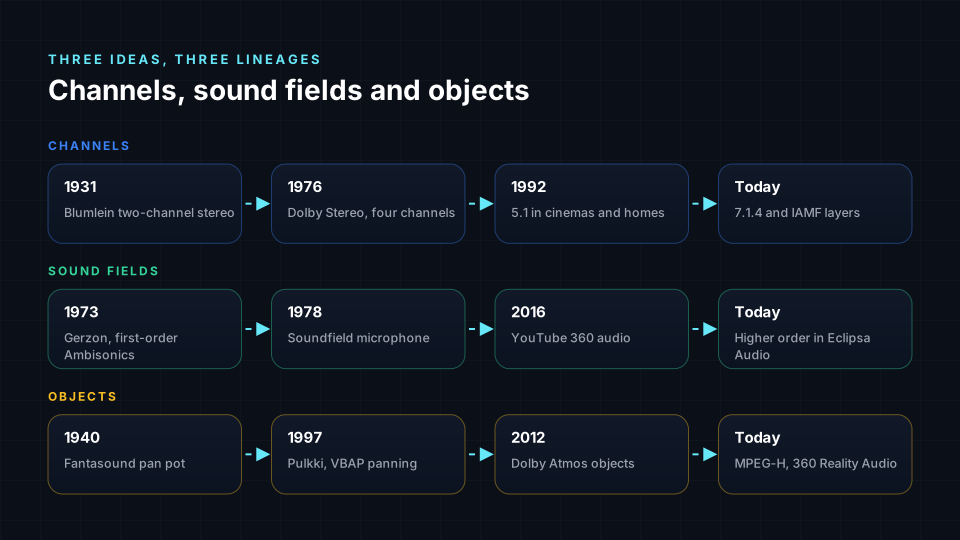
To move sound between speakers during mixing, Garity's team built a device to divide a signal between channels by turning a knob: the panoramic potentiometer, or pan pot. Every mixing console has one today, and the idea of steering a sound to a position is the ancestor of object-based audio.
Fantasia premiered at the Broadway Theatre in New York on 13 November 1940. Fantasound was expensive and bulky, only a small number of cinemas installed it, and wartime shortages ended the roadshow. The idea was decades ahead of the market.
The 1950s: widescreen, multichannel and the stereo record
After the war, cinema faced competition from television and answered with scale. Cinerama (1952) combined a vast curved screen with seven channels of magnetic sound engineered by Hazard Reeves. CinemaScope (1953) added four-track magnetic sound, and Todd-AO (1955) six tracks on 70 mm film. Multichannel sound became a mark of the premium cinema experience.
In the home, the stereo LP arrived in 1958, using the Westrex 45/45 system that followed Blumlein's 1931 groove. Stereo radio broadcasting followed. For the next sixty years, two channels would be the standard for music.
The 1970s: quad, Ambisonics and Dolby
Quadraphonic sound: the first format war
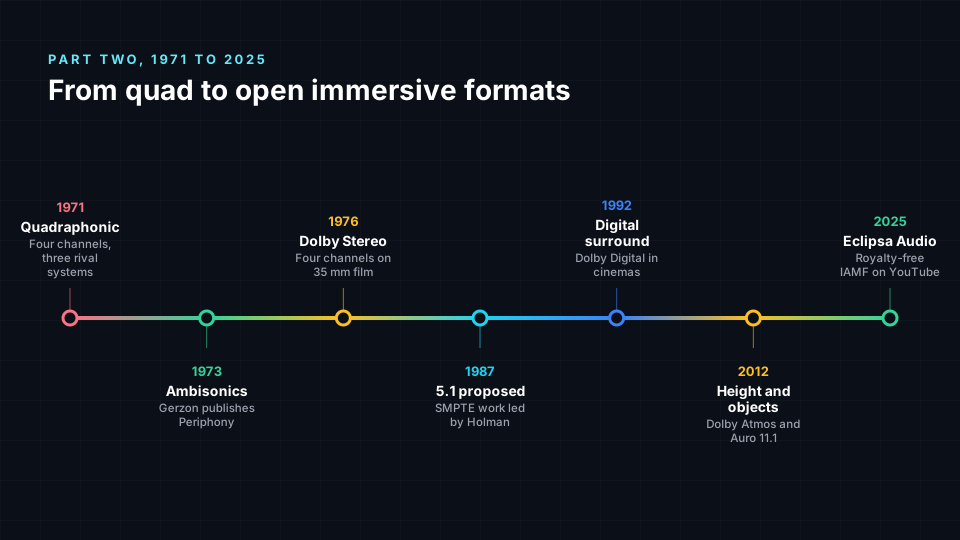
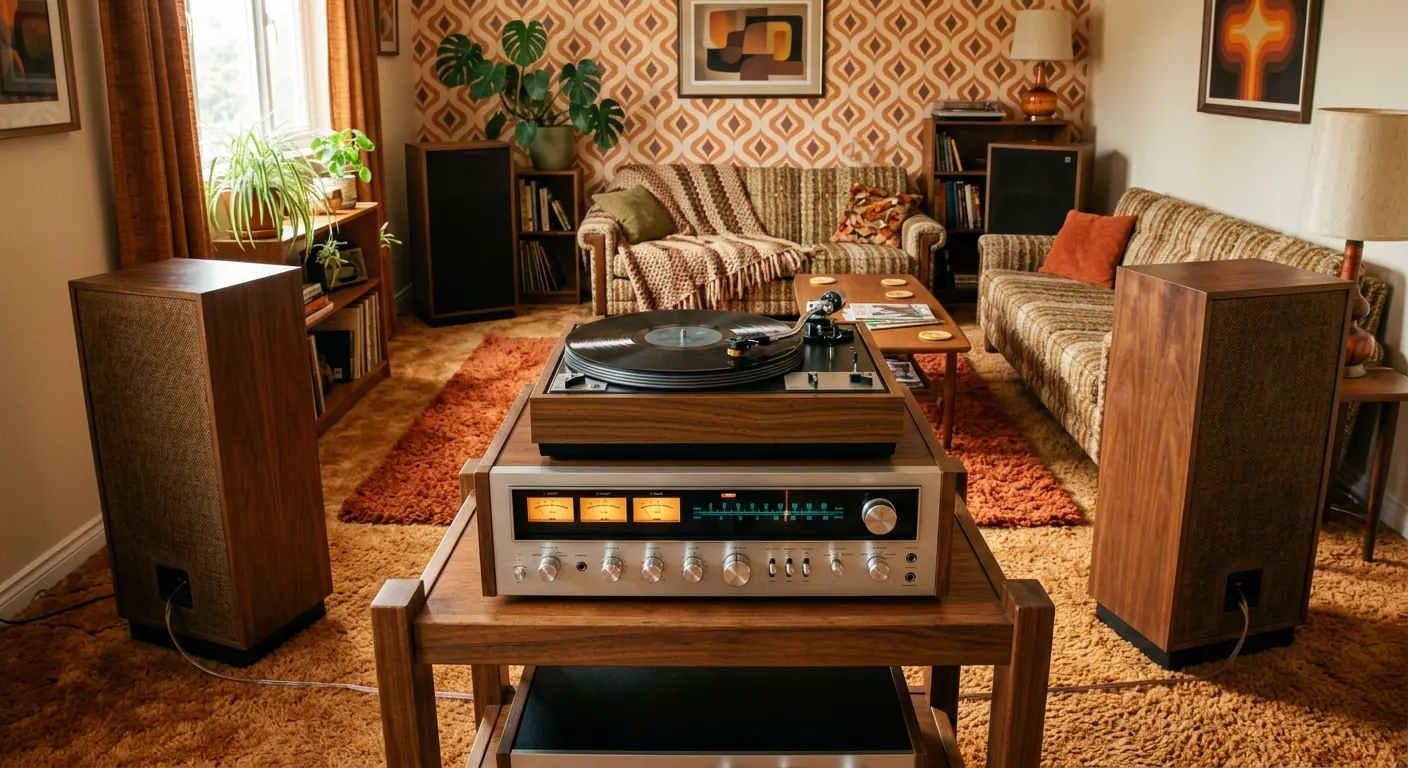
In the early 1970s the record industry tried to put four speakers in every living room. Quadraphonic records placed a channel in each corner. Pink Floyd's The Dark Side of the Moon was released in a quad mix in 1973, engineered by Alan Parsons, and Mike Oldfield's Tubular Bells followed.
The problem was not the music. It was that the industry produced three incompatible systems: SQ from CBS, QS from Sansui and the discrete CD-4 from JVC and RCA. Each needed its own decoder, records in one system played poorly on another, and buyers waited to see which would win. None did. By the end of the decade quad had faded.
Ambisonics: recording the whole sound field
At the same time, a group of British researchers took a more fundamental approach. Michael Gerzon, a mathematician at the Mathematical Institute in Oxford, and Peter Fellgett at the University of Reading, with support from the National Research Development Corporation, developed Ambisonics.
Instead of assigning sounds to speakers, Ambisonics describes the sound field at a point: the pressure and the directional components of sound arriving from every direction, including above and below. Gerzon set out the with-height version in "Periphony: With-Height Sound Reproduction", published in the Journal of the Audio Engineering Society in 1973. A decoder can then render that field to any arrangement of speakers.
Gerzon and Peter Craven designed the Soundfield microphone, with four capsules in a tetrahedron, which captures a first-order Ambisonics field directly. It was manufactured by Calrec from the late 1970s.
Ambisonics was elegant, flexible and decades ahead of demand. It lacked commercial backing and was marketed as a successor to quad just as that market collapsed. It survived in research and among enthusiasts until virtual reality and streaming needed exactly what it offered. YouTube adopted first-order Ambisonics for 360-degree video in 2016, and higher-order Ambisonics is one of the main building blocks of Eclipsa Audio today. Gerzon died in 1996, aged 50. Our guide to Ambisonics explained covers the technique in depth.
Dolby brings surround to the cinema
Ray Dolby founded Dolby Laboratories in London in 1965 to make noise reduction for recording studios. In the mid-1970s the company, with engineer Ioan Allen among the leading figures, adapted its technology for film. Dolby Stereo used a matrix to carry four channels, left, centre, right and surround, on the two optical tracks of a standard 35 mm print, so cinemas did not need special prints or magnetic stripes. It appeared on films from 1976, and the success of Star Wars in 1977 made it a standard. The same matrix later reached homes as Dolby Surround and Pro Logic.
Binaural recording and the artificial head
While the industry argued about speakers, others worked on headphones. Researchers built standardised artificial heads with microphones in the ear canals so that recordings would carry the cues of a real head. KEMAR, the Knowles Electronics Manikin for Acoustic Research, was described by Burkhard and Sachs in 1975 and became a reference for hearing research. Neumann introduced the KU 80 dummy head in the early 1970s, and its successor the KU 100 became a studio standard.
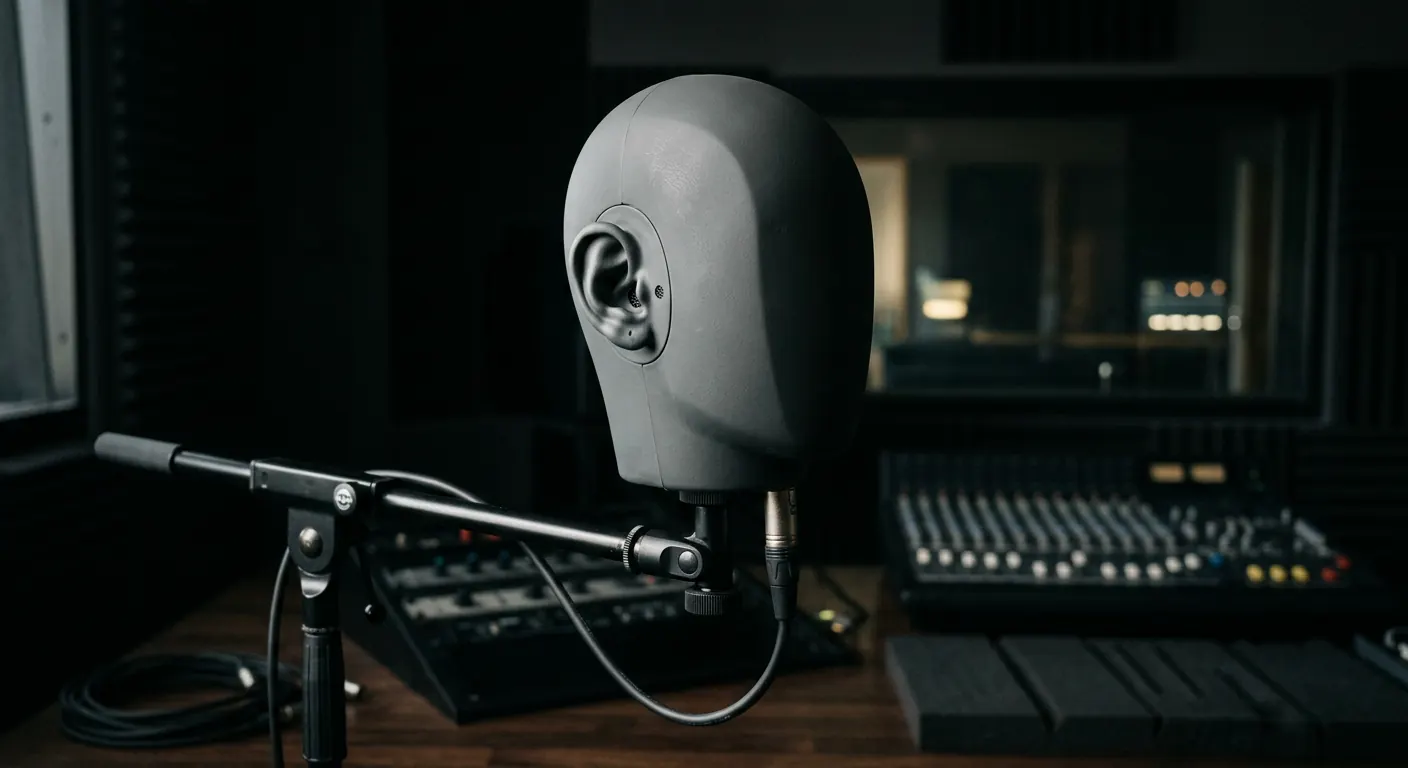
In the early 1980s Hugo Zuccarelli promoted Holophonics, a binaural recording technique used on records including Pink Floyd's The Final Cut (1983). In 1989 Frederic Wightman and Doris Kistler showed that headphone playback filtered with a listener's own head-related transfer functions could match real sound sources closely. That result underpins every binaural renderer in use today. For the difference between binaural and spatial audio, see binaural vs spatial audio.
Digital surround and the 5.1 standard
In 1983 Tomlinson Holman at Lucasfilm introduced THX, a certification for cinema sound quality, with Return of the Jedi. In 1987 a SMPTE working group considering sound for future digital film settled on five full-range channels plus a low-frequency effects channel. Holman named it 5.1.
Digital film sound followed quickly: Dolby Digital with Batman Returns in 1992, DTS with Jurassic Park in 1993 and Sony's SDDS the same year. The ITU standardised the 5.1 loudspeaker arrangement as ITU-R BS.775, and the DVD brought 5.1 into homes from the late 1990s. For the first time, surround sound was on mass-market media worldwide.
Research foundations: panning, wave fields and 22.2
Three research threads from the late 1980s to the 2000s shaped today's formats.
- Wave field synthesis. In 1988 A. J. (Guus) Berkhout at Delft University of Technology published "A holographic approach to acoustic control" in the Journal of the Audio Engineering Society. Wave field synthesis uses large arrays of loudspeakers to reconstruct the physical wavefront of a source, so that its position stays correct for every listener in the room. It was later commercialised for installations and some cinemas.
- Vector base amplitude panning. In 1997 Ville Pulkki, then at the Helsinki University of Technology, published "Virtual Sound Source Positioning Using Vector Base Amplitude Panning". VBAP places a sound between any three speakers in a three-dimensional layout, and it became a standard method for rendering objects to arbitrary speaker arrangements.
- 22.2 multichannel sound. In the 2000s NHK, with Kimio Hamasaki as a lead researcher, developed a 24-channel system with three vertical layers for its Super Hi-Vision television. It proved that layers of height speakers could create true three-dimensional sound for broadcast, and it is included in the ITU's advanced sound system recommendation, ITU-R BS.2051.
2012: height and objects reach the cinema
By 2010 the pieces were in place: digital cinema servers, height speakers, panning algorithms and powerful processors. Two systems arrived in 2012.
Auro-3D, developed by Wilfried Van Baelen at Galaxy Studios in Belgium, added layers of height speakers above the standard surround layout. Red Tails was the first feature released in Auro 11.1, in January 2012.
Dolby Atmos premiered with Pixar's Brave in June 2012. It combined channel beds with up to 118 objects, sounds with positions that the cinema processor renders to whatever speakers each auditorium has. The concept went back to Fantasound's pan pot: instead of mixing to fixed speakers, mix to positions. Atmos reached homes in 2014 and streaming music in 2019.
Standards bodies followed. MPEG-H 3D Audio, supporting channels, objects and higher-order Ambisonics, was published in 2015 and adopted by broadcasters in South Korea and Brazil. The ITU published the Audio Definition Model, ITU-R BS.2076, in 2015: an open way to describe channels, objects and scenes, and the basis of the ADM BWF master files used for Atmos music today.
For how these formats compare, see Dolby Atmos vs DTS:X and Eclipsa Audio vs MPEG-H 3D Audio.
Headphones, streaming and open formats
The smartphone changed the question. Most people now listened on headphones, so immersive audio had to work binaurally first.
- 2016: YouTube added spatial audio for 360-degree video using first-order Ambisonics.
- 2019: Sony launched 360 Reality Audio, built on MPEG-H, and Dolby Atmos music arrived on streaming services. See Dolby Atmos vs Sony 360 Reality Audio.
- 2020 to 2021: Apple introduced Spatial Audio with head tracking on AirPods, then brought Dolby Atmos music to Apple Music. See Apple Spatial Audio vs Dolby Atmos.
- 2023: the Alliance for Open Media released IAMF, a royalty-free immersive audio specification.
- 2025: Google and Samsung launched IAMF as Eclipsa Audio, with support on YouTube and Samsung TVs and soundbars. Apple introduced its own production format, ASAF.
The motivation of reach, putting immersive sound on every device at no cost, finally had an open standard behind it. Our article on why open source matters for immersive audio explains why that matters.
Twelve people who shaped immersive audio
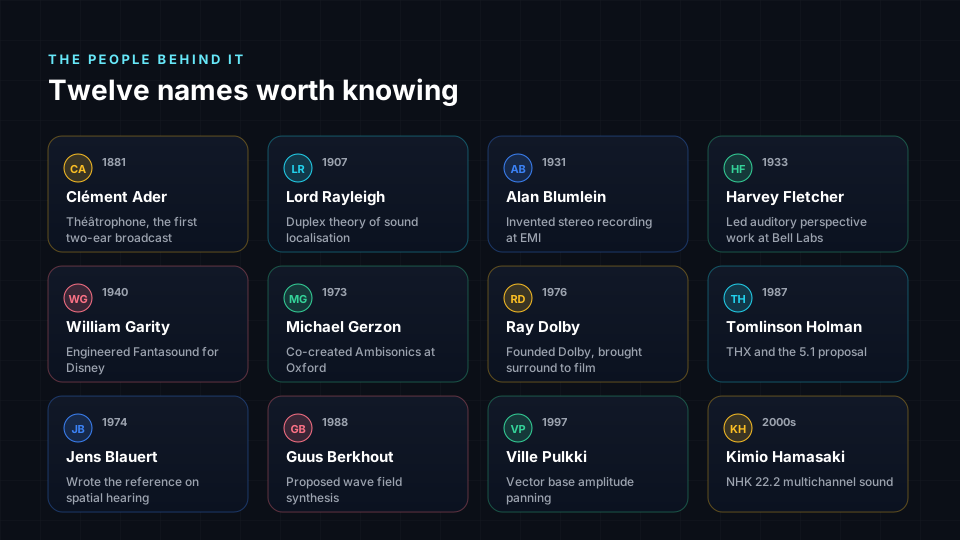
| Person | Key contribution | Year |
|---|---|---|
| Clément Ader | Théâtrophone, the first two-ear broadcast | 1881 |
| Lord Rayleigh | Duplex theory of sound localisation | 1907 |
| Alan Blumlein | Stereo patent, GB 394,325 | 1931 |
| Harvey Fletcher | Led auditory perspective research at Bell Labs | 1933 |
| William Garity | Engineered Fantasound and the pan pot | 1940 |
| Michael Gerzon | Co-created Ambisonics, "Periphony" | 1973 |
| Jens Blauert | Räumliches Hören, later Spatial Hearing | 1974 |
| Ray Dolby | Founded Dolby Laboratories, Dolby Stereo | 1976 |
| Tomlinson Holman | THX and the name 5.1 | 1983, 1987 |
| Guus Berkhout | Wave field synthesis | 1988 |
| Ville Pulkki | Vector base amplitude panning | 1997 |
| Kimio Hamasaki | NHK 22.2 multichannel sound | 2000s |
Many others belong on this list: Peter Fellgett and Peter Craven on Ambisonics, Steinberg and Snow at Bell Labs, Ioan Allen at Dolby, the researchers behind KEMAR and HRTF measurement, and the many engineers at Fraunhofer, NHK, IRCAM and the BBC whose work shaped today's standards.
Why good formats fade
History is full of immersive formats that sounded excellent and still failed. Their stories are more useful than the successes.
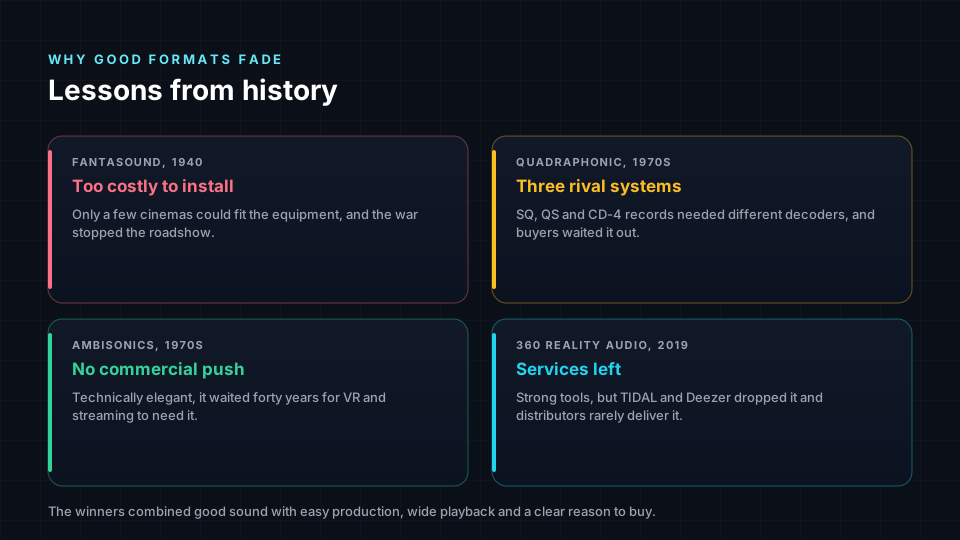
- Fantasound was too expensive to install, and the war ended its roadshow.
- Quadraphonic sound split into three incompatible systems, and buyers refused to choose.
- Ambisonics was technically elegant but lacked commercial backing, and waited forty years for a market.
- 360 Reality Audio had strong tools, but lost TIDAL and Deezer and is rarely delivered by distributors.
The formats that succeeded, stereo, Dolby Stereo, 5.1 and Atmos, combined good sound with three other things: a way to produce content without unusual effort, playback on equipment people already owned or wanted, and a clear reason to choose it. Sound quality alone has never been enough.
Today: AI removes the next barrier
For most of this history, the limit was playback: few people had the speakers or decoders to hear immersive sound. Headphone rendering and streaming removed that limit. The remaining barrier is production. An immersive mix still takes specialist skill, a suitable room and the original multitracks, which most of the world's recorded music no longer has.
AI is removing that barrier. Source separation can split a stereo recording into its parts, and automatic placement can build an immersive mix in minutes. The trade-offs are real, and some platforms do not accept such mixes, as we explain in upmixing stereo vs mixing from stems. But for the first time, any artist can hear their music in three dimensions. Where this may lead next is covered in the future of spatial and immersive audio.
Frequently asked questions
Who invented immersive audio?
No single person. Clément Ader demonstrated two-ear listening in 1881, Alan Blumlein patented stereo in 1931, Bell Labs demonstrated three-channel sound in 1933 and Michael Gerzon co-created Ambisonics in the 1970s. Dolby Atmos, introduced in 2012, brought height and objects to mainstream cinema.
What was the first surround sound film?
Disney's Fantasia, released in 1940 with the Fantasound system, is generally regarded as the first commercial film shown with multichannel surround sound.
Who invented stereo?
Alan Blumlein, an engineer at EMI, filed the patent that defined stereo recording and reproduction, British Patent 394,325, in December 1931. Bell Labs carried out parallel research in the United States.
Why did quadraphonic sound fail?
The industry released three incompatible systems, SQ, QS and CD-4, each needing its own decoder. Confused buyers waited, and the market faded by the end of the 1970s.
What is the oldest immersive audio format still in use?
Ambisonics, described by Michael Gerzon in 1973, is still used today in virtual reality, YouTube 360 videos and Eclipsa Audio.
When did Dolby Atmos start?
Dolby Atmos premiered in cinemas with Pixar's Brave in June 2012, reached home theatres in 2014 and streaming music in 2019.
References
Patents and primary papers
- Lord Rayleigh, "On our perception of sound direction", Philosophical Magazine, series 6, vol. 13, 1907.
- Alan D. Blumlein, "Improvements in and relating to sound-transmission, sound-recording and sound-reproducing systems", British Patent 394,325, filed 14 December 1931, granted 1933.
- Harvey Fletcher, "Auditory perspective: basic requirements", Electrical Engineering, vol. 53, no. 1, 1934. Part of the Bell Labs symposium on auditory perspective.
- J. C. Steinberg and W. B. Snow, "Auditory perspective: physical factors", Electrical Engineering, vol. 53, no. 1, 1934.
- William E. Garity and J. N. A. Hawkins, "Fantasound", Journal of the Society of Motion Picture Engineers, vol. 37, 1941.
- Michael A. Gerzon, "Periphony: With-Height Sound Reproduction", Journal of the Audio Engineering Society, vol. 21, no. 1, 1973.
- M. D. Burkhard and R. M. Sachs, "Anthropometric manikin for acoustic research", Journal of the Acoustical Society of America, vol. 58, no. 1, 1975.
- A. J. Berkhout, "A holographic approach to acoustic control", Journal of the Audio Engineering Society, vol. 36, no. 12, 1988.
- Frederic L. Wightman and Doris J. Kistler, "Headphone simulation of free-field listening", Journal of the Acoustical Society of America, vol. 85, no. 2, 1989.
- Ville Pulkki, "Virtual Sound Source Positioning Using Vector Base Amplitude Panning", Journal of the Audio Engineering Society, vol. 45, no. 6, 1997.
Books
- Jens Blauert, Spatial Hearing: The Psychophysics of Human Sound Localization, revised edition, MIT Press, 1997. First published in German as Räumliches Hören, 1974.
- Robert Alexander, The Inventor of Stereo: The Life and Works of Alan Dower Blumlein, Focal Press, 1999.
- Franz Zotter and Matthias Frank, Ambisonics: A Practical 3D Audio Theory for Recording, Studio Production, Sound Reinforcement, and Virtual Reality, Springer, 2019. Open access.
Standards and specifications
- ITU-R BS.775: Multichannel stereophonic sound system with and without accompanying picture, International Telecommunication Union. The 5.1 layout.
- ITU-R BS.2051: Advanced sound system for programme production, International Telecommunication Union. Layouts with height, including 22.2.
- ITU-R BS.2076: Audio Definition Model, International Telecommunication Union.
- ISO/IEC 23008-3, MPEG-H 3D Audio, International Organization for Standardization, first edition 2015. See also MPEG-H Audio, Fraunhofer IIS.
- IAMF specification, Alliance for Open Media, 2023.
Announcements
- Sony launches 360 Reality Audio, Sony Group press release, October 2019.
- Introducing Eclipsa Audio: immersive audio for everyone, Google Open Source Blog, January 2025.
- Use spatial audio in 360-degree and VR videos, YouTube Help.
Add the next chapter to your own music
The tools that took a century to build are now available to every artist. Spatial9 turns a stereo song or a set of stems into an immersive mix you can hear on headphones and publish to YouTube in Eclipsa Audio. See how it works for artists and producers.
Dolby, Dolby Atmos and Dolby Stereo are trademarks of Dolby Laboratories. THX is a trademark of THX Ltd. All other names are trademarks of their respective owners. Spatial9 is not affiliated with or endorsed by any of the companies mentioned.