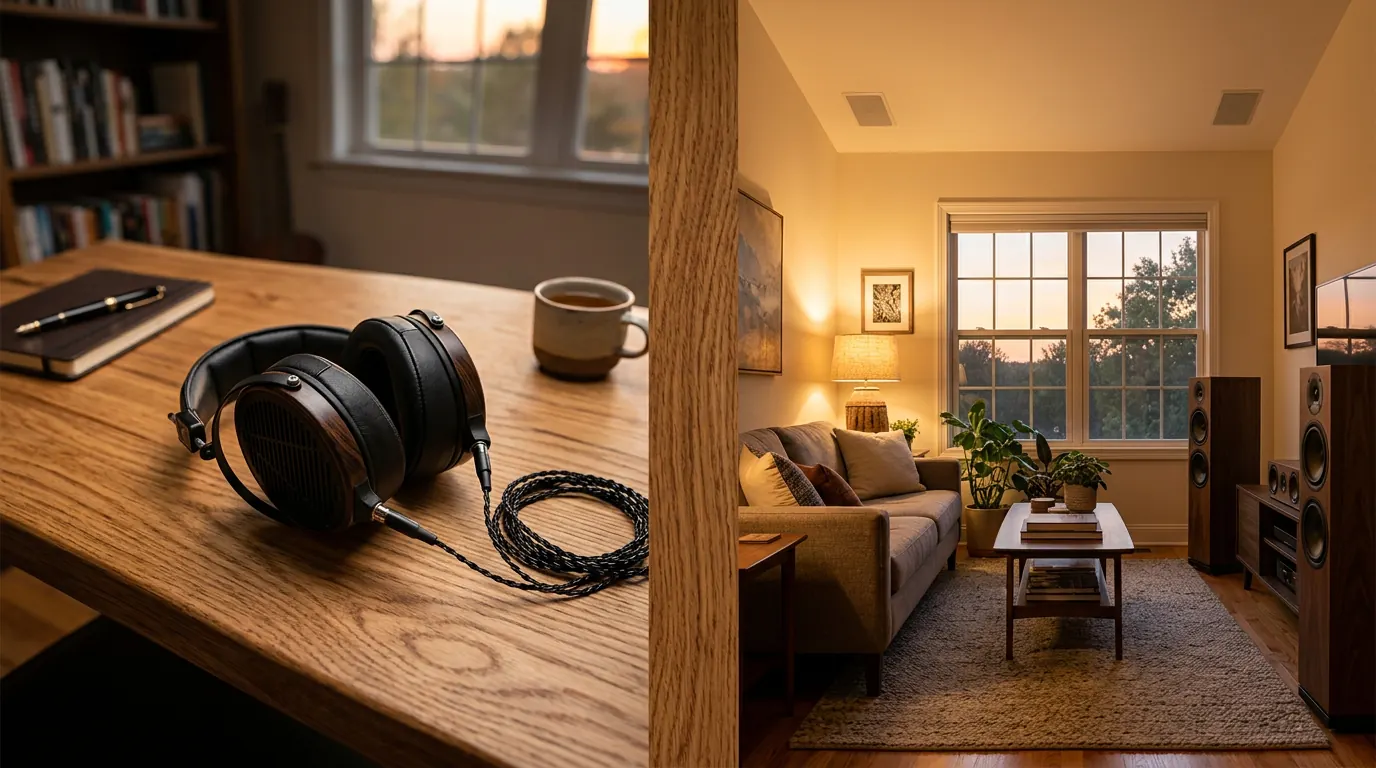
Headphone vs Speaker Spatial Audio: How Each Creates 3D Sound
Spatial9 Team · · Updated · 9 min read
Key takeaways
- Headphones create direction with binaural filters; speakers create it by playing sound from real positions in the room.
- The time difference between the ears is at most about two thirds of a millisecond, yet the brain uses it to locate sound.
- A 7.1.4 layout uses 12 speakers, including four height speakers, and is the usual reference for immersive music studios.
- Generic head models cause front-back confusion for some listeners, which head tracking and personalisation reduce.
The same Dolby Atmos or Eclipsa Audio file can play on a pair of earbuds, a soundbar or a twelve-speaker studio. It will not sound the same on each. That is not a flaw in the format: speakers and headphones deliver spatial cues to your ears in fundamentally different ways.
This guide explains how we hear direction, how each playback system recreates it, where each one excels and struggles, and what that means for listening and mixing. For a broader introduction, see our complete guide to spatial audio. For the terminology of headphone rendering, see binaural vs spatial audio.
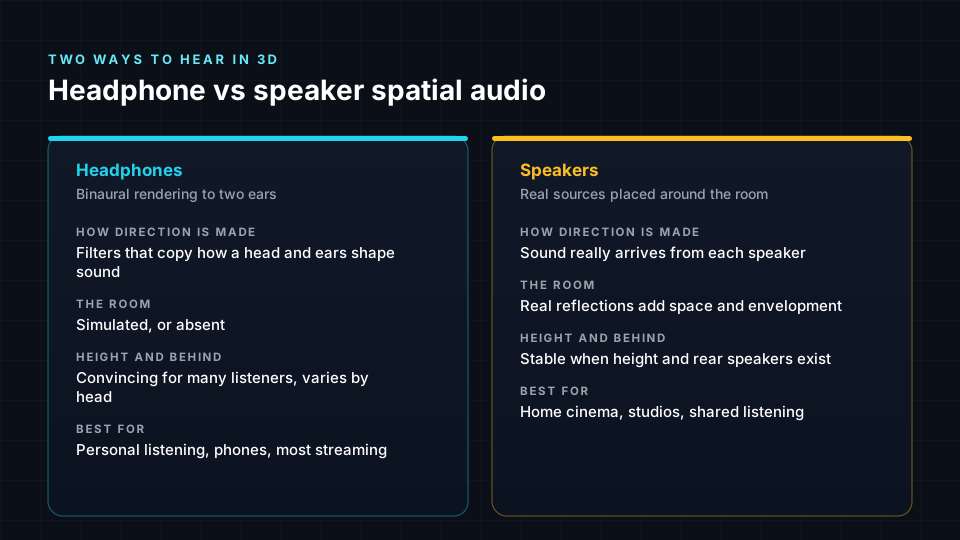
Headphone vs speaker spatial audio at a glance
| Headphones | Speakers | |
|---|---|---|
| How direction is created | Binaural filters imitate the head and ears | Sound really arrives from each speaker position |
| What each ear hears | Only its own channel | Every speaker, shaped by the room |
| The room | Simulated, or absent | Real reflections add space |
| Head movement | Scene turns with you, unless head tracking is on | Scene stays put naturally |
| Height and rear | Convincing for many listeners, varies by person | Stable with height and rear speakers |
| Personal fit | Depends on how well the head model matches you | Depends on the room and seat |
| Cost and space | Low, portable | Higher, needs a room |
| Most common use | Streaming music on phones | Home cinema, studios, shared listening |
How we hear direction
Your brain locates sound from a small set of cues. Lord Rayleigh described the first two in his duplex theory in 1907, and later research by Jens Blauert and others filled in the rest.
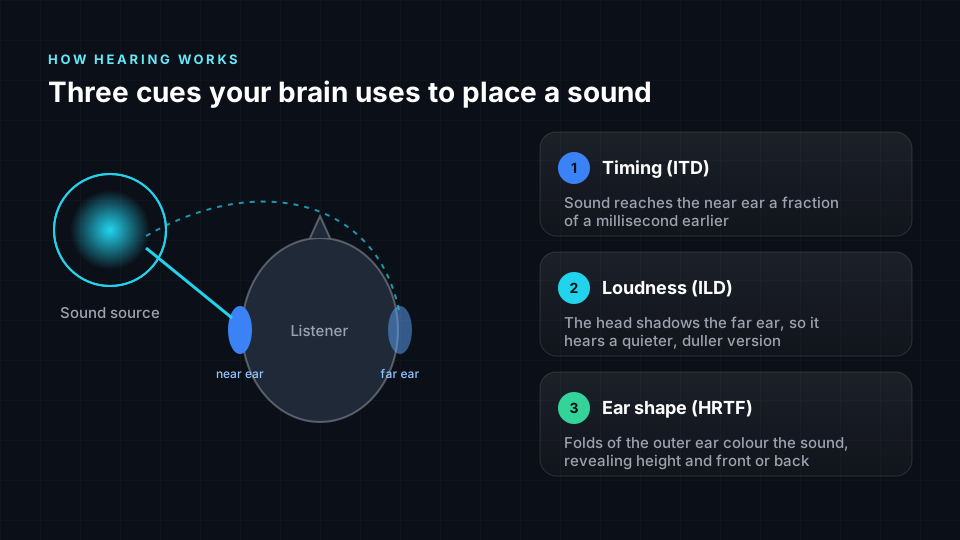
- Time difference. A sound from the left reaches your left ear slightly before your right. The largest difference, for a sound directly to one side, is about two thirds of a millisecond.
- Level difference. Your head shadows the far ear, especially at higher frequencies, so the near ear hears the sound louder.
- Ear shape. The folds of your outer ear colour sound differently depending on whether it comes from above, below, in front or behind. These spectral cues are personal: every ear is different.
- Head movement. Small, unconscious turns of the head change the other cues and resolve ambiguity, such as whether a sound is in front or behind.
- Room reflections. Echoes from walls and ceiling tell you about distance and space.
- Vision. What you see, or expect to see, pulls sound towards it.
Spatial playback works by delivering these cues. Speakers and headphones do it differently.
How speakers create spatial audio
With speakers, the renderer sends each sound to the speakers nearest its intended position. A sound placed above and to the left plays mostly from the top-left speaker. Because the sound genuinely comes from that direction, your own head and ears supply all of the cues automatically, including the personal ear-shape cues. Turning your head works naturally. The room adds reflections that make sound feel spacious.
The limits come from physics and rooms:
- Speaker count. A sound between two speakers is a phantom image, which is less precise than a real source. More speakers mean more precise placement.
- The sweet spot. Off-centre seats hear nearer speakers louder and earlier, which shifts the image.
- The room. Strong reflections and resonances can blur placement and colour the sound.
- Crosstalk. Each ear hears every speaker, which is natural, but means speakers cannot deliver a sound to only one ear.
Common layouts
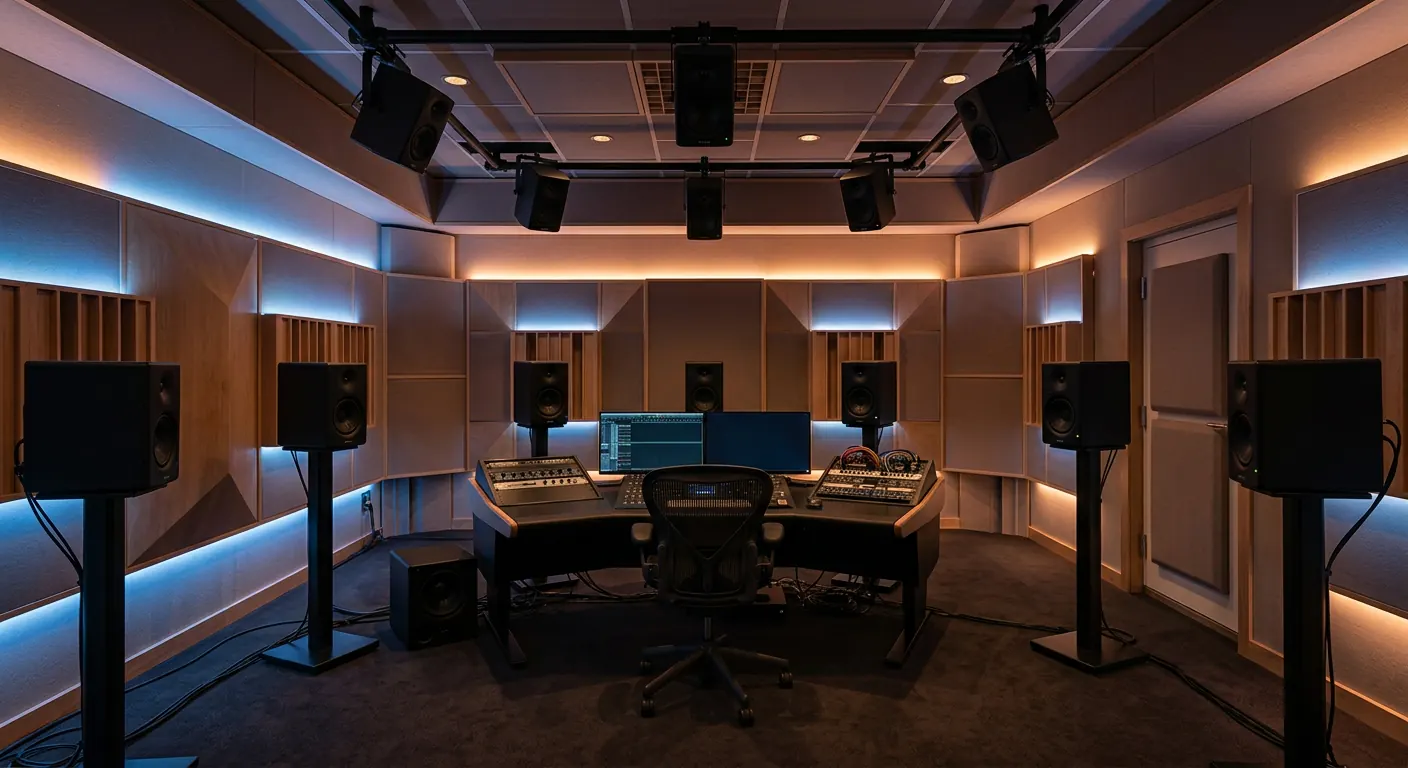
Layout names count speakers: ear-level speakers, then subwoofers, then height speakers. A 7.1.4 system has seven speakers around you at ear level, one subwoofer and four overhead.
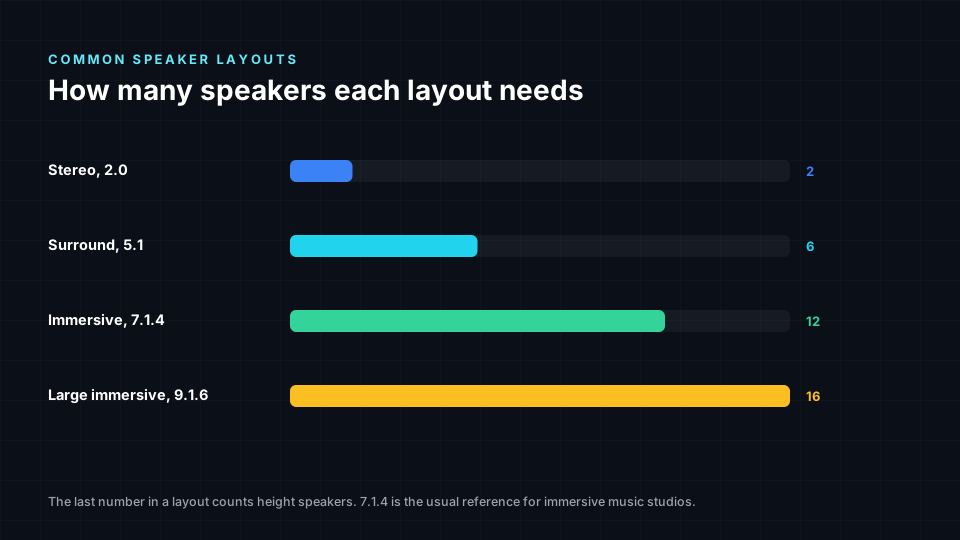
The ITU standardised the classic 5.1 arrangement in ITU-R BS.775 and advanced layouts with height in ITU-R BS.2051. Soundbars imitate these layouts with angled drivers that bounce sound off walls and ceilings, plus processing, which works well in some rooms and less well in others.
How headphones create spatial audio
Headphones put a speaker against each ear and nothing else, so sound naturally appears inside your head, between your ears. A binaural renderer changes that by filtering each sound with a head-related transfer function (HRTF): a measurement of how a head and ears change sound arriving from a particular direction. Apply the HRTF for "above and to the left", and the signal reaching each ear carries the time, level and ear-shape cues of a sound from that direction.
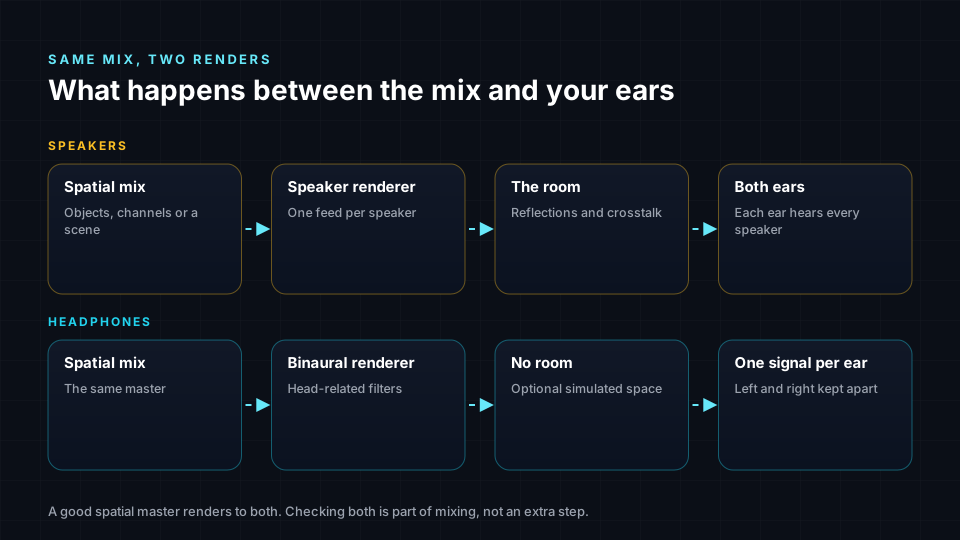
Done well, this is remarkably convincing, and it needs no special room. It is also why most spatial music is heard on headphones. The limits come from the gap between a generic model and your own head:
- Generic HRTFs. Most renderers use a typical head. Research by Elizabeth Wenzel and colleagues in 1993 showed that listeners using another person's HRTFs make more front-back confusions and misjudge elevation more often than with their own.
- Externalisation. Without room cues, sounds can collapse back inside the head. Renderers add simulated room reflections, which is what Dolby's Near, Mid and Far settings control.
- Head movement. If the scene turns with your head, a key cue is missing. Head tracking, available on devices such as recent AirPods, keeps the scene fixed in space.
- Personalisation. Some systems build a closer HRTF from a scan or photo of your ears, as Apple and Sony do.
Where each one excels
Headphones excel at intimacy and precision: sounds close to the head, detailed movement, and a consistent result wherever you are. They are also how the majority of listeners will hear your mix, on a phone, on the move.
Speakers excel at envelopment and stability: a real sense of being inside a space, solid height and rear images, and an experience you can share. They are the reference for film and for professional immersive mixing.
Their weaknesses mirror each other. Headphones depend on how well the head model fits each listener. Speakers depend on the room and the seat.
What this means for mixing
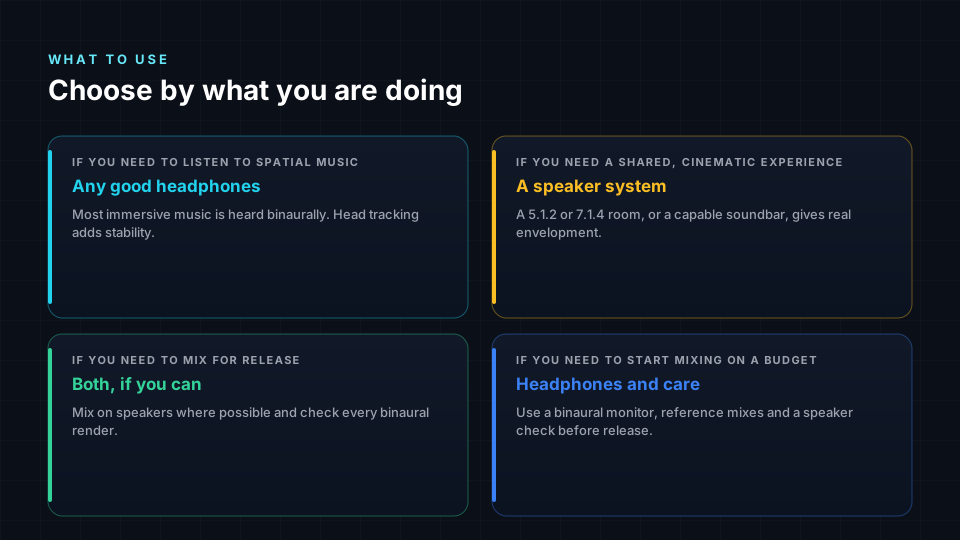
- Mix on speakers where you can. A calibrated 7.1.4 room gives you a reliable reference that does not depend on your own ears matching an HRTF.
- Check every binaural render. Because most listeners use headphones, the binaural version is not secondary. On Apple Music it is also rendered differently from Dolby's own render; see Apple Spatial Audio vs Dolby Atmos.
- Avoid relying on cues headphones handle poorly. Important elements placed directly behind or low behind the listener are the most likely to be misheard on headphones.
- Keep the centre solid. Lead vocals and bass usually anchor a mix. Keep them stable rather than spreading them widely.
- If you only have headphones, use a binaural monitor with head tracking if available, compare against professional reference mixes, and arrange a speaker check before release.

Common misconceptions
- "Spatial audio needs speakers on the ceiling." Headphones can reproduce height through binaural rendering. Height speakers are one way to hear it, not the only one.
- "Binaural is a different format." Binaural is a way of rendering a spatial mix for two ears. The same Atmos or Eclipsa Audio master produces both binaural and speaker playback.
- "Headphone spatial audio sounds the same to everyone." It depends on how closely the renderer's head model matches yours, which is why personalisation exists.
- "More speakers always sound better." A well-calibrated 7.1.4 room usually beats a poorly set up larger system.
- "Soundbars are the same as a full system." Good soundbars can be convincing, but bouncing sound off walls depends heavily on the room.
Frequently asked questions
Is spatial audio better on headphones or speakers?
Neither is better in every way. Speakers give more stable envelopment and a shared experience. Headphones are more personal, portable and precise, and they are how most people listen to spatial music.
Why does spatial audio sound inside my head on headphones?
Without room cues and head movement, the brain can place sounds inside the head. Renderers add simulated room reflections, and head tracking keeps the scene still as you move, both of which help sound appear outside.
Do I need special headphones for spatial audio?
No. Any headphones can play binaural spatial audio. Some models add head tracking and personalised profiles, which can improve the effect.
What is an HRTF?
A head-related transfer function: a measurement of how your head and ears filter sound arriving from a particular direction. Binaural renderers use HRTFs to make headphone sound appear to come from around you.
Can I mix spatial audio on headphones only?
You can, and many people start that way. Use a reliable binaural monitor, compare against reference mixes and try to check the mix on a speaker system before release.
What does 7.1.4 mean?
Seven speakers around you at ear level, one subwoofer and four speakers overhead. It is the usual reference layout for immersive music studios.
References
- Lord Rayleigh, "On our perception of sound direction", Philosophical Magazine, series 6, vol. 13, 1907. The duplex theory of time and level differences.
- Jens Blauert, Spatial Hearing: The Psychophysics of Human Sound Localization, revised edition, MIT Press, 1997. The standard reference on how humans locate sound.
- Frederic L. Wightman and Doris J. Kistler, "Headphone simulation of free-field listening", Journal of the Acoustical Society of America, vol. 85, no. 2, 1989. Validation of binaural synthesis with individual HRTFs.
- Elizabeth M. Wenzel, Marianne Arruda, Doris J. Kistler and Frederic L. Wightman, "Localization using nonindividualized head-related transfer functions", Journal of the Acoustical Society of America, vol. 94, no. 1, 1993. Front-back and elevation errors with generic HRTFs.
- ITU-R BS.775: Multichannel stereophonic sound system with and without accompanying picture, International Telecommunication Union. The 5.1 layout.
- ITU-R BS.2051: Advanced sound system for programme production, International Telecommunication Union. Layouts with height speakers.
- Dolby professional documentation, Dolby Laboratories. Speaker layouts and binaural render modes.
- Introducing Open Source DAW Plugin for Eclipsa Audio, Google Open Source Blog, June 2025. Rendering IAMF to loudspeakers and binaurally.
Hear one master on every system
A good spatial master plays on earbuds, soundbars and full speaker rooms. Spatial9 creates immersive mixes from your stereo songs or stems and lets you preview them on headphones before you export. See how it works for artists and producers.
Dolby and Dolby Atmos are trademarks of Dolby Laboratories. Apple and AirPods are trademarks of Apple Inc. All other names are trademarks of their respective owners. Spatial9 is not affiliated with or endorsed by them.