Spatial Audio & Immersive Music for Witch House: Complete Guide
Spatial9 Team · · 8 min read
Part of the series Spatial audio and immersive music by genre.
Key takeaways
- In a spatial witch house mix the kick and 808 sub stay locked in the centre, while slowed vocals, trap hats, synths, drones, choir samples, reverb and ghostly effects surround the listener.
- Witch house vocals work best dry and close in front, with their reverb sent behind and above, because the brain locates a sound by its first arrival.
- Reverb and drones arriving from the sides and behind create the cold, enveloping room that defines witch house, which is why space scores at maximum.
- The witch house immersion profile scores width 4, height 4, movement 2, low-end focus 4 and space 5 out of 5.
Witch house emerged in the United States in the late 2000s and early 2010s as an internet-born microgenre, spread through blogs, small labels and file sharing more than clubs. The name started half as a joke among artists in the scene, and the music was also called drag. Salem became one of its best known acts. Witch house borrows the slowed, pitched-down sound of chopped and screwed hip-hop and mixes it with 1980s goth and darkwave synths, the haze of shoegaze, and the menace of industrial and drone. The result is slow and heavy: booming 808 kicks and subs, skittering trap hats, vocals pitched down until they sound inhuman, eerie choir samples and long, cold reverb. Its occult imagery and symbol-filled artist names made it feel deliberately mysterious. Since witch house is so much about atmosphere, the space around the beat is half of the music. This guide covers how spatial audio for witch house works, where to place each element and how to make an immersive witch house mix. For the basics, see what spatial audio is.
Why witch house works in spatial audio
Witch house is built on contrast: a heavy, dry low end against vocals and synths drowned in reverb. In stereo that reverb has nowhere to go but the same two speakers as the beat, so the mix can turn muddy and the 808 loses its weight. In an immersive mix the reverb, choirs and drones can rise above and behind the listener, while the beat stays solid in front. The room itself becomes the instrument, and the darkness feels physical rather than flat.
The rule: a heavy, still floor, a haunted room above. Kick and 808 never move, while voices and echoes hang in the dark and drift slowly around the listener.
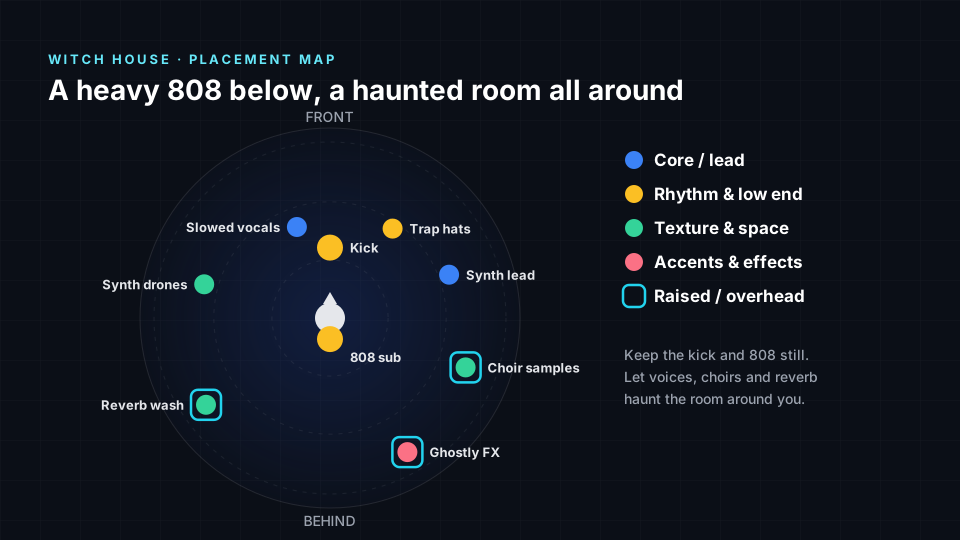
Immersive music for witch house: what listeners hear
- A low end you feel in your chest. The 808 stays deep, centred and steady.
- Voices from another world. Slowed vocals sit close in front, while their echoes fade far behind.
- Choirs overhead. Eerie choir samples hang above the listener like a cold cathedral.
- A room full of shadows. Reverb and drones surround you, with ghostly effects creeping past.
Where to place each element in a witch house mix
| Element | Position | Height | Why it works |
|---|---|---|---|
| Kick | Front centre | Ear level | Slow, heavy pulse |
| 808 sub | Centre | Ear level | Deep weight that never moves |
| Slowed vocals | Front left | Ear level | Close, strange and unsettling |
| Trap hats | Front right, moving | Ear level | Skittering detail |
| Synth lead | Right | Ear level | Cold melody beside the voice |
| Synth drones | Left | Ear level | Dark, wide floor of sound |
| Choir samples | Behind right | Raised | A cathedral overhead |
| Reverb wash | Behind left | Raised | The haunted room itself |
| Ghostly FX | Behind, moving | Raised | Things moving in the dark |
The psychoacoustics behind witch house placement
Every position in the table above follows how the ear and brain locate sound. Here is the reason behind the main choices for witch house.
- Kick and 808 stay centred. The ear finds almost no direction in frequencies below roughly 80 to 100 Hz, so the long witch house 808 gains nothing from being spread. Keeping it centred and mono keeps it heavy on any system and leaves the rest of the space free for atmosphere.
- Slowed vocals in front, their echoes behind. When a sound and its reflections arrive close together, the brain fixes its position by the first arrival. This is the precedence effect. The pitched-down voice stays in place just left of centre, while its long reverb and delays can fade away behind the listener without pulling it back.
- Reverb and drones around the listener. Sound arriving from the sides soon after the direct sound is what makes a space feel wide and enveloping, as Barron and Marshall found in concert halls. Sending witch house reverb and drones to the sides and behind creates that cold, cavernous feeling far better than reverb stacked in front.
- Choir samples above. The outer ear shapes high frequencies differently depending on where a sound comes from, and the brain reads these spectral cues as elevation, as Hebrank and Wright showed. The airy upper range of choir samples makes them easy to lift overhead, where they sound like voices in a high, dark ceiling.
The immersion profile for witch house
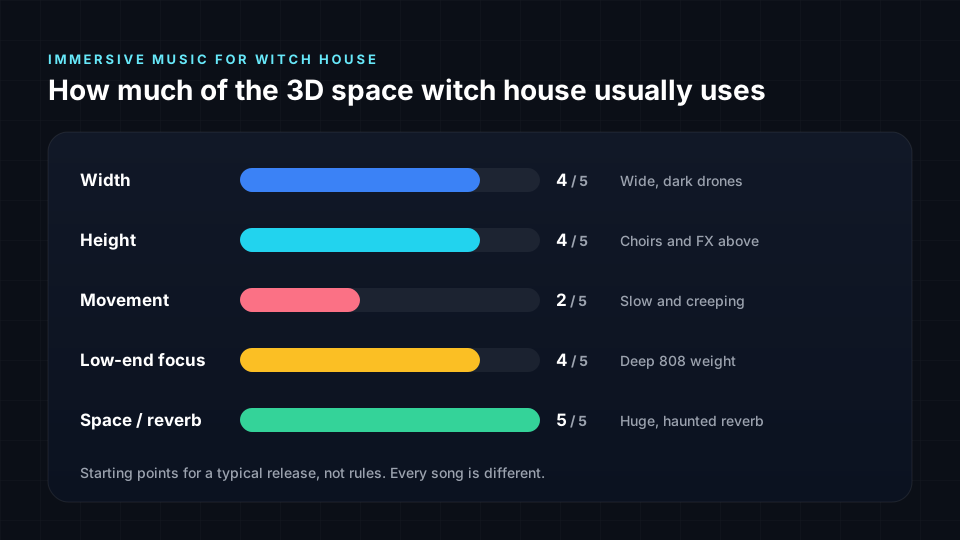
Space is at maximum because long reverb, drones and choirs are the heart of the genre. Width, height and low-end focus are high, since the dark atmosphere surrounds and rises above a deep, steady 808. Movement is low: witch house is slow and heavy, so sounds creep rather than fly. A few ghostly effects can drift behind the listener, but fast motion would break the trance.
Tips for an immersive witch house mix
- Keep the 808 mono. The sub must stay identical from every direction, however much reverb surrounds it.
- Split the dry and the wet. Keep the vocal itself close in front, and send its reverb behind and above.
- Use height for choirs. Lift choir samples and airy pads, and keep drones at ear level.
- Move slowly. Let only a few effects drift, and give them several bars to travel.
- Leave the centre clear. Keep reverb out of the middle so the kick and 808 stay punchy.
How to make immersive witch house from stereo
Spatial9 can create spatial audio from a stereo track in a few steps:
- Upload your stereo master or your stems.
- Spatial9's AI separates and places each part, locking the kick and 808 and sending slowed vocals, choirs and reverb around you.
- Preview it in binaural on headphones.
- Export Eclipsa Audio, ADM, binaural or Ambisonics.
- Publish a video. Create a YouTube-ready video with your immersive audio and publish it directly.
For related guides, read spatial audio for dark ambient and spatial audio for phonk. Every guide is listed in spatial audio and immersive music by genre.
Frequently asked questions
Can I make a witch house mix in Dolby Atmos or Eclipsa Audio?
Yes. The placements in this guide work for both. Spatial9 exports ADM, the standard file used by Dolby Atmos studios, as well as Eclipsa Audio for YouTube, so one immersive witch house mix covers both. If you plan to release the Atmos version on Apple Music, build it from your original stems or multitracks, because Apple does not accept Atmos made from a finished stereo master. See where to publish spatial audio. You may also hear this called a 3D witch house mix or witch house in spatial audio.
Is spatial audio good for witch house?
Yes. Witch house lives on atmosphere, and spatial audio lets reverb, drones and choirs surround the listener while the 808 stays heavy and clear in the centre.
How is witch house different from phonk in spatial audio?
Both borrow from Southern hip-hop, but phonk is punchier and drier, with cowbells and drums driving the mix and a smaller room. Witch house is slower and far more atmospheric, so it needs much more space, more height for choirs and reverb, and less movement.
Where should slowed vocals go in immersive witch house?
Close in front, just off centre, and fairly dry at the source. Send their reverb and delays behind and above the listener. This keeps the voice strange and present while the echoes create the haunted room.
Is witch house the same as drag?
Mostly, yes. Drag was another name used for the same scene and sound, especially for its slowest, most hip-hop influenced tracks. The placement in this guide works for both.
Can I convert a finished witch house track to spatial audio?
Yes. Spatial9 uses AI to generate an immersive mix from a stereo master and exports it as Eclipsa Audio, ADM, binaural or Ambisonics.
Does immersive witch house work on normal headphones?
Yes. The mix is rendered binaurally, so the haunted reverb and the deep 808 work on any regular headphones.
Dolby and Dolby Atmos are trademarks of Dolby Laboratories. Spatial9 is not affiliated with or endorsed by Dolby Laboratories.
Sources
- Blauert, J. (1997). Spatial Hearing: The Psychophysics of Human Sound Localization, revised edition. MIT Press. Low-frequency, elevation, distance and motion cues.
- Hebrank, J. and Wright, D. (1974). Spectral cues used in the localization of sound sources on the median plane. Journal of the Acoustical Society of America, 56(6), 1829-1834.
- Litovsky, R. Y., Colburn, H. S., Yost, W. A. and Guzman, S. J. (1999). The precedence effect. Journal of the Acoustical Society of America, 106(4), 1633-1654.
- Barron, M. and Marshall, A. H. (1981). Spatial impression due to early lateral reflections in concert halls. Journal of Sound and Vibration, 77(2), 211-232.
- Bregman, A. S. (1990). Auditory Scene Analysis: The Perceptual Organization of Sound. MIT Press.
Step into the haunted room
Upload a track to Spatial9 and hear your slowed vocals and choirs drift around a deep, steady 808 in minutes. Then export it or publish it straight to YouTube.