Spatial Audio & Immersive Music for Phonk: Complete Guide
Spatial9 Team · · 7 min read
Part of the series Spatial audio and immersive music by genre.
Key takeaways
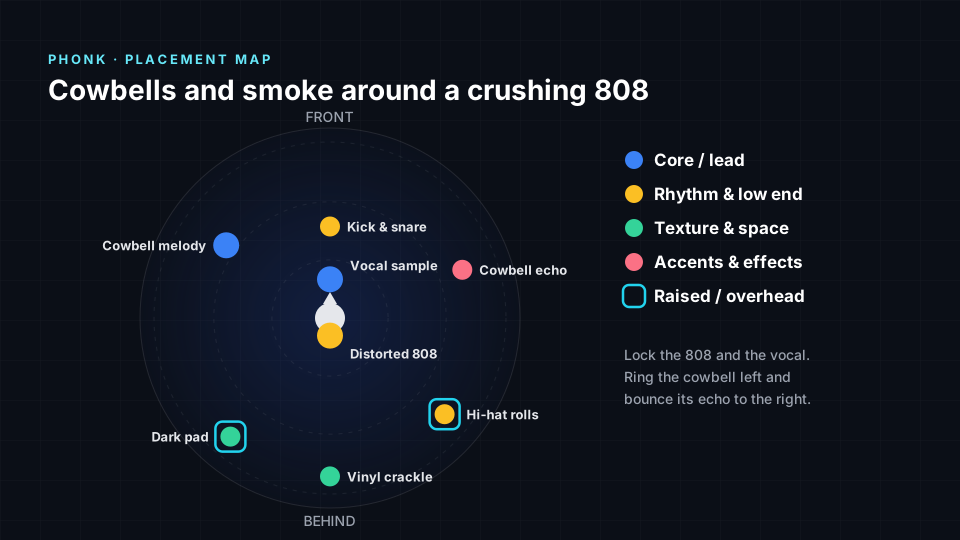
- In an immersive phonk mix the Memphis vocal sample, kick and snare and distorted 808 stay in the centre while the cowbell melody, its echo, hi-hat rolls, a dark pad and vinyl crackle surround the listener.
- The cowbell melody works best front left with its delay echo bouncing on the right, because a repeat that arrives from a different direction and late enough is heard as a second voice rather than fused into the first hit.
- Bass below roughly 80 to 100 Hz gives the ear very little direction, so the distorted phonk 808 should stay centred while only its upper distortion carries any sense of place.
- The phonk immersion profile scores width 4, height 2, movement 3, low-end focus 5 and space 2 out of 5.
Phonk grew out of 1990s Memphis rap tapes, reworked by SoundCloud producers in the 2010s and later pushed into the faster, harder drift phonk sound heard across car and gym videos. Its fingerprint is easy to spot: chopped and pitched vocal samples from old Memphis cassettes, a heavily distorted 808, rattling trap hi-hats and a looping cowbell melody, all soaked in tape saturation and lo-fi grit. Each track is built from a handful of loud, simple parts, so every part can own a direction without clutter. This guide covers how spatial audio for phonk works, where to place each element and how to make an immersive phonk mix. For the basics, see what spatial audio is.
Why phonk is ideal for spatial audio
In stereo, phonk is a wall of distortion. The 808, the cowbell and the vocal sample all fight for the same few kilohertz, and the cowbell's echo often disappears into the bass. Give each part its own direction and the loop opens up: the 808 hits harder because nothing else sits on top of it.
The rule: a crushing centre, a ringing edge. The 808 and the vocal stay locked while the cowbells call and answer from the sides.
Immersive music for phonk: what listeners hear
- An 808 that hits your chest. The distorted bass stays dead centre and never wanders.
- A voice from an old tape. The Memphis vocal sample sits close and slightly eerie in front.
- Cowbells that answer each other. The melody rings on the left, its echo bounces back from the right.
- Darkness behind. A low pad and vinyl crackle fill the space at your back like a night sky over the road.
Where to place each element in a phonk mix
| Element | Position | Height | Why it works |
|---|---|---|---|
| Vocal sample | Front centre | Ear level | Close, hypnotic focus |
| Kick & snare | Front centre | Ear level | The punch of the beat |
| Distorted 808 | Centre | Ear level | The heart of the track |
| Cowbell melody | Front left | Ear level | The signature hook |
| Cowbell echo | Right, bouncing | Ear level | Answers the melody |
| Hi-hat rolls | Behind right | Raised | Fast, bright energy |
| Dark pad | Behind left | Raised | Menacing depth |
| Vinyl crackle | Behind | Ear level | Lo-fi tape character |
The psychoacoustics behind Phonk placement
Every position in the table above follows how the ear and brain locate sound. Here is the reason behind the main choices for Phonk.
- The 808 stays centred. The fundamental of a phonk 808 usually sits well below 100 Hz, where the ear has almost no directional cues, which is why one subwoofer can serve a whole speaker array. Its distortion harmonics should come from the same centre as the body.
- Cowbell left, echo right. When a sound and its copy arrive close together, the brain fuses them and hears only the first direction. This is the precedence effect. A rhythmic delay of an eighth or a dotted eighth note arrives late enough to break that fusion, so the echo on the opposite side is heard as a separate answer rather than a smear.
- Hi-hat rolls raised behind. The outer ear shapes frequencies above roughly 4 kHz differently for each elevation, and those spectral cues are what tell us a sound is above us. Fast trap hats are almost all treble, so they are the one phonk element that can convincingly lift into the height layer.
- Dark pad and crackle behind. Front and back are easily confused when a sound has few sharp edges, so the rear suits textures that should feel like an atmosphere rather than a point.
The immersion profile for phonk
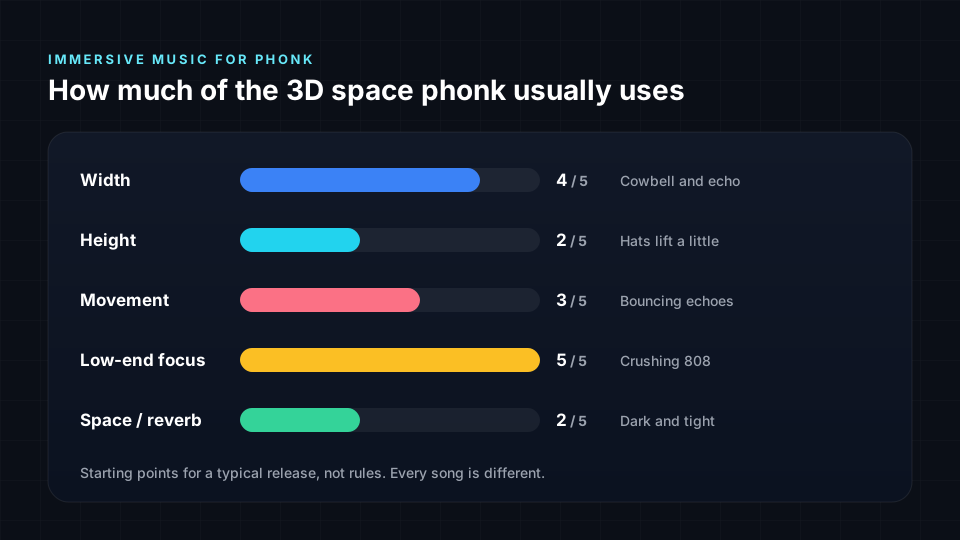
Low-end focus is at maximum because the distorted 808 is the identity of the genre. Width is strong thanks to the cowbell call and echo, while height stays low: only the hats rise. The space is deliberately dry and close, like music played loud inside a car.
Tips for an immersive phonk mix
- Protect the 808. Keep it centred, and keep other parts out of its low range so the distortion stays clean and heavy.
- Split the cowbell from its echo. Put the melody on one side and the delay on the other so the hook bounces across the listener.
- Keep the vocal sample dry and close. The lo-fi Memphis voice works best intimate, not drowned in reverb.
- Use height sparingly. Lift the hats and the pad, but leave the drums and the 808 at ear level.
- Let the drop hit wide. Hold the cowbell narrow in the intro, then open it to full width when the 808 drops.
How to make immersive phonk from stereo
Spatial9 can create spatial audio from a stereo track in a few steps:
- Upload your stereo master or your stems.
- Spatial9's AI separates and places each part, keeping the 808 centred and spreading the cowbells to the sides.
- Preview it in binaural on headphones.
- Export Eclipsa Audio, ADM, binaural or Ambisonics.
- Publish a video. Create a YouTube-ready video with your immersive audio and publish it directly.
For related guides, read spatial audio for trap and spatial audio for drill. Every guide is listed in spatial audio and immersive music by genre.
Frequently asked questions
Can I make a phonk mix in Dolby Atmos or Eclipsa Audio?
Yes. The placements in this guide work for both. Spatial9 exports ADM, the standard file used by Dolby Atmos studios, as well as Eclipsa Audio for YouTube, so one immersive phonk mix covers both. If you plan to release the Atmos version on Apple Music, build it from your original stems or multitracks, because Apple does not accept Atmos made from a finished stereo master. See where to publish spatial audio. You may also hear this called a 3D phonk mix or phonk in spatial audio.
Is spatial audio good for phonk?
Yes. Phonk is built from a few loud, distorted parts, and giving each one its own direction makes the 808 hit harder and the cowbell hook easier to hear.
Where should the cowbell go in an immersive phonk mix?
Front left or front right at ear level, with its delay echo on the opposite side. That keeps the hook clear and lets it bounce across the listener.
Should the distorted 808 move in drift phonk?
No. The 808 is the anchor of the track and its low frequencies carry little direction anyway. Keep it centred and let the cowbell echo provide the movement.
Can I convert a finished phonk track to spatial audio?
Yes. Spatial9 uses AI to generate an immersive mix from a stereo master and exports it as Eclipsa Audio, ADM, binaural or Ambisonics.
Does immersive phonk work on normal headphones?
Yes. The mix is rendered binaurally, so the cowbells and the 808 keep their positions on any regular headphones.
Dolby and Dolby Atmos are trademarks of Dolby Laboratories. Spatial9 is not affiliated with or endorsed by Dolby Laboratories.
Sources
- Blauert, J. (1997). Spatial Hearing: The Psychophysics of Human Sound Localization, revised edition. MIT Press. Low-frequency, elevation, distance and motion cues.
- Mills, A. W. (1958). On the minimum audible angle. Journal of the Acoustical Society of America, 30(4), 237-246.
- Hebrank, J. and Wright, D. (1974). Spectral cues used in the localization of sound sources on the median plane. Journal of the Acoustical Society of America, 56(6), 1829-1834.
- Bronkhorst, A. W. (2000). The cocktail party phenomenon: a review of research on speech intelligibility in multiple-talker conditions. Acta Acustica united with Acustica, 86, 117-128.
- Litovsky, R. Y., Colburn, H. S., Yost, W. A. and Guzman, S. J. (1999). The precedence effect. Journal of the Acoustical Society of America, 106(4), 1633-1654.
- Barron, M. and Marshall, A. H. (1981). Spatial impression due to early lateral reflections in concert halls. Journal of Sound and Vibration, 77(2), 211-232.
- Neuhoff, J. G. (1998). Perceptual bias for rising tones. Nature, 395, 123-124.
- Bregman, A. S. (1990). Auditory Scene Analysis: The Perceptual Organization of Sound. MIT Press.
Put your listeners in the driver's seat
Upload a track to Spatial9 and hear your cowbells and 808 surround you in minutes. Then export it or publish it straight to YouTube.