Spatial Audio & Immersive Music for Trip Hop: Bristol Sound & Abstract Hip Hop
Spatial9 Team · · 9 min read
Part of the series Spatial audio and immersive music by genre.
Key takeaways
- In a spatial trip hop mix the drum break and heavy bass stay centred and the vocal stays close in front, while dub echoes, vinyl crackle and a dark reverb room sit behind the listener.
- Trip hop needs depth more than width, because spreading every part around the listener would lose the close, claustrophobic feel of the genre.
- Dub echoes can fall away behind the listener without moving the vocal, because the brain locates a sound by its first arrival, an effect known as the precedence effect.
- The trip hop immersion profile scores width 3, height 2, movement 2, low-end focus 4 and space 4 out of 5.
Trip hop grew out of Bristol, England, in the late 1980s and early 1990s, where sound system culture, hip hop, dub, reggae and soul met in the same clubs and house parties. Massive Attack, Portishead and Tricky made the sound famous, and the UK music press began calling it trip hop in the mid 1990s, a name many of the artists never liked. The sound is slow and heavy: a dusty hip-hop drum break, often between about 70 and 100 BPM, a deep dub bassline, vinyl crackle, samples from jazz, soul and old film soundtracks, scratching, moody strings and a haunting sung vocal or a murmured rap. Trip hop is about atmosphere and tension. It feels close and claustrophobic, so space has to be used with care, adding depth and shadow without losing the intimacy. This guide covers how spatial audio for trip hop works, where to place each element and how to make an immersive trip hop mix. For the basics, see what spatial audio is.
Why trip hop needs a careful 3D mix
Trip hop is built on contrast: a voice that feels inches away against a dark, echoing room behind it. In stereo that depth is squeezed onto a flat line. In spatial audio the vocal can stay close and the room can open up behind and above, so the listener hears the distance between them. But trip hop is not ambient music. Spread too wide, the beat loses its weight and the vocal loses its intimacy.
The rule: a heavy, close centre, a dark room behind. Drums, bass and vocal stay together in front, while echoes, crackle and reverb sink into the shadows behind the listener.
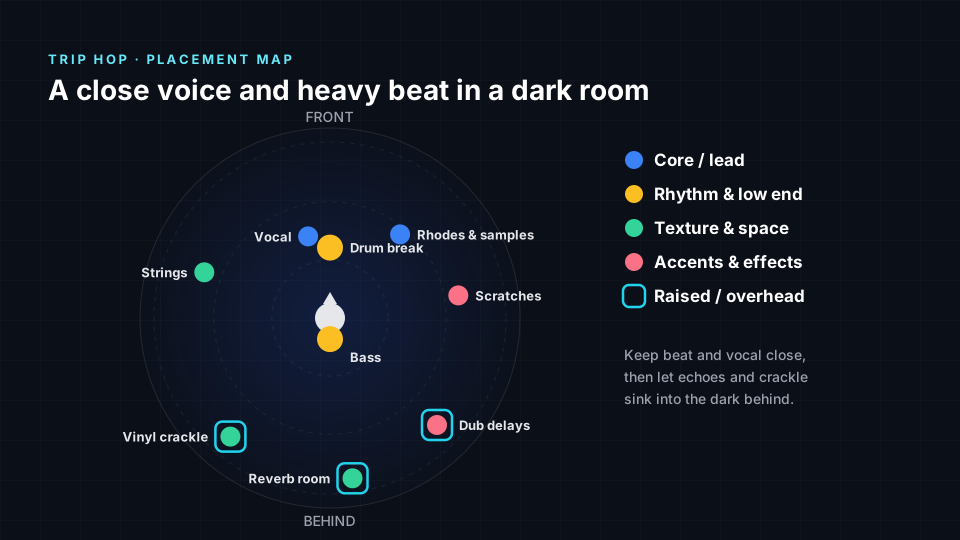
Immersive music for trip hop: what listeners hear
- A beat that drags you in. The slow break and heavy bass sit right in the middle, weighty and steady.
- A voice close to your ear. The vocal stays just in front, intimate and slightly unsettling.
- Shadows behind you. Dub delays and reverb fall away into a dark room at your back.
- Dust in the air. Vinyl crackle and sampled textures hang around and above, like smoke.
Where to place each element in a trip hop mix
| Element | Position | Height | Why it works |
|---|---|---|---|
| Drum break | Front centre | Ear level | Heavy, dragging pulse |
| Bass | Centre | Ear level | Deep dub weight on every system |
| Vocal | Front left of centre | Ear level | Close, intimate and clear |
| Rhodes & samples | Front right | Ear level | Jazzy colour beside the voice |
| Scratches | Right, moving | Ear level | Turntable cuts that shift and flick |
| Strings | Left | Ear level | Moody, cinematic harmony |
| Dub delays | Behind right, moving | Raised | Echoes that sink into the dark |
| Vinyl crackle | Behind left | Raised | Dusty texture in the air |
| Reverb room | Behind | Raised | A dark, smoky space |
The psychoacoustics behind trip hop placement
Every position in the table above follows how the ear and brain locate sound. Here is the reason behind the main choices for trip hop.
- Drum break and bass stay centred. The ear finds almost no direction in frequencies below roughly 80 to 100 Hz, so the deep dub bass gains nothing from being spread. Keeping the bass and the kick of the break centred and mono keeps the beat heavy and slow on any system, which is where trip hop gets its weight.
- The vocal sits in front. Our sense of direction is sharpest straight ahead, where the minimum audible angle is smallest, as Mills showed. Placing the vocal close to the front centre makes it feel precise and near, which matches the intimate, confessional tone of trip hop singing.
- Dub delays behind and above. When a sound and its repeats arrive close together, the brain fixes its position by the first arrival. This is the precedence effect. The vocal or snare stays in front, while its dub echoes are free to fall away behind the listener without pulling the source with them.
- Scratches and samples on their own paths. The brain groups sounds into separate streams by pitch, timbre and direction, a process Bregman called auditory stream segregation. Giving scratches a moving position to the side lets them read as a separate turntable layer instead of cluttering the break.
The immersion profile for trip hop
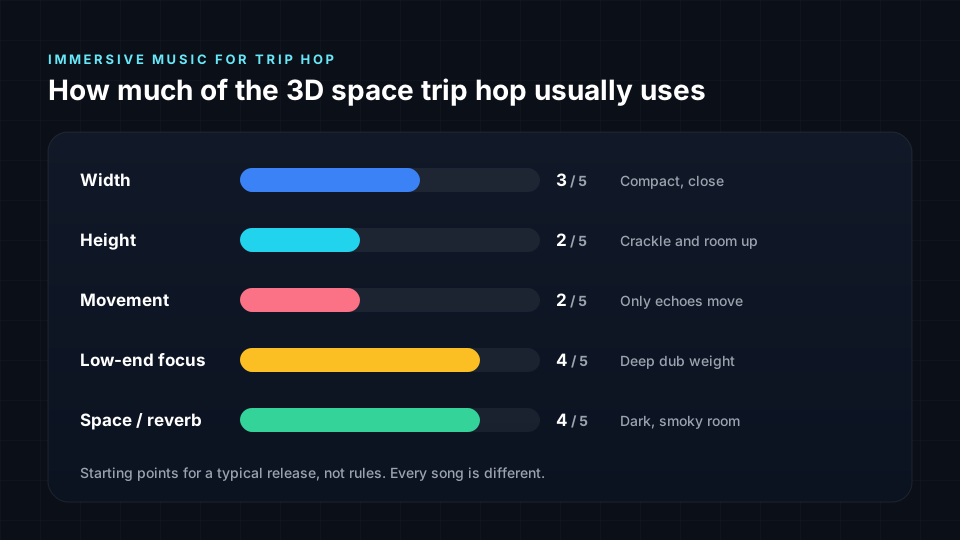
Low-end focus and space are high because trip hop lives on deep dub bass and dark reverb. Width is moderate and height is low on purpose: the genre feels close and enclosed, and spreading every part around the listener would lose that intimacy. Movement stays low too. Only dub echoes and scratches move, slowly or briefly, while the beat and vocal stay fixed in front.
Tips for an immersive trip hop mix
- Keep the beat heavy and still. The drum break and bass should never move or spread.
- Keep the vocal dry and close. Let the echoes carry the space, not the voice itself.
- Use depth more than width. Put the dark room behind the listener instead of stretching everything wide.
- Keep the dust subtle. Vinyl crackle should be felt above and around, never heard as noise in front.
- Move only the effects. Let dub delays and scratches drift or flick, and keep everything else fixed.
Trip Hop styles: bristol sound and abstract hip hop
The core placement holds for both styles: beat and bass centred, effects and room behind. What changes is whether a vocal leads the track and how much of the space belongs to samples and turntables.
Bristol Sound
The Bristol sound is the original form of trip hop, shaped by the city's sound system crews and the scene around Massive Attack, Portishead and Tricky. It leans on dub and reggae bass, soul and jazz samples, cinematic strings and a strong vocal, often sung by a guest. In spatial audio the vocal is the anchor, so keep it close in front and dry. Push the dub bass heavy and centred, place strings and samples at the sides and send the dub echoes deep behind. Keep the room dark and the whole picture fairly compact.
Abstract Hip Hop
Abstract hip hop is the mostly instrumental, sample-based side of trip hop that took shape in the mid 1990s, built from crate-dug breaks, layered samples and turntable cuts. With no vocal in front, the samples take the lead. Spread sampled loops and melodic fragments across the front and sides, and give scratches and cut-up phrases their own moving paths. The break and bass stay centred. Because there is more instrumental detail, this style can use a little more width and movement than vocal trip hop.
How to make immersive trip hop from stereo
Spatial9 can create spatial audio from a stereo track in a few steps:
- Upload your stereo master or your stems.
- Spatial9's AI separates and places each part, locking the drum break and bass, keeping the vocal close and sending dub echoes and crackle behind you.
- Preview it in binaural on headphones.
- Export Eclipsa Audio, ADM, binaural or Ambisonics.
- Publish a video. Create a YouTube-ready video with your immersive audio and publish it directly.
For related guides, read spatial audio for downtempo and spatial audio for hip-hop. Every guide is listed in spatial audio and immersive music by genre.
Frequently asked questions
Does this guide cover bristol sound and abstract hip hop?
Yes. The Bristol sound keeps a close, dry vocal in front with heavy dub bass, side strings and samples, and deep echoes behind. Abstract hip hop has no lead vocal, so sampled loops and scratches lead from the front and sides, with a little more width and movement.
Can I make a trip hop mix in Dolby Atmos or Eclipsa Audio?
Yes. The placements in this guide work for both. Spatial9 exports ADM, the standard file used by Dolby Atmos studios, as well as Eclipsa Audio for YouTube, so one immersive trip hop mix covers both. If you plan to release the Atmos version on Apple Music, build it from your original stems or multitracks, because Apple does not accept Atmos made from a finished stereo master. See where to publish spatial audio. You may also hear this called a 3D trip hop mix or trip hop in spatial audio.
Is spatial audio good for trip hop?
Yes, if it keeps the intimacy. Spatial audio can place a dark, echoing room behind a close vocal and heavy beat, which adds depth without losing the claustrophobic feel that defines trip hop.
How is trip hop different from hip hop in spatial audio?
Hip hop puts the rapper and the punch of the drums first, with a dry, upfront mix. Trip hop is slower and darker, with more dub echo, reverb and texture, so it uses more space behind the listener while keeping the front just as close.
Where should dub echoes go in immersive trip hop?
Behind and slightly above the listener, moving slowly. The vocal or snare stays in front while its echoes sink into the dark room, which creates depth without cluttering the beat.
Can I convert a finished trip hop track to spatial audio?
Yes. Spatial9 uses AI to generate an immersive mix from a stereo master and exports it as Eclipsa Audio, ADM, binaural or Ambisonics.
Does immersive trip hop work on normal headphones?
Yes. The mix is rendered binaurally, so the close vocal, heavy beat and dark room behind you work on any regular headphones.
Dolby and Dolby Atmos are trademarks of Dolby Laboratories. Spatial9 is not affiliated with or endorsed by Dolby Laboratories.
Sources
- Blauert, J. (1997). Spatial Hearing: The Psychophysics of Human Sound Localization, revised edition. MIT Press. Low-frequency, elevation, distance and motion cues.
- Mills, A. W. (1958). On the minimum audible angle. Journal of the Acoustical Society of America, 30(4), 237-246.
- Hebrank, J. and Wright, D. (1974). Spectral cues used in the localization of sound sources on the median plane. Journal of the Acoustical Society of America, 56(6), 1829-1834.
- Bronkhorst, A. W. (2000). The cocktail party phenomenon: a review of research on speech intelligibility in multiple-talker conditions. Acta Acustica united with Acustica, 86, 117-128.
- Litovsky, R. Y., Colburn, H. S., Yost, W. A. and Guzman, S. J. (1999). The precedence effect. Journal of the Acoustical Society of America, 106(4), 1633-1654.
- Barron, M. and Marshall, A. H. (1981). Spatial impression due to early lateral reflections in concert halls. Journal of Sound and Vibration, 77(2), 211-232.
- Neuhoff, J. G. (1998). Perceptual bias for rising tones. Nature, 395, 123-124.
- Bregman, A. S. (1990). Auditory Scene Analysis: The Perceptual Organization of Sound. MIT Press.
Step into the smoke
Upload a trip hop track to Spatial9 and hear your vocal stay close while dub echoes sink into a dark room behind you. Then export it or publish it straight to YouTube.