Spatial Audio & Immersive Music for Vaporwave: Mallsoft, Future Funk & Hardvapour
Spatial9 Team · · 9 min read
Part of the series Spatial audio and immersive music by genre.
Key takeaways
- In a spatial vaporwave mix the soft drum machine and slowed bass stay in the centre, the sample loop and vocal chops sit in front, and sax, keys, pads, hiss and reverb surround the listener.
- Vaporwave reverb works best spread behind and above the listener, because the brain locates a sound by its first arrival, so the loop stays clear in front while its tails fill the room.
- Heavily filtered vaporwave samples lack the high-frequency cues the ear uses for height, so they belong at ear level while brighter pads and reverb tails float overhead.
- The vaporwave immersion profile scores width 4, height 3, movement 2, low-end focus 2 and space 5 out of 5.
Vaporwave grew up online in the early 2010s, spread through Bandcamp, Tumblr and music blogs rather than clubs or radio. Its best-known early release is Floral Shoppe by Macintosh Plus, and Daniel Lopatin's Eccojams experiments are often named as a starting point. The sound is built from recycled media of the 1980s and 1990s: smooth jazz, elevator music, corporate training videos, city pop and soft rock, slowed down, pitched low, looped and chopped. A typical track has a hazy sample loop, a soft drum machine, lazy bass, a lonely saxophone or electric piano, warm pads and plenty of tape hiss and reverb. Vaporwave is less about a groove and more about a mood: nostalgia, emptiness and a strange, glossy calm. That mood lives in the space around the sounds, which is why vaporwave suits spatial audio so well. This guide covers how spatial audio for vaporwave works, where to place each element and how to make an immersive vaporwave mix. For the basics, see what spatial audio is.
Why vaporwave is ideal for spatial audio
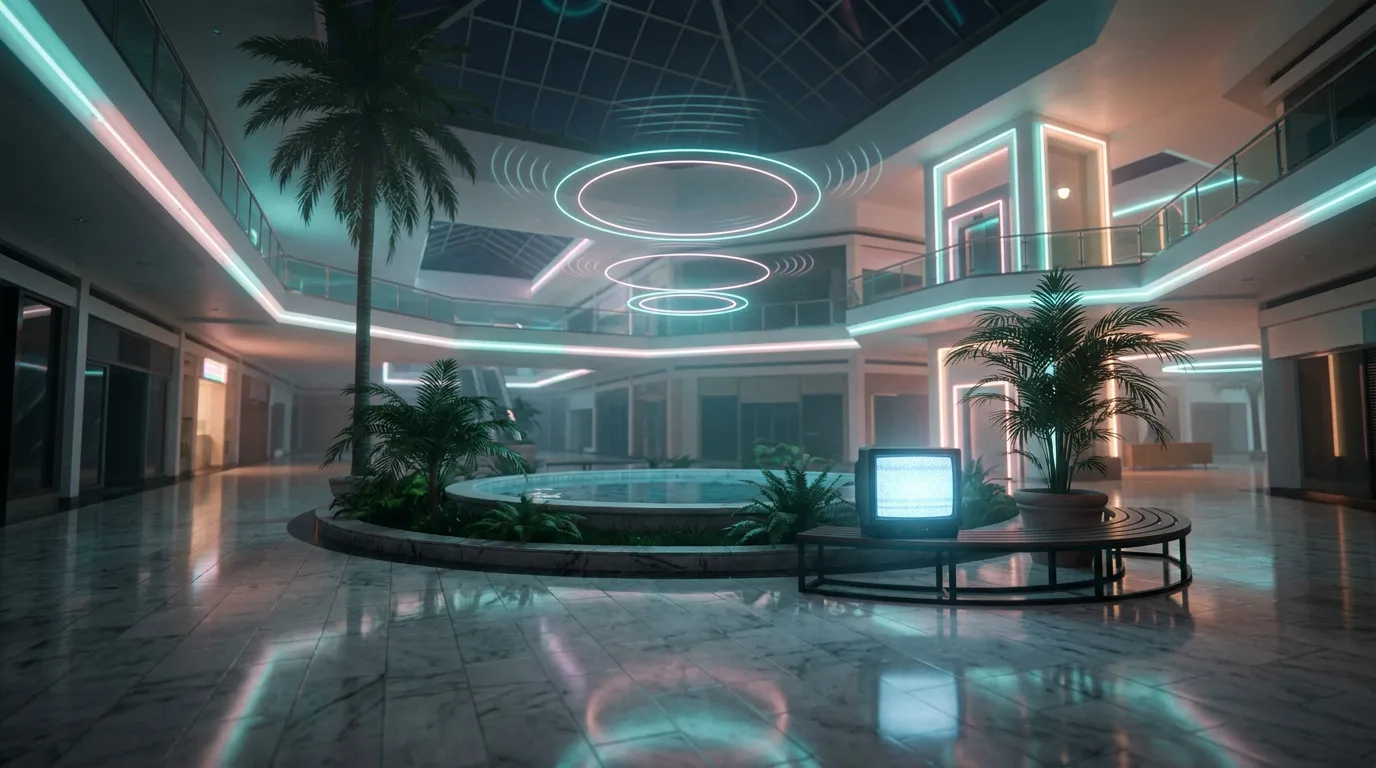
Vaporwave is already a genre about places: malls, hotel lobbies, waiting rooms and old computer screens. In stereo that sense of place is squeezed between two speakers, and the long reverbs blur into the loop. In an immersive mix the reverb can surround the listener and rise above them, while the sample stays clear in front, so the track feels like standing inside a vast, empty building.
The rule: a clear loop in front, an empty mall all around. The beat and bass stay soft and centred, while reverb, hiss and pads drift slowly through a huge space.
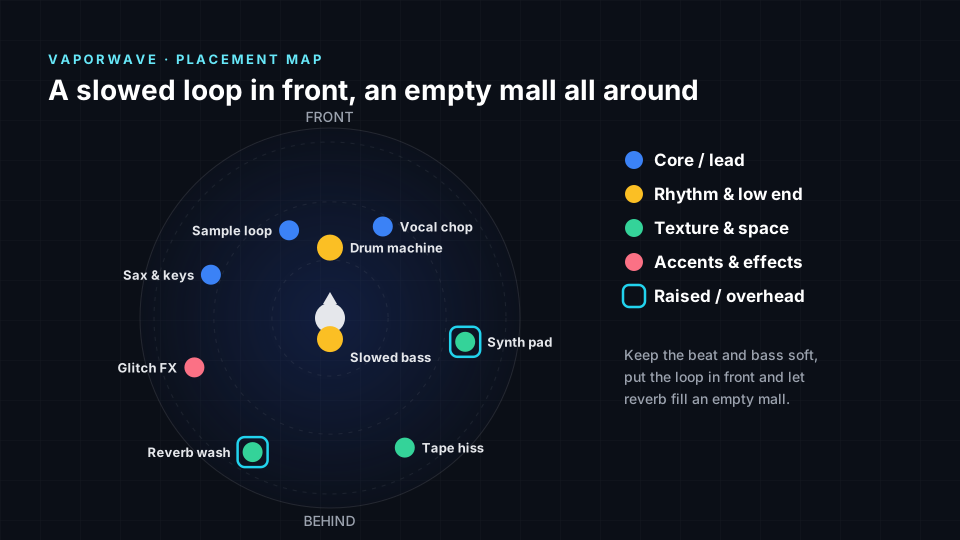
Immersive music for vaporwave: what listeners hear
- A loop that hangs in front of you. The slowed sample stays close and clear.
- An empty building all around. Long reverb tails surround the listener and rise overhead.
- A lonely saxophone off to the side. Smooth sax and electric piano sit wide, like music from another room.
- Tape hiss behind your head. Noise and wobble give a sense of old media playing somewhere in the dark.
Where to place each element in a vaporwave mix
| Element | Position | Height | Why it works |
|---|---|---|---|
| Drum machine | Front centre | Ear level | Soft, steady pulse under the haze |
| Slowed bass | Centre | Ear level | Warm, lazy low end that never wanders |
| Sample loop | Front left | Ear level | The hook, kept clear and close |
| Vocal chop | Front right, moving | Ear level | Pitched fragments that drift and repeat |
| Sax & keys | Left | Ear level | Smooth jazz colour from the side |
| Synth pad | Right | Raised | Glossy warmth floating above |
| Glitch FX | Left, slightly behind, moving | Ear level | Skips and stutters that catch the ear |
| Tape hiss | Behind right | Ear level | Old media texture in the background |
| Reverb wash | Behind left, moving | Raised | The empty mall around the listener |
The psychoacoustics behind vaporwave placement
Every position in the table above follows how the ear and brain locate sound. Here is the reason behind the main choices for vaporwave.
- Drum machine and bass stay centred. The ear finds almost no direction in frequencies below roughly 80 to 100 Hz, so a slowed, pitched-down bass gains nothing from being spread. Keeping it centred and mono keeps the low end stable while everything above it drifts.
- Reverb behind, sample in front. When a sound and its reflections arrive close together, the brain fixes its position by the first arrival. This is the precedence effect. The sample loop stays put in front, while its long reverb can be spread behind and above without pulling the hook out of place.
- A mall that surrounds you. Sound arriving from the sides soon after the direct sound is what makes a space feel wide and enveloping. Sending vaporwave reverb and pads to the sides and rear creates that feeling of standing inside a large, empty building.
- Bright parts go up, muffled parts stay low. The ear judges height mostly from high-frequency spectral cues shaped by the outer ear (Hebrank and Wright). Vaporwave samples are often heavily filtered and dull, so they lose those cues and work best at ear level. Brighter synth pads and reverb tails keep their top end, so they are the parts that can convincingly float overhead.
The immersion profile for vaporwave
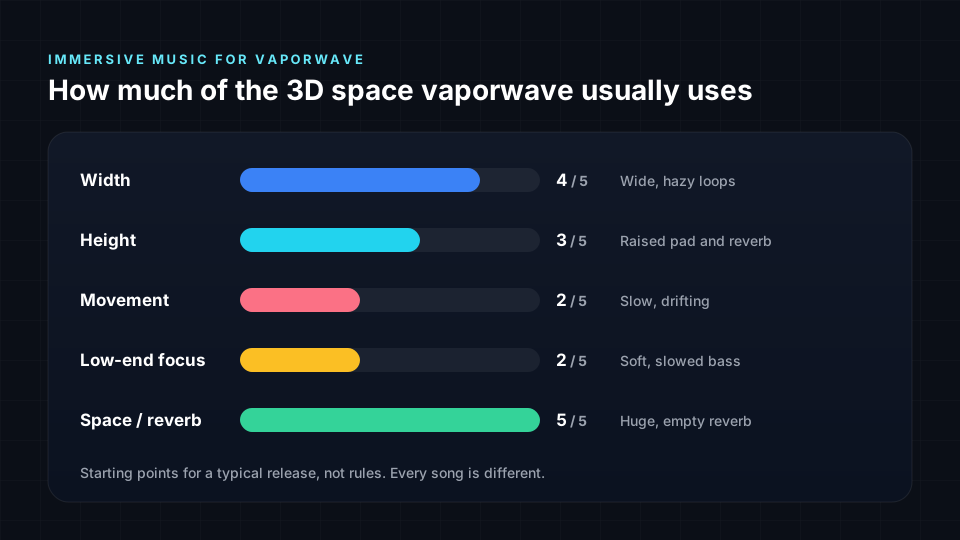
Space is at maximum because reverb and emptiness are the heart of the genre. Width is high, since loops, sax and pads spread far around the listener. Low-end focus is low: vaporwave bass is soft and slowed rather than heavy, so it supports the mood instead of driving it. Movement stays low too, because the genre is hazy and patient, and fast panning would break the dreamlike calm.
Tips for an immersive vaporwave mix
- Keep the loop clear. The sample is the hook, so leave it in front and do not bury it in its own reverb.
- Make the reverb the room. Spread long tails around and above the listener instead of stacking them on the loop.
- Move slowly or not at all. Let reverb and vocal chops drift gently rather than spin around the head.
- Use noise as distance. Tape hiss and wobble placed behind make the past feel far away.
- Leave silence in the space. Emptiness is part of the aesthetic, so do not fill every direction.
Vaporwave styles: mallsoft, future funk and hardvapour
The core placement still applies to every vaporwave style: a soft centred beat and bass, the sample in front and reverb all around. What changes is the tempo, how much rhythm there is and how much space the style needs.
Mallsoft
Mallsoft takes the shopping mall theme literally. It uses muzak, soft pop and ambient samples with very heavy reverb, often mixed with recordings of crowds, footsteps and announcements. In a spatial mix this is the most room-focused style of all. Keep the music loop slightly distant in front, as if from ceiling speakers, and raise it a little. Place crowd murmur and footsteps around the listener at ear level, and let the reverb fill the whole space above and behind.
Future Funk
Future funk is the upbeat, danceable side of vaporwave. It chops disco, funk, boogie and Japanese city pop samples over a four-on-the-floor kick, with heavy sidechain pumping and filter sweeps, close to French house. In a spatial mix it behaves more like a club track. Lock the kick and bass firmly in the centre, keep the chopped vocal hook in front, and spread guitar licks, horn stabs and strings wide on both sides. Filter sweeps can rise overhead into each drop. Use a tighter room so the groove stays punchy.
Hardvapour
Hardvapour is a deliberately aggressive offshoot that swapped the calm, glossy mood for speed, distortion and darkness, borrowing from gabber, hardcore and industrial sounds. In a spatial mix the distorted kick moves to the centre of attention and must stay locked and mono. Harsh samples and shouted chops can sit in front and to the sides, while noise bursts and glitches jump between directions. Keep the reverb shorter than in classic vaporwave, or the distortion will smear into mud.
Closely related styles, such as slushwave and signalwave, follow the same pattern.
How to make immersive vaporwave from stereo
Spatial9 can create spatial audio from a stereo track in a few steps:
- Upload your stereo master or your stems.
- Spatial9's AI separates and places each part, keeping the beat and bass centred, the sample loop in front and the reverb and hiss around you.
- Preview it in binaural on headphones.
- Export Eclipsa Audio, ADM, binaural or Ambisonics.
- Publish a video. Create a YouTube-ready video with your immersive audio and publish it directly.
For related guides, read spatial audio for synthwave and spatial audio for lo-fi. Every guide is listed in spatial audio and immersive music by genre.
Frequently asked questions
Does this guide cover mallsoft, future funk and hardvapour?
Yes. Mallsoft is the most spacious style, with distant loops, crowd sounds and reverb filling a whole building. Future funk acts like a club track, with a locked kick and bass, chopped hooks in front and wide disco samples. Hardvapour keeps a hard, mono kick in the centre with harsh samples and glitches around it and shorter reverb.
Can I make a vaporwave mix in Dolby Atmos or Eclipsa Audio?
Yes. The placements in this guide work for both. Spatial9 exports ADM, the standard file used by Dolby Atmos studios, as well as Eclipsa Audio for YouTube, so one immersive vaporwave mix covers both. If you plan to release the Atmos version on Apple Music, build it from your original stems or multitracks, because Apple does not accept Atmos made from a finished stereo master. See where to publish spatial audio. You may also hear this called a 3D vaporwave mix or vaporwave in spatial audio.
Is spatial audio good for vaporwave?
Yes. Vaporwave is built on mood, nostalgia and empty space, and spatial audio lets the reverb become a real place around the listener while the loop stays clear in front.
How is vaporwave different from synthwave in spatial audio?
Synthwave is driven by punchy drums, bright arpeggios and big leads, so it uses more movement and a stronger low end. Vaporwave is slower and hazier, built on chopped samples, and relies on space and stillness instead of energy.
Where should the sample loop go in immersive vaporwave?
In front, close and at ear level. It is the hook of the track, so it should stay clear while its reverb spreads behind and above the listener.
Can I convert a finished vaporwave track to spatial audio?
Yes. Spatial9 uses AI to generate an immersive mix from a stereo master and exports it as Eclipsa Audio, ADM, binaural or Ambisonics.
Does immersive vaporwave work on normal headphones?
Yes. The mix is rendered binaurally, so the empty-mall reverb and drifting loops work on any regular headphones.
Dolby and Dolby Atmos are trademarks of Dolby Laboratories. Spatial9 is not affiliated with or endorsed by Dolby Laboratories.
Sources
- Blauert, J. (1997). Spatial Hearing: The Psychophysics of Human Sound Localization, revised edition. MIT Press. Low-frequency, elevation, distance and motion cues.
- Mills, A. W. (1958). On the minimum audible angle. Journal of the Acoustical Society of America, 30(4), 237-246.
- Hebrank, J. and Wright, D. (1974). Spectral cues used in the localization of sound sources on the median plane. Journal of the Acoustical Society of America, 56(6), 1829-1834.
- Bronkhorst, A. W. (2000). The cocktail party phenomenon: a review of research on speech intelligibility in multiple-talker conditions. Acta Acustica united with Acustica, 86, 117-128.
- Litovsky, R. Y., Colburn, H. S., Yost, W. A. and Guzman, S. J. (1999). The precedence effect. Journal of the Acoustical Society of America, 106(4), 1633-1654.
- Barron, M. and Marshall, A. H. (1981). Spatial impression due to early lateral reflections in concert halls. Journal of Sound and Vibration, 77(2), 211-232.
- Neuhoff, J. G. (1998). Perceptual bias for rising tones. Nature, 395, 123-124.
- Bregman, A. S. (1990). Auditory Scene Analysis: The Perceptual Organization of Sound. MIT Press.
Step inside the empty mall
Upload a track to Spatial9 and hear your slowed loops float through a vast, hazy space in minutes. Then export it or publish it straight to YouTube.