Spatial Audio & Immersive Music for Disco: Complete Guide
Spatial9 Team · · Updated
Part of the series Spatial audio and immersive music by genre.
Disco records were some of the most lavishly arranged pop music ever made: full string sections, horn stabs, multiple percussionists and a rhythm section locked into a perfect groove. In stereo, all of that is squeezed into two speakers. In spatial audio, each section gets its own place, like the musicians standing around you in the club. This guide covers how spatial audio for disco works, where to place each element and how to make an immersive disco mix. For the basics, see what spatial audio is.
Why disco shines in spatial audio
Disco is orchestral dance music. Its arrangements were written in sections, with strings answering horns and guitar locking with the hi-hat. Those sections map naturally onto a 3D space, so the music feels bigger without changing a single note.
The rule: keep the groove tight and in front. Drums, bass and vocal stay close and centred so the track still makes people dance.
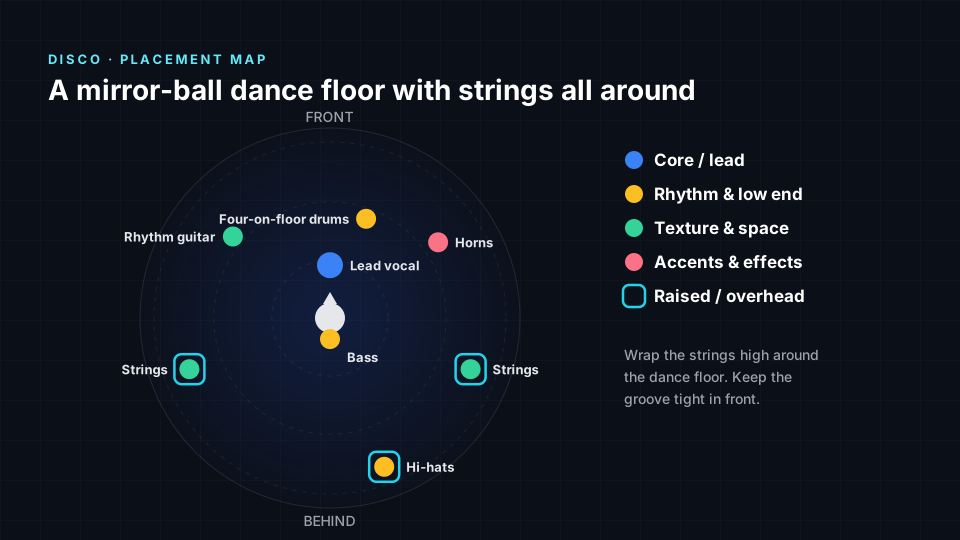
Immersive music for disco: what listeners hear
- A groove you can lean on. Kick, bass and hats stay locked and punchy.
- Strings all around. Sweeping string lines rise up on both sides.
- Horns that answer. Brass stabs jump in from the front right.
- A shimmering room. Hi-hats and reverb sparkle above like a mirror ball.
Where to place each element in a disco mix
| Element | Position | Height | Why it works |
|---|---|---|---|
| Lead vocal | Front centre | Ear level | The star of the record |
| Four-on-the-floor drums | Front | Ear level | Drives the dance floor |
| Bass | Centre | Ear level | Locks with the kick |
| Rhythm guitar | Front left | Ear level | The classic chicken-scratch groove |
| Horns | Front right | Ear level | Stabs answer the guitar |
| Strings | Left and right | Raised | Lush, sweeping scale |
| Hi-hats | Behind | Raised | Sparkle and air |
The psychoacoustics behind disco placement
Every position in the table above follows how the ear and brain locate sound. Here is the reason behind the main choices for disco.
- Four-on-the-floor drums and bass centred. Deep bass is the hardest sound for the ear to locate. Its wavelengths are several metres long, far larger than your head, so both ears receive almost the same level and only a tiny timing difference. The dance pulse stays rock solid, as it did on club systems.
- Rhythm guitar left, horns right. Sounds that overlap in pitch mask each other less when they arrive from different directions, so spreading them keeps every part clear without extra EQ. Choppy guitar and horn stabs live in the same range, so splitting them keeps both funky.
- Strings left and right, raised. Sound arriving from the sides, slightly different at each ear, creates the feeling of being inside the music. Acousticians call this envelopment. Disco strings were recorded big and lush, and side placement turns them into a wrap-around sweep.
- Hi-hats behind and raised. Height is heard mainly through treble: the folds of the outer ear colour frequencies above roughly 4 kHz differently for each elevation, so airy, bright parts are the ones that truly sound overhead. The open hat is pure treble, so it sits convincingly up and around you.
The immersion profile for disco
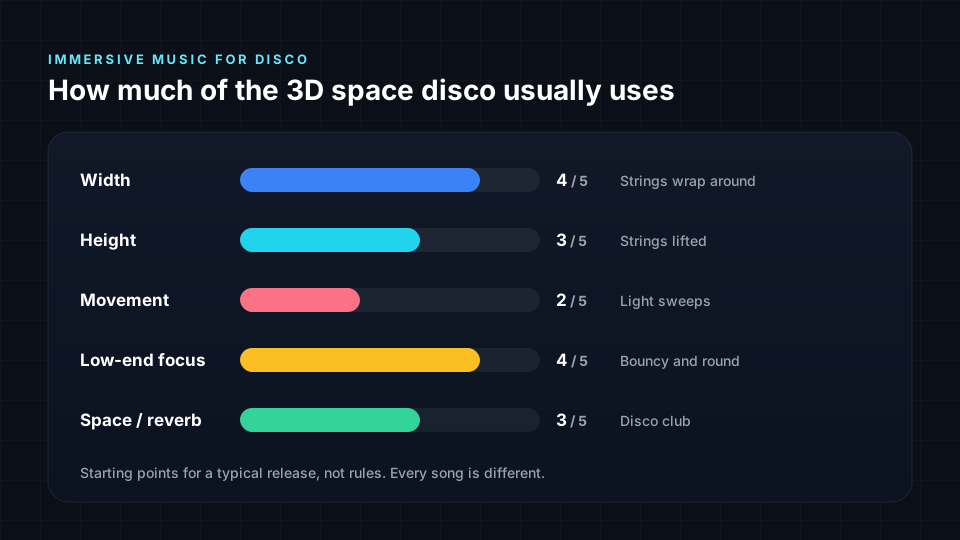
Disco scores high for width and low end. Movement stays low because the arrangement already provides motion: the music swings, so the sounds do not need to fly around.
Tips for an immersive disco mix
- Treat it like a live band. Fixed positions for each section sound natural and classic.
- Raise the strings. Height makes string sweeps feel cinematic.
- Keep the guitar and hats tight. Their timing is the groove, so do not wash them in reverb.
- Let the horns punch. Short stabs from one side add excitement.
- Save the widest moment for the break. Open the strings fully when the band drops out.
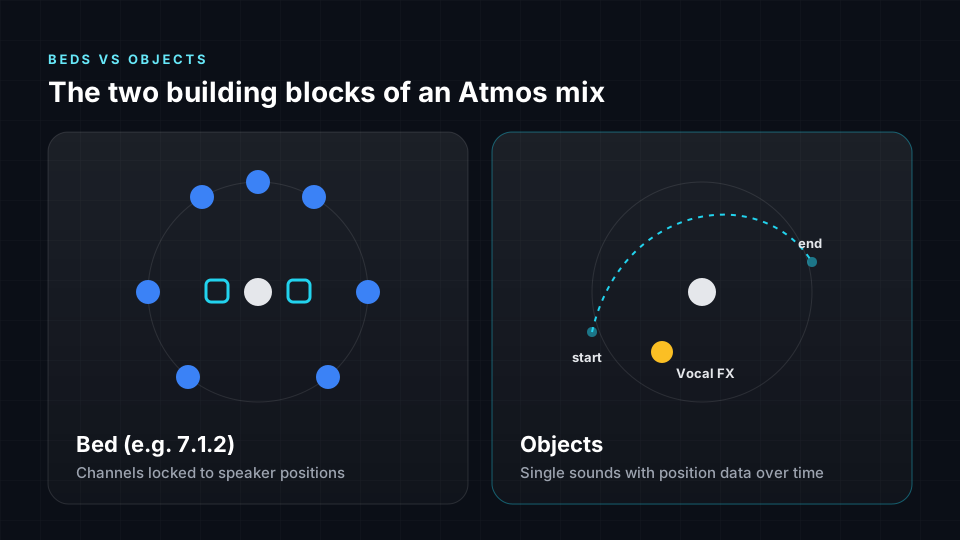
How to make immersive disco from stereo
Spatial9 can create spatial audio from a stereo track in a few steps:
- Upload your stereo master or your stems.
- Spatial9's AI separates and places each part, from strings to horns.
- Preview it in binaural on headphones.
- Export Eclipsa Audio, ADM, binaural or Ambisonics.
- Publish a video. Create a YouTube-ready video with your immersive audio and publish it directly.
For related guides, read spatial audio for funk and spatial audio for house. Every guide is listed in spatial audio and immersive music by genre.
Frequently asked questions
Can I make a disco mix in Dolby Atmos or Eclipsa Audio?
Yes. The placements in this guide work for both. Spatial9 exports ADM, the standard file used by Dolby Atmos studios, as well as Eclipsa Audio for YouTube, so one immersive disco mix covers both. You may also hear this called a 3D disco mix or disco in spatial audio.
Is spatial audio good for disco?
Yes. Disco is arranged in sections, and spreading strings, horns and guitar around the listener makes it feel like a live orchestra on the dance floor.
Where should strings go in an immersive disco mix?
Wide and raised on both sides of the listener. That gives the classic string sweeps height and scale.
Can I remix an old disco record in spatial audio?
Yes. Spatial9 can separate a stereo master into its parts and place them in 3D, even when the original multitracks are lost.
Should disco sounds move around?
Mostly no. Fixed positions keep the band feel. A gentle swirl on a string sweep or filter effect is enough.
Does immersive disco work on normal headphones?
Yes. The mix is rendered binaurally, so the 3D effect works on any regular headphones.
Dolby and Dolby Atmos are trademarks of Dolby Laboratories. Spatial9 is not affiliated with or endorsed by Dolby Laboratories.
Sources
- Blauert, J. (1997). Spatial Hearing: The Psychophysics of Human Sound Localization, revised edition. MIT Press. Low-frequency, elevation, distance and motion cues.
- Mills, A. W. (1958). On the minimum audible angle. Journal of the Acoustical Society of America, 30(4), 237-246.
- Hebrank, J. and Wright, D. (1974). Spectral cues used in the localization of sound sources on the median plane. Journal of the Acoustical Society of America, 56(6), 1829-1834.
- Bronkhorst, A. W. (2000). The cocktail party phenomenon: a review of research on speech intelligibility in multiple-talker conditions. Acta Acustica united with Acustica, 86, 117-128.
- Litovsky, R. Y., Colburn, H. S., Yost, W. A. and Guzman, S. J. (1999). The precedence effect. Journal of the Acoustical Society of America, 106(4), 1633-1654.
- Barron, M. and Marshall, A. H. (1981). Spatial impression due to early lateral reflections in concert halls. Journal of Sound and Vibration, 77(2), 211-232.
- Neuhoff, J. G. (1998). Perceptual bias for rising tones. Nature, 395, 123-124.
- Bregman, A. S. (1990). Auditory Scene Analysis: The Perceptual Organization of Sound. MIT Press.
Put your listeners under the mirror ball
Upload a track to Spatial9 and hear your strings and horns surround the dance floor in minutes. Then export it or publish it straight to YouTube.