Spatial Audio & Immersive Music for Dub Techno: Complete Guide
Spatial9 Team · · 8 min read
Part of the series Spatial audio and immersive music by genre.
Key takeaways
- In a spatial dub techno mix the kick and sub bass stay centred and the dry chord stab sits just in front, while stab echoes, delay tails, reverb, hats, rim shots and hiss spread around and above the listener.
- Dub techno echoes can drift away from the chord without pulling it along, because the brain fixes a sound's position by its first arrival, which is known as the precedence effect.
- Reverb arriving from the sides and above makes a space feel enveloping, which is why the dub techno reverb wash should surround the listener rather than sit in front.
- The dub techno immersion profile scores width 5, height 4, movement 3, low-end focus 4 and space 5 out of 5.
Dub techno took shape in Berlin in the early 1990s, when the duo behind the Basic Channel label began releasing records from 1993 that joined the pulse of Detroit techno to the studio methods of Jamaican dub. Dub producers of the 1970s had treated the mixing desk as an instrument, throwing parts into tape echo and spring reverb and pulling them back out again. Dub techno applies that idea to a four to the floor groove. The sound is calm and hypnotic: a soft, round kick, a deep sub bass, quiet hats and rim shots, and a single minor chord stab that is filtered, delayed and reverbed until it becomes a cloud. Hiss and crackle often sit underneath. Because the echo is the music, dub techno is one of the most natural genres for spatial audio. This guide covers how spatial audio for dub techno works, where to place each element and how to make an immersive dub techno mix. For the basics, see what spatial audio is.
Why dub techno is made for spatial audio
In stereo, every dub techno echo has to fit between two speakers, so the delays pile up and the chord can sound muddy. In an immersive mix the original stab can stay in one place while each repeat moves further away, to the side, behind and above. The listener hears the echo travel through a room, which is exactly what the genre has always tried to suggest.
The rule: a still pulse, a moving echo. The kick, sub and dry stab stay put, and only the delays and reverb move and spread.
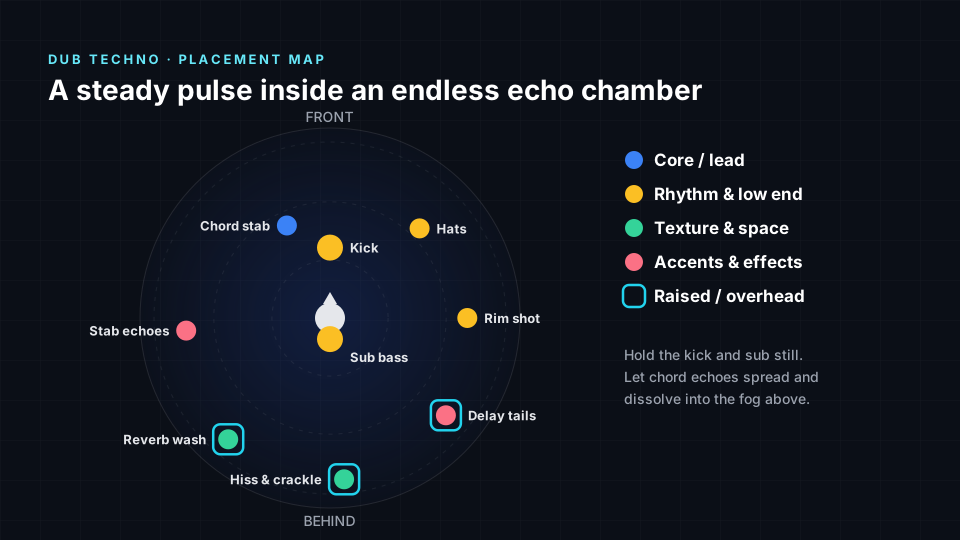
Immersive music for dub techno: what listeners hear
- A chord that turns into a room. The stab sounds in front, then its echoes spread out around you.
- A pulse that never moves. Kick and sub stay soft, centred and steady.
- Echoes that drift away. Delay tails slide slowly behind and above the listener.
- A fog of hiss and reverb. Texture and space hang overhead like haze.
Where to place each element in a dub techno mix
| Element | Position | Height | Why it works |
|---|---|---|---|
| Kick | Front centre | Ear level | Soft, hypnotic pulse |
| Sub bass | Centre | Ear level | Warm, steady foundation |
| Chord stab | Front left | Ear level | The dry source of every echo |
| Hats | Front right | Ear level | Light, steady timekeeping |
| Rim shot | Right | Ear level | Sparse, dry accent |
| Stab echoes | Left, moving | Ear level | Repeats that slide away from the stab |
| Delay tails | Behind right, moving | Raised | Echoes fading into the distance |
| Reverb wash | Behind left | Raised | The dub chamber around you |
| Hiss & crackle | Behind | Raised | Analogue haze above the groove |
The psychoacoustics behind dub techno placement
Every position in the table above follows how the ear and brain locate sound. Here is the reason behind the main choices for dub techno.
- Kick and sub stay centred. The ear finds almost no direction in frequencies below roughly 80 to 100 Hz, so the warm dub techno sub gains nothing from being spread. A centred, mono sub stays round and even, which keeps a long, slow track grounded however far the echoes travel.
- The stab stays put while its echoes move. When a sound and its delayed copies arrive close together, the brain fixes the position by the first arrival. This is the precedence effect. The dry stab anchors itself in front, so its repeats can drift to the sides and behind without pulling the chord out of place.
- Reverb from the sides and above. Reflections that arrive from the sides soon after the direct sound make a space feel wide and enveloping, as Barron and Marshall found in concert halls. Surrounding the listener with the dub techno reverb wash creates that sense of being inside the echo chamber.
- Height for hiss and tails. The outer ear shapes high frequencies differently depending on elevation, which is how we hear height, as Hebrank and Wright showed. Bright hiss and the top of the delay tails carry those cues well, so they can float convincingly above the groove.
The immersion profile for dub techno
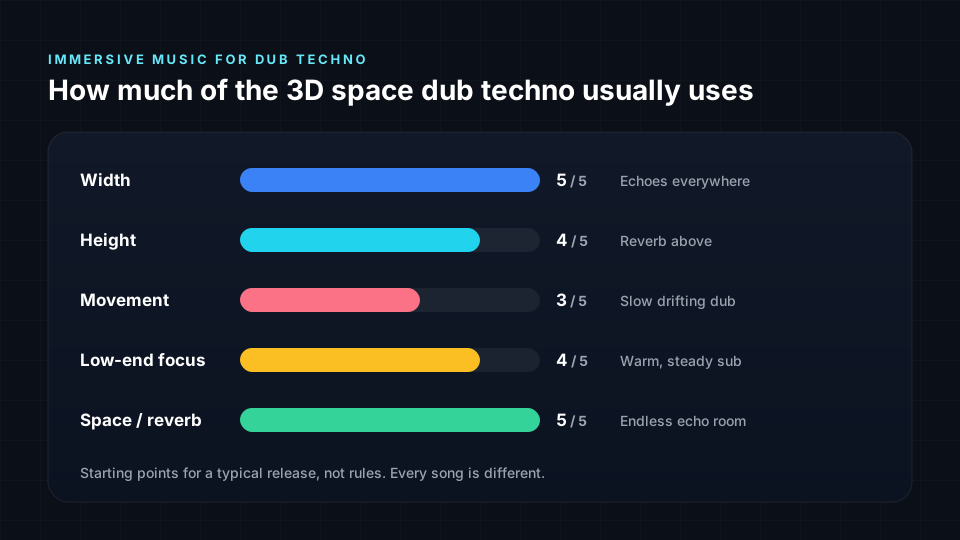
Width and space are at maximum because echoes and reverb are the heart of dub techno and can fill the whole room. Height is high, with tails and hiss floating above. Movement stays moderate because the motion comes from slowly drifting echoes, not from fast pans. Low-end focus is strong but not extreme, since the dub techno sub is soft and round rather than pounding.
Tips for an immersive dub techno mix
- Keep the source dry and still. Let the chord stab stay in one place so its echoes have something to move away from.
- Spread each repeat further out. Place later delays wider, further back and higher than earlier ones.
- Move slowly. Dub techno is patient, so any echo movement should take bars, not beats.
- Keep the sub mono and warm. The low end must feel the same from every direction.
- Lift the haze. Put hiss, crackle and the top of the reverb above the listener rather than in front.
How to make immersive dub techno from stereo
Spatial9 can create spatial audio from a stereo track in a few steps:
- Upload your stereo master or your stems.
- Spatial9's AI separates and places each part, keeping the kick and sub centred and spreading chord echoes, reverb and hiss around and above you.
- Preview it in binaural on headphones.
- Export Eclipsa Audio, ADM, binaural or Ambisonics.
- Publish a video. Create a YouTube-ready video with your immersive audio and publish it directly.
For related guides, read spatial audio for minimal techno and spatial audio for hypnotic techno. Every guide is listed in spatial audio and immersive music by genre.
Frequently asked questions
Can I make a dub techno mix in Dolby Atmos or Eclipsa Audio?
Yes. The placements in this guide work for both. Spatial9 exports ADM, the standard file used by Dolby Atmos studios, as well as Eclipsa Audio for YouTube, so one immersive dub techno mix covers both. If you plan to release the Atmos version on Apple Music, build it from your original stems or multitracks, because Apple does not accept Atmos made from a finished stereo master. See where to publish spatial audio. You may also hear this called a 3D dub techno mix or dub techno in spatial audio.
Is spatial audio good for dub techno?
Yes. Dub techno is built on echo and space, and spatial audio lets those echoes travel around and above the listener instead of stacking up between two speakers.
How is dub techno different from minimal techno in spatial audio?
Dub techno leans on long delays, reverb and a single chord stab, so the mix is wide, deep and full of space. Minimal techno is drier and more percussive, so its immersion comes from small, precise clicks and hits placed around the listener rather than from echoes.
Where should the chord echoes go in immersive dub techno?
Start with the dry stab just in front, then let each repeat move further away, out to the side, behind and finally above. Later, darker repeats can sit higher and further back so the chord seems to dissolve into the room.
Should the hiss and crackle be spread in a 3D dub techno mix?
Yes, gently. Raised and slightly behind, hiss and crackle feel like the air of the room. Keep them quiet so they add texture without masking the hats.
Can I convert a finished dub techno track to spatial audio?
Yes. Spatial9 uses AI to generate an immersive mix from a stereo master and exports it as Eclipsa Audio, ADM, binaural or Ambisonics.
Does immersive dub techno work on normal headphones?
Yes. The mix is rendered binaurally, so the drifting echoes and the warm, centred sub work on any regular headphones.
Dolby and Dolby Atmos are trademarks of Dolby Laboratories. Spatial9 is not affiliated with or endorsed by Dolby Laboratories.
Sources
- Blauert, J. (1997). Spatial Hearing: The Psychophysics of Human Sound Localization, revised edition. MIT Press. Low-frequency, elevation, distance and motion cues.
- Mills, A. W. (1958). On the minimum audible angle. Journal of the Acoustical Society of America, 30(4), 237-246.
- Hebrank, J. and Wright, D. (1974). Spectral cues used in the localization of sound sources on the median plane. Journal of the Acoustical Society of America, 56(6), 1829-1834.
- Bronkhorst, A. W. (2000). The cocktail party phenomenon: a review of research on speech intelligibility in multiple-talker conditions. Acta Acustica united with Acustica, 86, 117-128.
- Litovsky, R. Y., Colburn, H. S., Yost, W. A. and Guzman, S. J. (1999). The precedence effect. Journal of the Acoustical Society of America, 106(4), 1633-1654.
- Barron, M. and Marshall, A. H. (1981). Spatial impression due to early lateral reflections in concert halls. Journal of Sound and Vibration, 77(2), 211-232.
- Neuhoff, J. G. (1998). Perceptual bias for rising tones. Nature, 395, 123-124.
- Bregman, A. S. (1990). Auditory Scene Analysis: The Perceptual Organization of Sound. MIT Press.
Step inside the echo chamber
Upload a track to Spatial9 and hear your chord echoes drift around a steady, centred pulse in minutes. Then export it or publish it straight to YouTube.