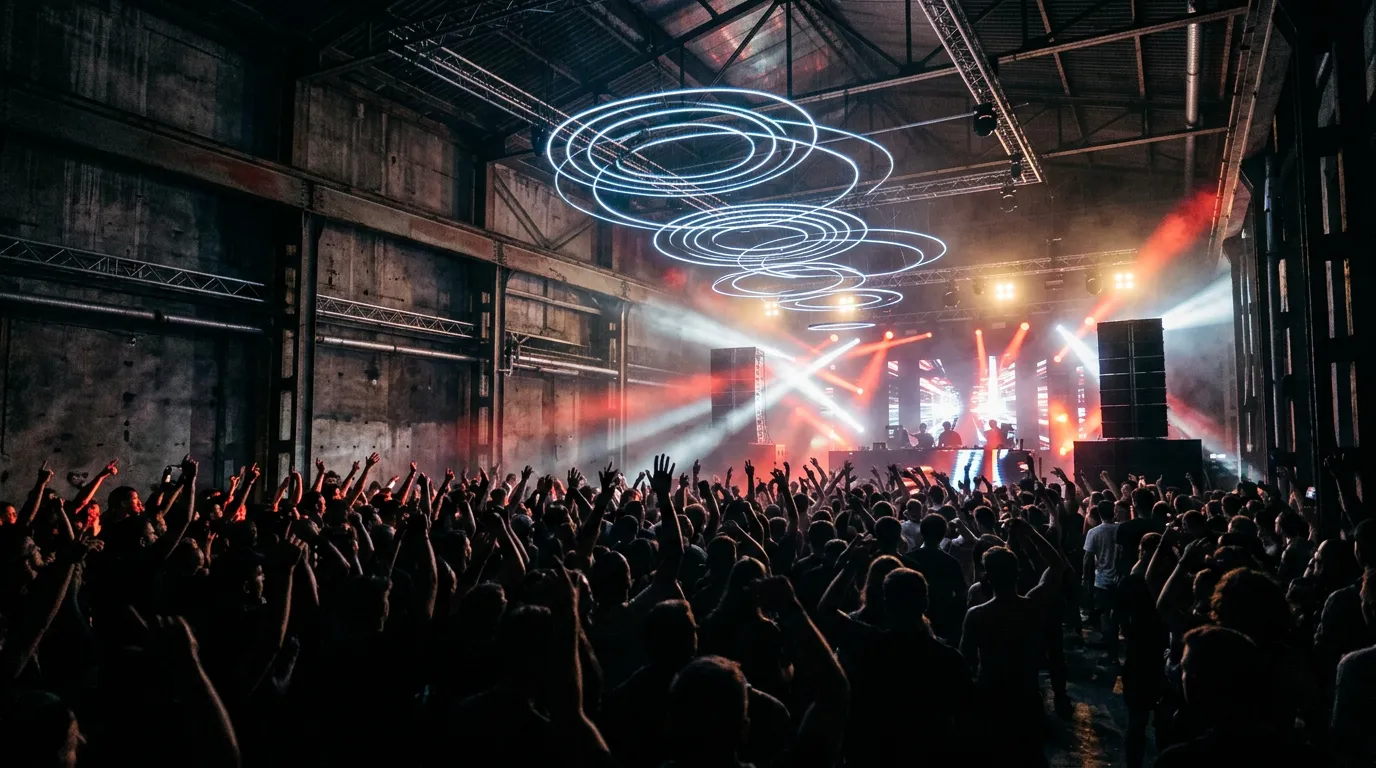
Spatial Audio & Immersive Music for Hard Techno: Schranz, Neo Rave & Industrial Techno
Spatial9 Team · · 9 min read
Part of the series Spatial audio and immersive music by genre.
Key takeaways
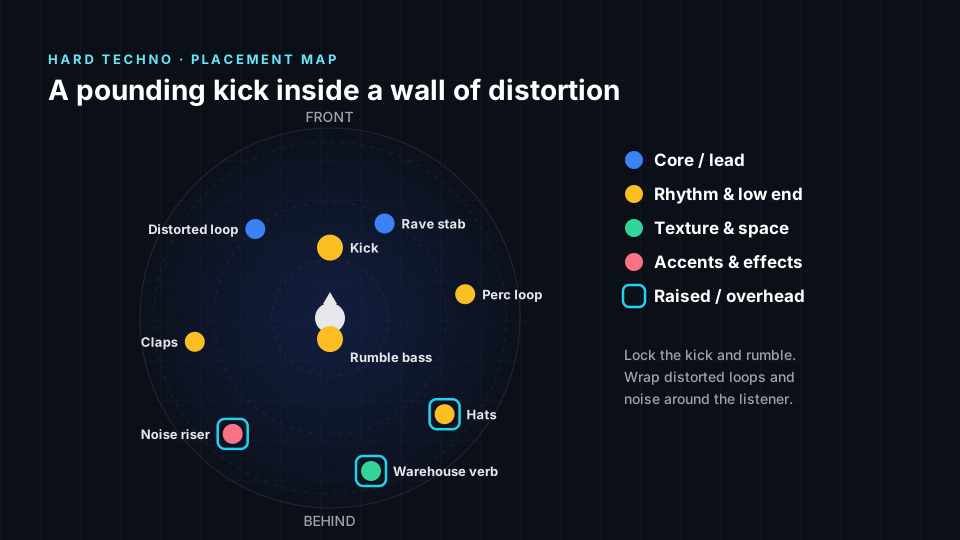
- In a spatial hard techno mix the kick and rumble bass stay locked in the centre, while distorted loops, rave stabs, claps, percussion, hats, noise risers and a short warehouse reverb surround the listener.
- Distorted loops and claps work best on opposite sides in hard techno, because sounds that share a frequency range mask each other less when they arrive from different directions.
- Hard techno needs a short, tight reverb in 3D, because long tails blur a fast kick, so the immersion comes from width and moving loops rather than from a large room.
- The hard techno immersion profile scores width 4, height 3, movement 4, low-end focus 5 and space 2 out of 5.
Hard techno grew out of the 1990s techno scenes in Germany, the UK and the Netherlands, when producers pushed the Detroit and Berlin sound faster, harder and more distorted. Germany gave it schranz, Birmingham gave it a raw, industrial edge, and since the late 2010s a new wave of producers has brought it back to large stages with faster tempos and rave melodies. The sound is relentless: a heavily driven kick, often between about 140 and 160 BPM, a rumbling low end built from reverb and distortion, looped and saturated percussion, short rave stabs and bursts of noise. Because so much of the track is distortion and density, the stereo version can feel like a single wall. Space is what lets the parts breathe and hit separately. This guide covers how spatial audio for hard techno works, where to place each element and how to make an immersive hard techno mix. For the basics, see what spatial audio is.
Why hard techno needs a careful 3D mix
Hard techno is dense on purpose. Distorted loops, claps, percussion and noise all crowd the same upper mids, and in stereo they fight for two speakers. An immersive mix gives each layer its own direction, so the track stays loud and aggressive while every loop stays readable. The danger is the opposite: spread the kick or the rumble and the whole track loses its punch.
The rule: a locked core, a loud room around it. Kick and rumble never move, while loops and noise surround the listener and do the moving.
Immersive music for hard techno: what listeners hear
- A kick that hits you in the chest. The kick and rumble stay centred, mono and heavy.
- Loops that circle the room. Distorted percussion shifts around the front and sides.
- Noise that rises overhead. Risers and sweeps climb behind and above before each drop.
- A loud room, not a big hall. The reverb stays short and tight, like a packed warehouse.
Where to place each element in a hard techno mix
| Element | Position | Height | Why it works |
|---|---|---|---|
| Kick | Front centre | Ear level | The pounding core of the track |
| Rumble bass | Centre | Ear level | Heavy and steady on every system |
| Rave stab | Front right | Ear level | Melody that cuts through the noise |
| Distorted loop | Front left, moving | Ear level | The driving hook, slowly shifting |
| Perc loop | Right, moving | Ear level | Restless, rolling energy |
| Claps | Left | Ear level | Sharp backbeat away from the loop |
| Hats | Behind right | Raised | Fast top end above the crowd |
| Noise riser | Behind left, moving | Raised | Tension that climbs overhead |
| Warehouse verb | Behind | Raised | A tight, loud room |
The psychoacoustics behind hard techno placement
Every position in the table above follows how the ear and brain locate sound. Here is the reason behind the main choices for hard techno.
- Kick and rumble stay centred. The ear finds almost no direction in frequencies below roughly 80 to 100 Hz, so the hard techno rumble gains nothing from being spread. Keeping it centred and mono keeps it punchy on club systems and headphones alike, and stops the low end from smearing at high tempos.
- Distorted loop and claps on opposite sides. Two sounds that share a frequency range mask each other far less when they arrive from different directions. This is spatial release from masking. Saturated loops and claps both live in the upper mids, so splitting them keeps both audible without turning the track down.
- Rising noise placed above. Listeners tend to hear a rising pitch as something rising or coming closer, a bias Neuhoff described for rising tones. A noise riser that sweeps up in pitch and also climbs overhead matches that instinct and makes the build feel bigger.
- Separate streams in a dense groove. The brain groups sounds into streams by pitch, timbre and direction, as Bregman showed in his work on auditory scene analysis. Giving each loop its own place lets the listener follow three or four layers at once instead of one noisy block.
The immersion profile for hard techno
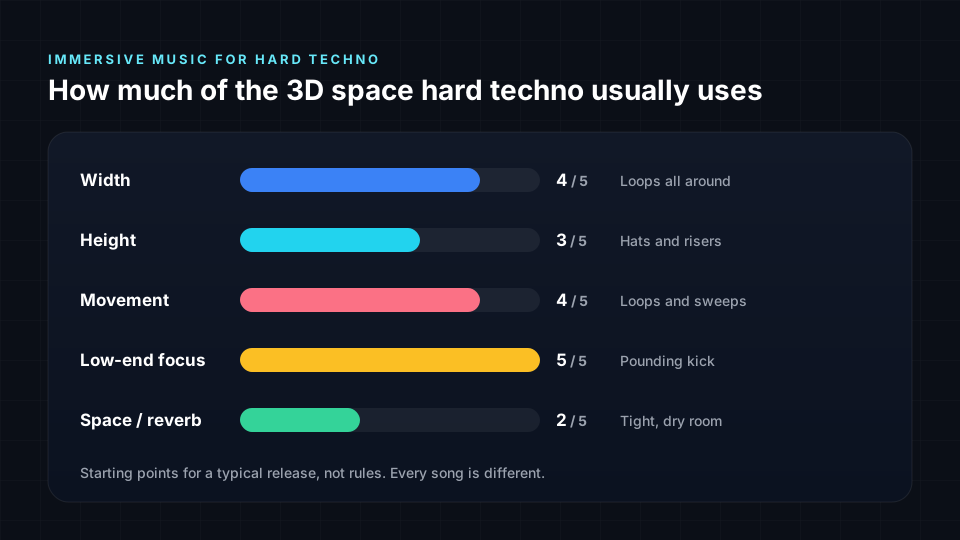
Low-end focus is at maximum because the kick and rumble carry the whole track. Movement and width are high because loops and noise are spread and shifted around the listener. Space is low on purpose: long reverbs blur fast kicks, so hard techno works best in a tight, loud room rather than a cathedral.
Tips for an immersive hard techno mix
- Keep the kick and rumble mono. Any spread in the low end weakens the punch.
- Split the loops. Put competing distorted layers in different directions instead of cutting them.
- Move the loops, not the kick. Slow movement in the percussion keeps the energy without blurring the groove.
- Use height for builds. Send risers and noise sweeps upward before the drop.
- Keep the reverb short. A tight room keeps a fast kick clean and hard.
Hard Techno styles: schranz, neo rave and industrial techno
The core placement still applies to every hard techno style: kick and rumble locked in the centre, loops around the listener, noise overhead. What changes is how dense the loops are, how much melody there is and how much room the track needs.
Schranz
Schranz is the German style of hard techno from the late 1990s and 2000s, built on fast, heavily compressed and filtered percussion loops with little or no melody. In a spatial mix, the loops are the whole story. Spread two or three of them around the front and sides, and let the filter movement become physical movement, sweeping a loop slowly from front left to the side as the filter opens. Keep the kick very centred and dry, because schranz is fast and the loops are already dense. Height can stay modest, with hats and the odd noise burst above.
Neo Rave
Neo rave describes the newer, faster wave of hard techno that borrows from 1990s rave, trance and hardcore: big detuned stabs, rave chords, short vocal hooks and euphoric breakdowns at around 150 BPM and above. Here the melody earns more space. Place the rave stab or lead in front and slightly raised so it rises above the loops, and let pads and chords open wide in the breakdown. Vocal hooks belong near the front centre. Keep the kick and rumble locked, and save the biggest overhead movement for the build before the drop.
Industrial Techno
Industrial techno takes the raw, metallic side of the genre, with roots in the Birmingham sound of the 1990s and a strong revival in Berlin and beyond in the 2010s. It uses clanging metal hits, noise, harsh textures and a darker, often slower groove. In a spatial mix it can take more space than other hard techno styles. Scatter metallic hits around the sides and behind, place noise layers raised, and use a slightly longer, darker reverb so the track feels like a concrete hall. The kick and rumble still stay centred.
Closely related styles such as hard groove and hardstyle-tinged hard techno follow the same pattern, with a locked low end and more swing or more melody on top.
How to make immersive hard techno from stereo
Spatial9 can create spatial audio from a stereo track in a few steps:
- Upload your stereo master or your stems.
- Spatial9's AI separates and places each part, locking the kick and rumble and sending distorted loops and noise around you.
- Preview it in binaural on headphones.
- Export Eclipsa Audio, ADM, binaural or Ambisonics.
- Publish a video. Create a YouTube-ready video with your immersive audio and publish it directly.
For related guides, read spatial audio for hardgroove and spatial audio for techno. Every guide is listed in spatial audio and immersive music by genre.
Frequently asked questions
Does this guide cover schranz, neo rave and industrial techno?
Yes. Schranz centres on fast, filtered percussion loops spread around the listener. Neo rave adds rave stabs, chords and vocal hooks that sit in front and rise above the loops. Industrial techno scatters metallic hits and noise around a darker, slightly larger room. All three keep the kick and rumble locked in the centre.
Can I make a hard techno mix in Dolby Atmos or Eclipsa Audio?
Yes. The placements in this guide work for both. Spatial9 exports ADM, the standard file used by Dolby Atmos studios, as well as Eclipsa Audio for YouTube, so one immersive hard techno mix covers both. If you plan to release the Atmos version on Apple Music, build it from your original stems or multitracks, because Apple does not accept Atmos made from a finished stereo master. See where to publish spatial audio. You may also hear this called a 3D hard techno mix or hard techno in spatial audio.
Is spatial audio good for hard techno?
Yes, if the low end stays centred. Hard techno is dense, and spatial audio separates the distorted loops so the track sounds louder and clearer at the same time, while the kick keeps all of its punch.
How is hard techno different from techno in spatial audio?
Hard techno is faster, denser and more distorted, so it needs a shorter reverb and more separation between loops. Classic techno leaves more room for long delays, deep atmosphere and height, while hard techno keeps the room tight and puts the energy into width and movement.
Where should the rumble go in immersive hard techno?
In the centre, mono, with the kick. The rumble is low enough that the ear cannot locate it, and spreading it only weakens the punch. Any reverb tails above the rumble can sit behind and slightly raised.
Can I convert a finished hard techno track to spatial audio?
Yes. Spatial9 uses AI to generate an immersive mix from a stereo master and exports it as Eclipsa Audio, ADM, binaural or Ambisonics.
Does immersive hard techno work on normal headphones?
Yes. The mix is rendered binaurally, so the surrounding loops and the centred kick work on any regular headphones.
Dolby and Dolby Atmos are trademarks of Dolby Laboratories. Spatial9 is not affiliated with or endorsed by Dolby Laboratories.
Sources
- Blauert, J. (1997). Spatial Hearing: The Psychophysics of Human Sound Localization, revised edition. MIT Press. Low-frequency, elevation, distance and motion cues.
- Mills, A. W. (1958). On the minimum audible angle. Journal of the Acoustical Society of America, 30(4), 237-246.
- Hebrank, J. and Wright, D. (1974). Spectral cues used in the localization of sound sources on the median plane. Journal of the Acoustical Society of America, 56(6), 1829-1834.
- Bronkhorst, A. W. (2000). The cocktail party phenomenon: a review of research on speech intelligibility in multiple-talker conditions. Acta Acustica united with Acustica, 86, 117-128.
- Litovsky, R. Y., Colburn, H. S., Yost, W. A. and Guzman, S. J. (1999). The precedence effect. Journal of the Acoustical Society of America, 106(4), 1633-1654.
- Barron, M. and Marshall, A. H. (1981). Spatial impression due to early lateral reflections in concert halls. Journal of Sound and Vibration, 77(2), 211-232.
- Neuhoff, J. G. (1998). Perceptual bias for rising tones. Nature, 395, 123-124.
- Bregman, A. S. (1990). Auditory Scene Analysis: The Perceptual Organization of Sound. MIT Press.
Put your crowd inside the warehouse
Upload a track to Spatial9 and hear your distorted loops wrap around a pounding, centred kick in minutes. Then export it or publish it straight to YouTube.