
Spatial Audio & Immersive Music for Organic House: Complete Guide
Spatial9 Team · · 7 min read
Part of the series Spatial audio and immersive music by genre.
Key takeaways
- In an immersive organic house mix the kick and bass stay in the centre while hand drums, oud, flute and kalimba form a loose circle and field recordings rise behind the listener.
- The oud or guitar works best front left and the flute front right, because two melodic instruments in a similar range are easier to hear apart when they come from different directions.
- Sound behind the head is located less precisely than sound in front, which makes the rear a natural place for diffuse field recordings such as wind, birds and water.
- The organic house immersion profile scores width 4, height 3, movement 2, low-end focus 3 and space 4 out of 5.
Organic house is a slower, warmer branch of deep house that grew in the 2010s. It blends a gentle four-on-the-floor groove with acoustic and traditional sounds: hand percussion, oud, nylon guitar, flutes, kalimba, handpan and recordings of nature. The scene is closely linked to sunset sets, desert gatherings and labels such as Sol Selectas. Because the genre already sounds like real players in a real place, spatial audio can make that place audible. This guide covers how spatial audio for organic house works, where to place each element and how to make an immersive organic house mix. For the basics, see what spatial audio is.
Why organic house is ideal for spatial audio
Organic house mixes many acoustic textures that each have their own character. In stereo, the oud, flute, hand drums and nature sounds are squeezed onto one line and lose their sense of place. Around the listener, each one can sit where a real musician would, and the landscape behind them can open up.
The rule: a soft heartbeat, a living landscape. The kick and bass stay calm in the centre while the instruments and nature surround you.
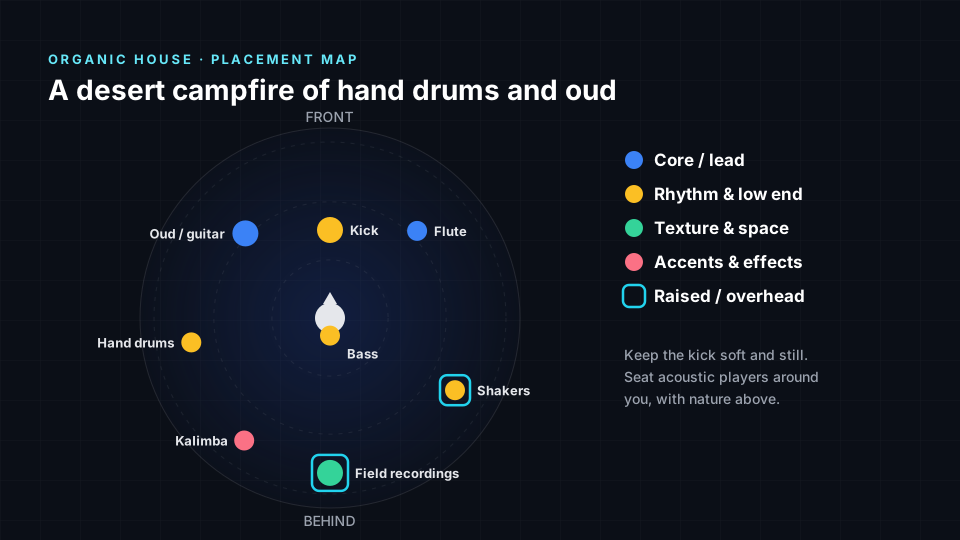
Immersive music for organic house: what listeners hear
- Musicians around a fire. Oud, flute and hand drums each play from their own seat.
- A soft, steady pulse. The kick and bass stay warm and never push.
- Nature all around. Wind, birds and water open the space behind and above.
- Small details that drift. A kalimba or handpan moves gently through the back.
Where to place each element in an organic house mix
| Element | Position | Height | Why it works |
|---|---|---|---|
| Kick | Front centre | Ear level | A soft, steady pulse |
| Bass | Centre | Ear level | Warm and deep |
| Oud / guitar | Front left | Ear level | The main melodic voice |
| Flute | Front right | Ear level | Answers the oud |
| Hand drums | Left | Ear level | Earthy rhythm at the side |
| Shakers | Behind right | Raised | Light, airy shimmer |
| Kalimba | Behind left, drifting | Ear level | Gentle melodic detail |
| Field recordings | Behind | Raised | The landscape around you |
The psychoacoustics behind Organic House placement
Every position in the table above follows how the ear and brain locate sound. Here is the reason behind the main choices for Organic House.
- Kick and bass stay centred. Sound below roughly 80 to 100 Hz offers the brain very little directional information, so the low end of organic house loses nothing by staying in the middle. A centred, rounded bass keeps the slow groove relaxed and stable.
- Oud front left, flute front right. Two sounds in a similar range mask each other less when they come from different directions, an effect known as spatial release from masking. Oud and flute often share the mid range, so opposite sides keep both melodies clear.
- Shakers raised. Elevation is judged mostly from how the outer ear filters frequencies above roughly 4 kHz. Shakers are bright and airy, so they rise convincingly, while the woody hand drums feel more natural at ear level.
- Field recordings behind. The ear is less precise about sounds behind the head, and front-back confusion is common. That suits wind, birds and water, which should feel like an environment around you rather than a point source.
The immersion profile for organic house
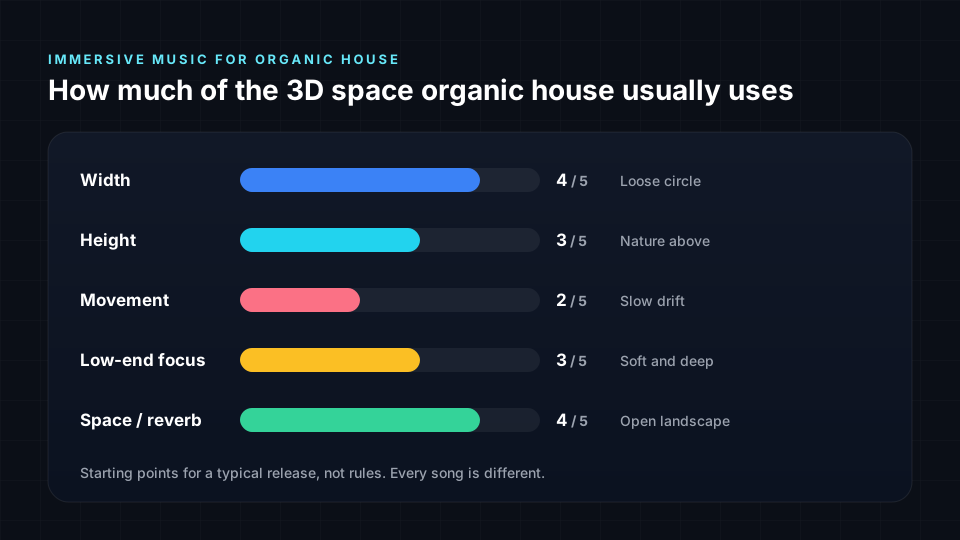
Width and space are high because the genre recreates players in an open landscape. Movement stays low: the groove is calm, and only small details should drift.
Tips for an immersive organic house mix
- Seat each acoustic part. Give every instrument a fixed place, as if real players sat around you.
- Keep the kick gentle. Organic house is about warmth, not punch.
- Let nature fill the back. Field recordings work best as a wide, raised layer behind.
- Use natural reverb. A believable outdoor or room sound suits the genre better than huge digital tails.
- Move only small details. A drifting kalimba or handpan adds life without breaking the calm.
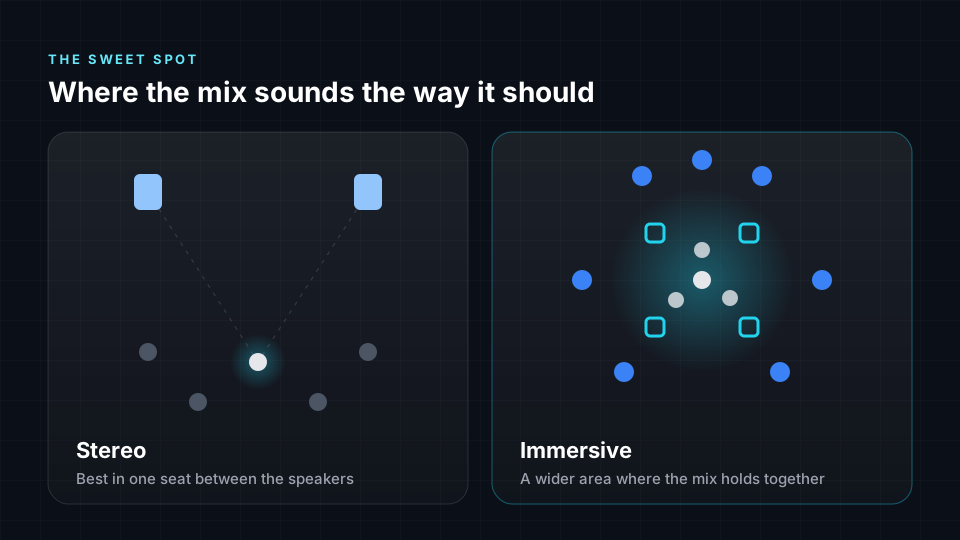
How to make immersive organic house from stereo
Spatial9 can create spatial audio from a stereo track in a few steps:
- Upload your stereo master or your stems.
- Spatial9's AI separates and places each part, seating acoustic instruments around you and lifting nature sounds behind.
- Preview it in binaural on headphones.
- Export Eclipsa Audio, ADM, binaural or Ambisonics.
- Publish a video. Create a YouTube-ready video with your immersive audio and publish it directly.
For related guides, read spatial audio for Afro house and spatial audio for world electronic music. Every guide is listed in spatial audio and immersive music by genre.
Frequently asked questions
Can I make an organic house mix in Dolby Atmos or Eclipsa Audio?
Yes. The placements in this guide work for both. Spatial9 exports ADM, the standard file used by Dolby Atmos studios, as well as Eclipsa Audio for YouTube, so one immersive organic house mix covers both. If you plan to release the Atmos version on Apple Music, build it from your original stems or multitracks, because Apple does not accept Atmos made from a finished stereo master. See where to publish spatial audio. You may also hear this called a 3D organic house mix or organic house in spatial audio.
Is spatial audio good for organic house?
Yes. Organic house is built from acoustic textures and nature sounds, and placing them around the listener gives the music the sense of place it is reaching for.
Where should field recordings go in an organic house mix?
Behind and slightly above the listener, spread wide. They should feel like the environment, not like another instrument.
Should the acoustic instruments move?
Mostly no. Real players stay in one place, so fixed positions sound more natural. Save gentle movement for one small detail such as a kalimba.
Can I convert a finished organic house track to spatial audio?
Yes. Spatial9 uses AI to generate an immersive mix from a stereo master and exports it as Eclipsa Audio, ADM, binaural or Ambisonics.
Does immersive organic house work on normal headphones?
Yes. The mix is rendered binaurally, so the circle of instruments and the landscape behind it work on any regular headphones.
Dolby and Dolby Atmos are trademarks of Dolby Laboratories. Spatial9 is not affiliated with or endorsed by Dolby Laboratories.
Sources
- Blauert, J. (1997). Spatial Hearing: The Psychophysics of Human Sound Localization, revised edition. MIT Press. Low-frequency, elevation, distance and motion cues.
- Mills, A. W. (1958). On the minimum audible angle. Journal of the Acoustical Society of America, 30(4), 237-246.
- Hebrank, J. and Wright, D. (1974). Spectral cues used in the localization of sound sources on the median plane. Journal of the Acoustical Society of America, 56(6), 1829-1834.
- Bronkhorst, A. W. (2000). The cocktail party phenomenon: a review of research on speech intelligibility in multiple-talker conditions. Acta Acustica united with Acustica, 86, 117-128.
- Litovsky, R. Y., Colburn, H. S., Yost, W. A. and Guzman, S. J. (1999). The precedence effect. Journal of the Acoustical Society of America, 106(4), 1633-1654.
- Barron, M. and Marshall, A. H. (1981). Spatial impression due to early lateral reflections in concert halls. Journal of Sound and Vibration, 77(2), 211-232.
- Bregman, A. S. (1990). Auditory Scene Analysis: The Perceptual Organization of Sound. MIT Press.
Put your listeners in the landscape
Upload a track to Spatial9 and hear your acoustic instruments and nature sounds surround you in minutes. Then export it or publish it straight to YouTube.