Creative Thinking in Immersive Music Mixing: Unlock Ideas Without Listener Fatigue
Spatial9 Team · · 17 min read
Key takeaways
- In immersive mixing, space is an instrument: placement, height and motion are artistic choices, and AI placement in Spatial9 is a starting point, not the final answer.
- Creativity grows from limits. A move budget, one big moment per song and short timed sketches produce bolder, clearer mixes than unlimited options.
- Listener fatigue comes from constant motion, a crowded ceiling, harsh highs, reverb fog, loud and dense masters and a drifting centre. Each has a simple fix.
- Anchor lead vocal, kick, snare and bass front centre, keep the height layer lighter than the main layer, and aim near -18 LUFS with peaks under -1 dBTP for Dolby Atmos music.
Stereo gave producers a line between two speakers. Dolby Atmos, Eclipsa Audio and binaural headphone mixes give you a whole sphere. That freedom is thrilling, and it is also where many immersive mixes go wrong. When everything can go anywhere, it is tempting to put everything everywhere. The result can be impressive for thirty seconds and exhausting after three minutes.
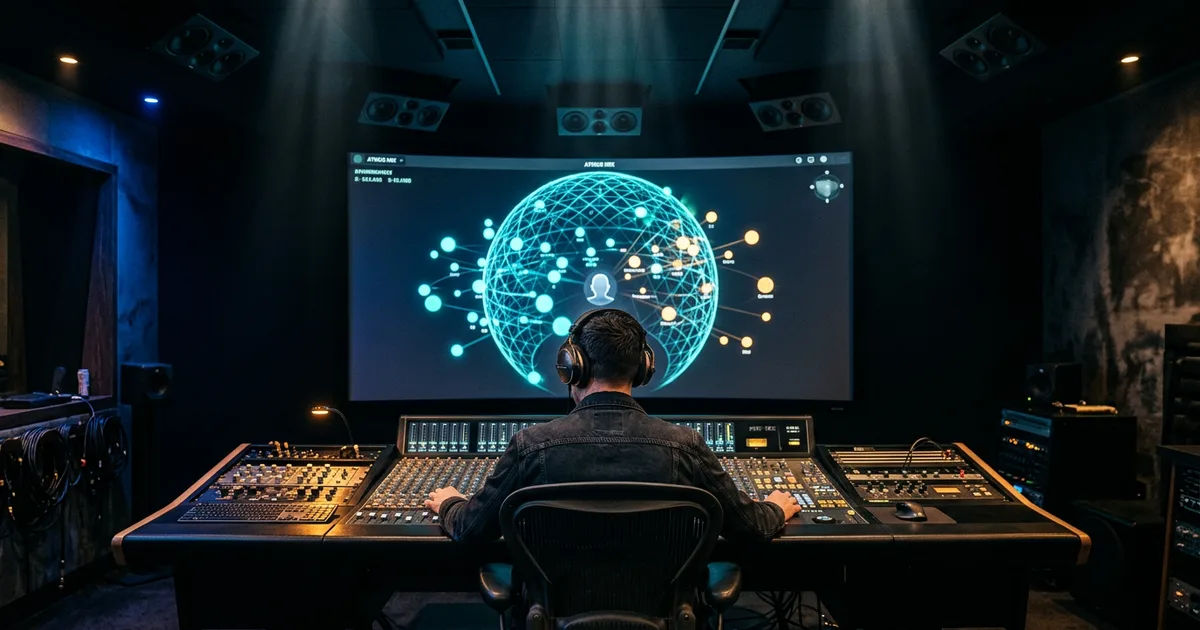
Spatial9 separates your song into stems, identifies each part and places it in 3D automatically. That gives you a strong starting point in seconds. What turns that starting point into a mix people replay is your creative judgement: what to anchor, what to move, when to open the space and when to hold back.
Why creative thinking matters in immersive music
Space is a new instrument, not a bigger stereo
In stereo, you mostly decide left, right, loud or quiet. In an immersive mix you also decide front or behind, low or high, close or far, still or moving. Each of those is a musical decision. A backing vocal that rises into the height speakers on the last chorus can feel like a key change. A guitar that slowly moves from behind you to your side can feel like a new verse starting. When you think of space this way, it stops being a technical setting and becomes part of the arrangement.
AI gives you the canvas, you give it meaning
The Spatial9 engine handles the slow parts: separating stems, recognising instruments and suggesting a balanced 3D placement. Our comparison of the Spatial9 Music Engine and mixing by hand explains what the AI does well. What it cannot know is what your song means to you. Is it a confession or a celebration? Should the listener feel surrounded by a crowd or alone in a small room? Those answers come from you, and they are what make one immersive mix memorable and another forgettable. We call this approach AI as a creative partner.
Listeners remember feelings, not positions
Nobody leaves a song thinking "the shaker was at 110 degrees". They remember that the chorus lifted them up, or that the bridge felt like floating. Creative thinking keeps you focused on that feeling. It also protects you from the most common immersive trap: using space to show off the format rather than to serve the music.
How creativity works, and how to unlock it in a session
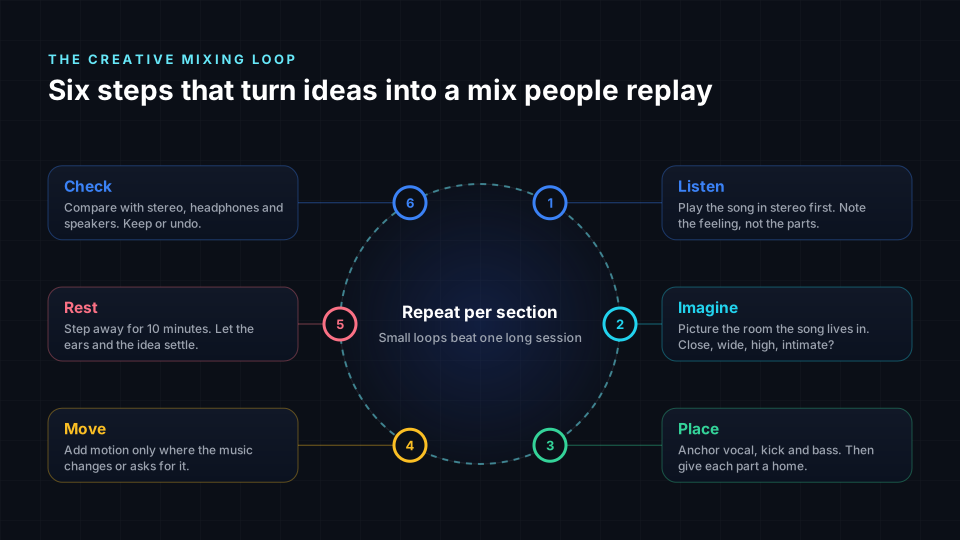
Creativity is not a mood you wait for. Research on the creative process describes it as a set of stages you can deliberately move through. In 1926 the psychologist Graham Wallas described four of them: preparation, incubation, illumination and verification. A mixing session follows the same shape. You prepare by listening and planning, you incubate by stepping away, the idea arrives, and you verify it on different speakers.
1. Prepare: listen before you place
Play the original stereo mix once from start to finish without touching anything. Close your eyes. Write down three words for how the song feels, such as "warm, intimate, late night" or "huge, defiant, bright". Those three words become your brief. Every spatial choice should support them.
2. Imagine the room the song lives in
Before you move a single stem, picture a place. A small jazz club, a cathedral, the inside of a car at night, a festival field. That image tells you how wide the mix should be, how high the reverbs should reach and how close the vocal should sit. Spatial9's 3D sphere view and virtual 7.1.4 speaker room make it easy to see that picture as you build it.
3. Use limits to spark ideas
Too many options freeze creativity. Studies on creative constraints, including the 2017 "Green Eggs and Ham hypothesis" paper by Catrinel Haught-Tromp, found that working within a clear limit often leads to more original results. Brian Eno and Peter Schmidt built their famous Oblique Strategies cards in 1975 on the same idea: a single unexpected instruction can break a creative block. In an immersive session, a limit might be "only three moving objects in the whole song" or "nothing in the height speakers until the first chorus".
4. Step away and let ideas incubate
A 2009 review of incubation studies by Ut Na Sio and Thomas Ormerod found that taking a break from a problem tends to improve creative problem solving. Mixing adds a second reason: your ears adapt. After a long stretch of listening, you stop noticing harsh frequencies and excessive movement. A ten-minute break with no audio resets both your ideas and your hearing.
5. Verify with honest ears
An idea that sounds exciting in the moment needs a second listen. Compare your immersive mix with the original stereo, check it on headphones and speakers, and listen once at low volume. If the idea still works, keep it. If it only worked because it was new, undo it without regret.
10 creative exercises for your next Spatial9 session
These exercises are short on purpose. Each fits inside a single session, and each trains a different creative muscle. Use Spatial9's solo, mute and per-stem controls to focus, and the 3D sphere to see what you are doing.
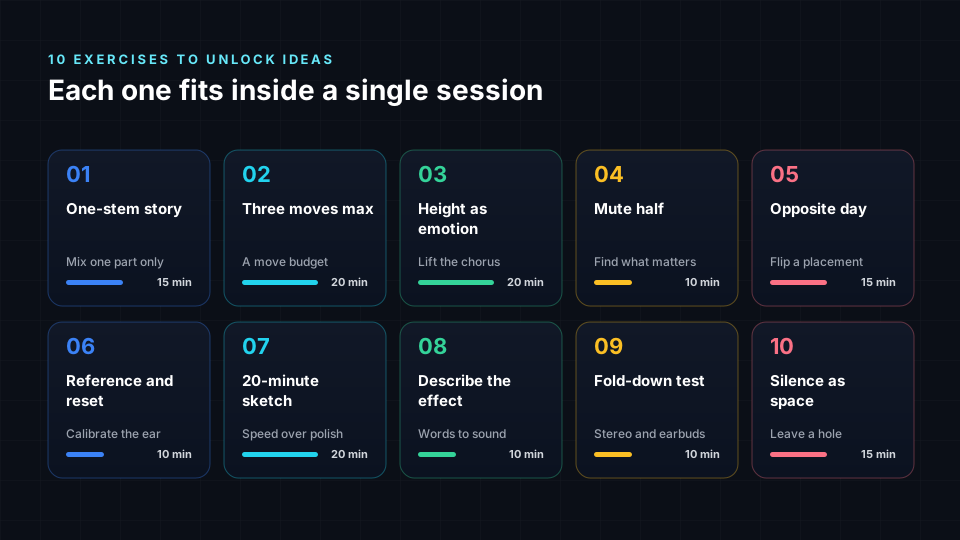
- One-stem story (15 minutes). Solo a single stem, such as a pad or a backing vocal, and give it a journey through the song using placement alone. When you unmute everything, you will hear how much one thoughtful part can add.
- Three moves maximum (20 minutes). Allow yourself only three moving objects for the entire song. You will be forced to choose the moments that truly deserve motion, and the result is almost always more musical.
- Height as emotion (20 minutes). Keep the height speakers almost empty in the verses. On the first chorus, lift one or two parts, such as harmonies or a reverb return. Notice how the chorus opens up without getting louder.
- Mute half (10 minutes). Mute half of the stems and mix only what is left. You will discover which parts carry the song and which were only filling space. Many mixes improve when some parts move to the background.
- Opposite day (15 minutes). Take your most obvious placement and try the opposite. Put the acoustic guitar behind instead of in front, or the drums close instead of wide. Most experiments will fail, and one will surprise you.
- Reference and reset (10 minutes). Play a professional immersive mix you love in a similar genre, then return to yours. Your ears recalibrate, and you will instantly hear whether your space is too busy or too timid.
- 20-minute sketch (20 minutes). Set a timer and mix the whole song fast, without perfecting anything. Speed bypasses overthinking. Keep the sketch as a reference for the big picture while you refine details later.
- Describe the effect (10 minutes). Use the Effects Rack's "describe an effect" option and type what you feel, not what you want technically. Try phrases like "a dusty room far away" or "the vocal whispering just behind me". Words often unlock sounds you would not have built by hand.
- Fold-down test (10 minutes). Listen to your mix as binaural on headphones and compare it with the stereo version. If the vocal or groove gets weaker, your creative choices are hurting the core of the song.
- Silence as space (15 minutes). Find one moment in the song where you can empty a whole zone, such as removing everything from behind the listener for four bars. Space only feels big when there are moments when it is small.
If you are new to placing stems in 3D, start with our hands-on lab your first immersive mix, then come back to these exercises.
The artistic rules every immersive mix should follow
Creative freedom works best inside a few artistic rules. These rules are not restrictions on taste. They are how human hearing works, and breaking them without a reason usually confuses or tires the listener.
Rule 1: Anchor the spine of the song
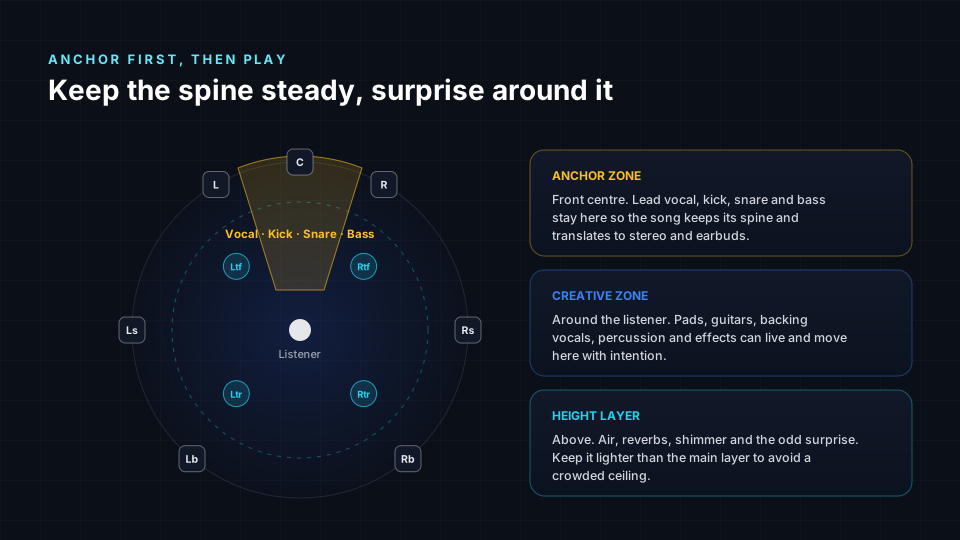
Lead vocal, kick, snare and bass carry the song. Keep them front and centre, or very close to it, in every section. This keeps the groove steady, helps the vocal stay clear, and makes sure your mix still works when it is played on earbuds, a phone or a stereo speaker.
Rule 2: Contrast creates impact
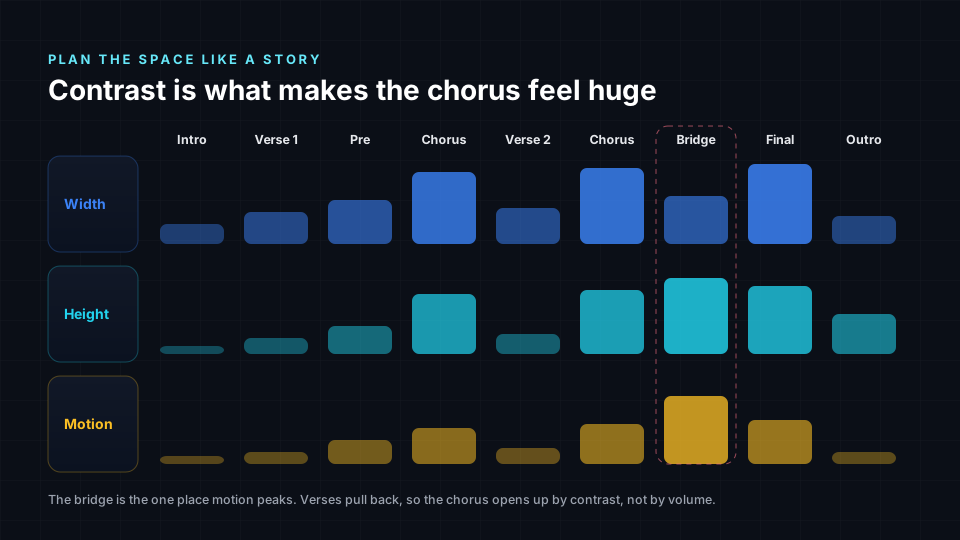
A chorus feels huge because the verse was smaller. If every section is equally wide, high and busy, nothing stands out. Plan the space across the whole song, the same way an arranger plans dynamics. Keep the verses intimate, open the chorus, and save your boldest moment for the bridge or final chorus.
Rule 3: Every movement needs a musical reason
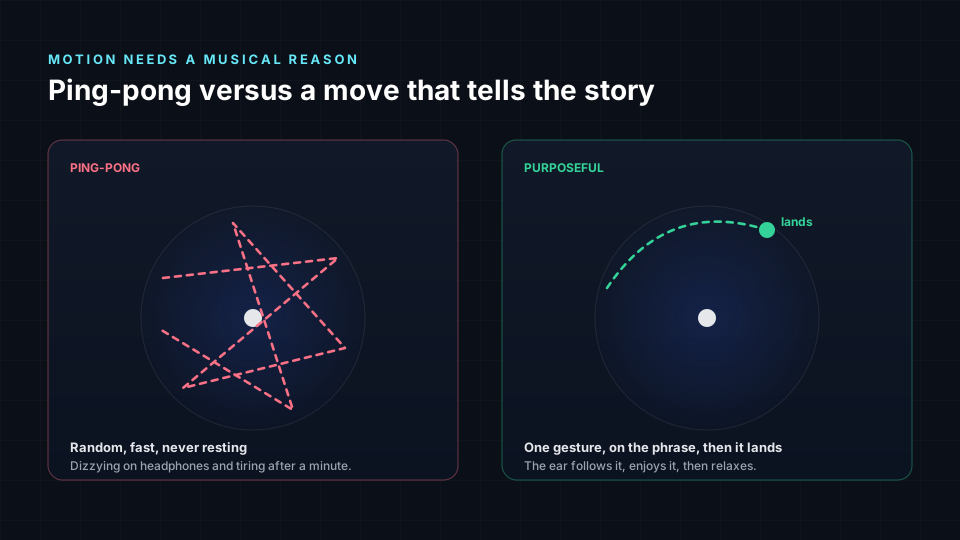
Movement attracts attention, because the brain is wired to notice sounds that change position. That is powerful, and it is also why too much motion is tiring. Tie every movement to something in the music: a phrase, a fill, a transition or a lyric. Let the object land and rest when the musical moment ends.
Rule 4: Keep the height layer lighter than the main layer
The height speakers are perfect for air, reverbs, shimmer and the occasional surprise. When too many parts live up there, the image becomes crowded and blurry, especially on headphones. A good starting rule is that the height layer should feel like the ceiling of a room, not a second band playing above you.
Rule 5: Respect the low end
Low frequencies are hard to locate, and moving them around tends to weaken the groove. Keep bass and kick focused, and let the low-frequency effects channel support the mix rather than carry it.
Rule 6: Protect clarity and dynamics
Immersive mixes have more room, so there is less need to squash everything to sound full. Dolby recommends delivering Dolby Atmos music at around -18 LUFS integrated loudness with true peaks no higher than -1 dBTP. That headroom keeps transients alive and lets the space breathe. Our guide to the mix console, metering and clarity shows how to read these meters in Spatial9.
Listener fatigue: what it is and how to avoid it
Listener fatigue is the tiredness, irritation or loss of attention people feel after listening to a mix for a while. It is not only about volume. A mix can be at a sensible level and still be exhausting if it demands constant attention. In immersive audio, fatigue often comes from the brain working too hard to track where everything is.
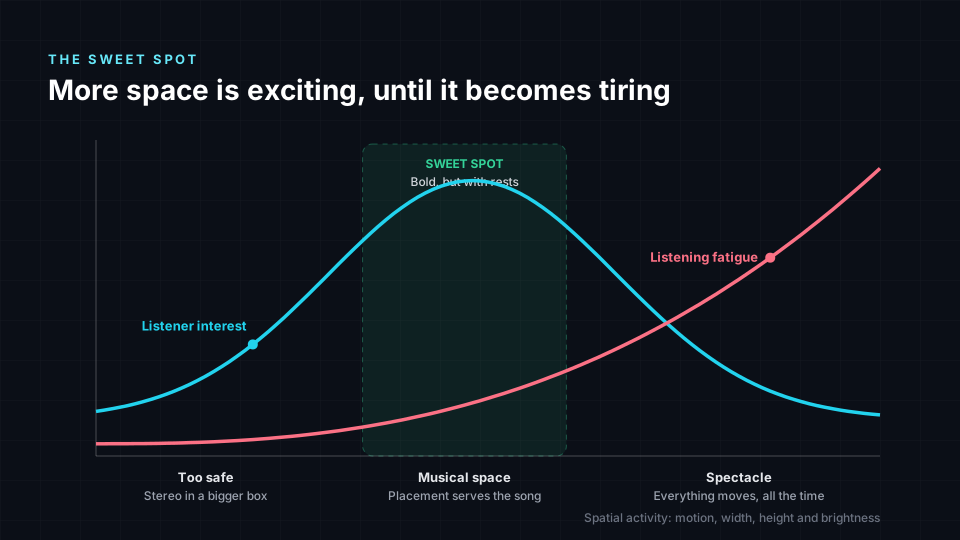
Psychoacoustics explains why. Albert Bregman's work on auditory scene analysis describes how the brain groups sounds into streams it can follow. Each extra moving or widely spread element adds another stream to track. A few are exciting. Too many become noise, and the listener either tunes out or turns the song off.
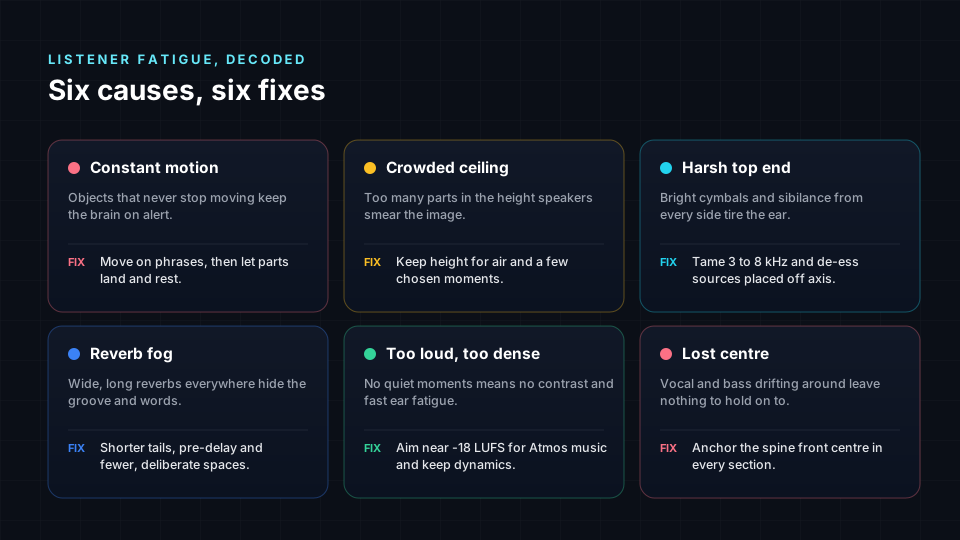
| Creative choice | When it delights | When it causes fatigue | Safer approach |
|---|---|---|---|
| Moving objects | One gesture on a fill or transition | Several parts moving all the time | Move on phrases, then let parts rest |
| Height speakers | Lifting harmonies in a chorus | Drums, guitars and synths all overhead | Use height for air and key moments |
| Wide placement | Pads and reverbs surrounding you | Vocal and bass spread around the room | Keep the spine of the song centred |
| Bright detail | Cymbals adding sparkle in one area | Harsh highs arriving from every side | Tame 3 to 8 kHz on off-axis sources |
| Long reverbs | A dreamy breakdown or outro | Every part in a big wash all song | Shorter tails, more pre-delay, fewer spaces |
| Loudness | Strong, confident chorus | Compressed, dense, no quiet moments | Aim near -18 LUFS, keep the dynamics |
Listen safely while you mix
Your own ears are your most important tool. The WHO and ITU safe listening guideline (H.870) treats 80 decibels for 40 hours a week as the reference limit for adults. Mix at a moderate level, take regular breaks, and check your work at low volume. Quiet listening also reveals balance problems that loud listening hides, because our sensitivity to bass and treble changes with level, as shown in the equal-loudness contours of ISO 226.
10 common mistakes in immersive music mixing, and how to fix them
These issues appear in many immersive releases, from beginner projects to commercial albums. Each one has a simple fix. For the technical rules behind them, such as monitoring, LFE, loudness and delivery, read our 10 non-negotiable best practices for immersive and spatial music mixing.
- Ping-pong panning. Sounds jump around the listener for no musical reason. Fix it by tying every move to a phrase and limiting how many objects move at once.
- Everything in the height speakers. Putting full instruments overhead to "use the format" crowds the image. Keep height for air, reverbs, harmonies and a few special moments.
- The vocal lost in the room. A lead vocal placed wide or with heavy reverb loses its connection with the listener. Keep it front and centre, and add space with a send rather than by moving it.
- Spread-out bass. Bass placed in several speakers or moving around weakens the groove and causes uneven low end. Keep it focused and centred.
- Same space all song. No change between verse and chorus means no lift. Plan a song energy map and save width and height for the big moments.
- Reverb fog. Long, wide reverbs on many parts blur rhythm and lyrics. Use fewer reverbs, shorter tails and some pre-delay so the dry sound arrives first.
- Harsh highs from every side. Bright sources placed around and above the listener quickly become tiring. Tame the upper mids and de-ess sources that sit off axis.
- Mixing only on one system. A mix built only on speakers can collapse on headphones, and the opposite is also true. Check both, and read our comparison of headphone and speaker spatial audio.
- Ignoring the stereo version. Many listeners will still hear a stereo or binaural fold-down. If the immersive mix only works in a full speaker room, it is not finished. Learn the difference in binaural vs spatial audio.
- Mixing too loud for too long. Loud monitoring flatters busy mixes and tires your ears, so you make worse decisions. Mix at a moderate level and take a break every 45 to 60 minutes.
A creative session workflow in Spatial9
Here is how the ideas in this guide fit together in a real Spatial9 session.
- Upload and listen. Upload your stereo track or stems. While Spatial9 separates and places each part, listen to the original once and write your three feeling words.
- Review the AI placement. Look at the 3D sphere view. Ask whether the placement matches the room you imagined. Keep what works and note what does not.
- Anchor the spine. Check that lead vocal, kick, snare and bass sit front and centre. Adjust the volume of each stem until the core of the song feels solid.
- Shape the story. Sketch your song energy map. Decide which section gets the biggest spatial moment, and keep the others more restrained.
- Add intentional movement. Choose up to three moments for motion and tie each one to the music.
- Colour with effects. Use the Effects Rack on single stems or on the master bus, and try "describe an effect" for ideas you cannot name technically.
- Rest and check. Take a break, then compare against the stereo mix on headphones and speakers. Listen once at low volume.
- Export. Export Dolby Atmos (ADM), Eclipsa Audio (IAMF), binaural and multichannel versions. Our guide to best practices for exporting audio stems covers the details.
Stuck on a creative decision? The Niner AI mixing tutor can suggest ideas and explain why a placement works.
The creative session checklist
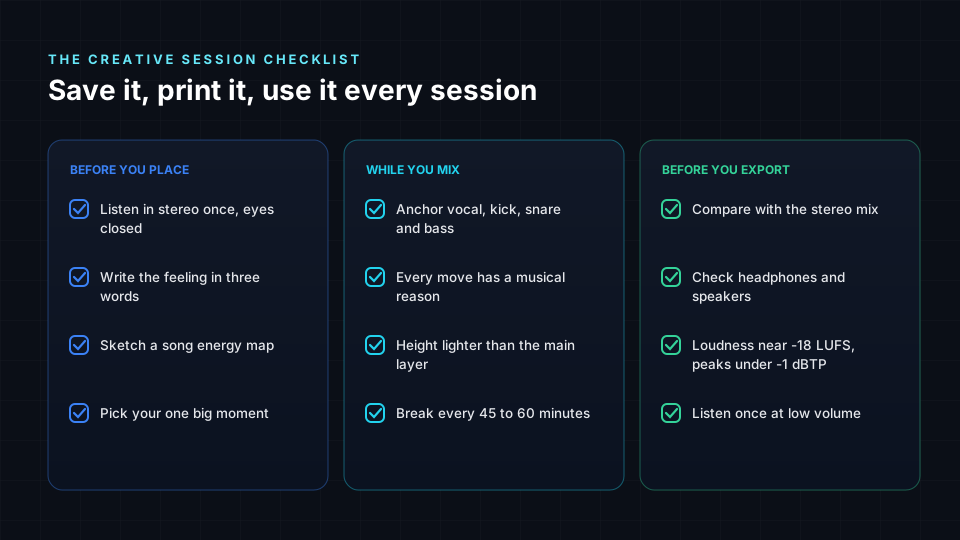
- Listen to the stereo mix once with your eyes closed, and write the feeling in three words.
- Sketch a song energy map and pick your one big spatial moment.
- Anchor lead vocal, kick, snare and bass at the front centre.
- Give every movement a musical reason, and let it land.
- Keep the height layer lighter than the main layer.
- Take a break every 45 to 60 minutes.
- Compare with the stereo version, on headphones and on speakers.
- Aim for around -18 LUFS integrated with true peaks under -1 dBTP before you export.
- Listen once at low volume before you call it finished.
Frequently asked questions
Why does creative thinking matter in immersive music mixing?
Because space is part of the arrangement. Placement, height and motion change how a song feels, so they should be chosen for emotional reasons, not just because the format allows them. Creative thinking keeps every spatial choice connected to the music.
How can I be more creative when mixing in Dolby Atmos or spatial audio?
Set yourself limits, such as only three moving objects in a song, sketch a plan of how the space should grow across sections, take regular breaks and try short timed exercises. Limits and fresh ears lead to bolder, clearer ideas than unlimited options.
What causes listener fatigue in immersive audio?
The most common causes are constant motion, too many parts in the height speakers, harsh high frequencies from many directions, long reverbs everywhere, loud and over-compressed masters, and a lead vocal or bass that drifts away from the centre.
How do I avoid listener fatigue in a spatial mix?
Anchor the vocal, kick, snare and bass at the front centre, move objects only on musical phrases, keep the height layer light, control harsh frequencies, use shorter reverbs, and leave dynamic range. Check the mix on headphones and speakers and at low volume.
Should everything move in an immersive mix?
No. Movement draws attention, so it works best when it is rare and tied to the music. Most parts should stay in place, with a few purposeful gestures at transitions, fills or emotional peaks.
What loudness should I use for a Dolby Atmos music mix?
Dolby recommends around -18 LUFS integrated loudness with true peaks no higher than -1 dBTP for Dolby Atmos music. This leaves room for dynamics, which helps immersive mixes sound open rather than crowded.
Can AI help with creative immersive mixing?
Yes. Spatial9 separates your song into stems and suggests a 3D placement in seconds, which removes the slow technical work. You then make the creative decisions about what to anchor, what to move and when to open up the space.
Start your next creative session
The best immersive mixes are not the busiest ones. They are the ones where every placement, lift and movement means something. Start with a strong AI placement, anchor the heart of the song, plan the space like a story, and let a few bold moments shine. Your listeners will feel the difference, and they will keep listening.
Try it in the Spatial9 Immersive Classroom, or open the Spatializer and turn your next track into an immersive mix. To learn how the ear hears space in the first place, read how we hear in 3D. Once your creative ideas are in place, run your mix through our 10 non-negotiable immersive mixing best practices before you release it.
Sources
- Wallas, G. (1926). The Art of Thought. Jonathan Cape, London.
- Eno, B. and Schmidt, P. (1975). Oblique Strategies: Over One Hundred Worthwhile Dilemmas. Self-published card deck.
- Haught-Tromp, C. (2017). The Green Eggs and Ham hypothesis: How constraints facilitate creativity. Psychology of Aesthetics, Creativity, and the Arts, 11(1), 10–17.
- Sio, U. N. and Ormerod, T. C. (2009). Does incubation enhance problem solving? A meta-analytic review. Psychological Bulletin, 135(1), 94–120.
- Bregman, A. S. (1990). Auditory Scene Analysis: The Perceptual Organization of Sound. MIT Press.
- ISO 226:2023. Acoustics: Normal equal-loudness-level contours. International Organization for Standardization.
- WHO and ITU (2019). Safe listening devices and systems: a WHO-ITU standard (ITU-T H.870).
- ITU-R BS.1770. Algorithms to measure audio programme loudness and true-peak audio level.
- Dolby Laboratories. Dolby Atmos Music mastering and delivery guidelines (-18 LUFS integrated, -1 dBTP true peak).