AI spatial audio research
A structured map of the research behind AI spatial audio and where Spatial9 builds on it.
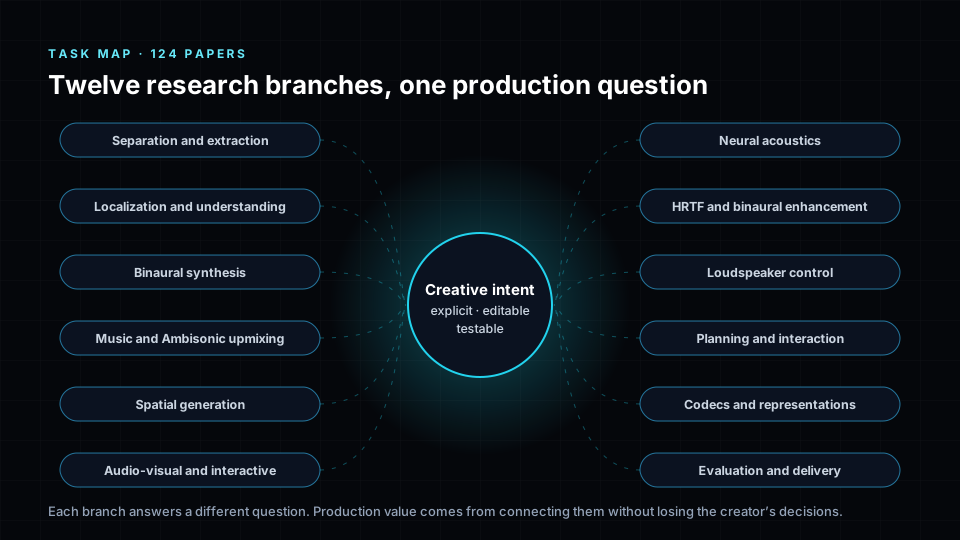
This page maps the academic research behind AI spatial audio and shows where Spatial9 draws on it. It summarizes the scope and method of the Spatial9 research review, organizes its twelve research branches into tables of key methods and production relevance, places the work in a historical timeline of immersive audio, and states the principles Spatial9 applies to its own architecture.
It is written for engineers, researchers, students and technical decision makers who want to know which capabilities come from published research and how Spatial9 interprets that evidence. For how placement decisions are generated in practice, see Spatial inference.
Scope of the review
The Spatial9 Engineering Team reviewed 124 academic records on AI spatial and immersive audio. The set consists of the ninety-six records of an original research catalog plus twenty-eight additions covering spatial reasoning, binaural enhancement, loudspeaker control, production interaction and differentiable processing. Four standards or assessment recommendations are discussed separately as delivery context and are not counted as academic models.
| Item | Value |
|---|---|
| Research branches | 12 |
| Assessment criteria | 14 |
| Code examples | 15 |
| Literature cutoff | 25 October 2026 |
How each record is assessed
Every record receives a review in three parts: the research contribution as its authors report it, the Spatial9 assessment of strengths and limits for immersive production, and a verdict on its practical role. You can read any verdict in the full research review or start with the summary.
Evidence boundaries
The review is a narrative critical review with an explicit catalog and version history. It does not claim preregistered systematic screening, pooled effect sizes or a global coverage rate.
- Primary sources preferred. Secondary search results served discovery only.
- Access depth recorded. Where full text was not inspected, the judgment is limited to what the available material establishes.
- Versions distinguished. Duplicate arXiv records and title changes are not counted as new model families.
- No league table. Comparative judgments concern technical fit, with no numerical ranking.
The production chain
The review treats spatial audio as a chain of representations and decisions rather than a single model. The same waveform may be analyzed for source identity, turned into editable objects, rendered for a listener and then compressed for delivery. Research can improve any one step without solving the others.
The chain runs from source through separation, understanding, editable scene state and rendering to delivery. The representation determines what can still be edited after each handoff.
| Representation | What it carries |
|---|---|
| Channel-based | Signals assigned to a playback arrangement |
| Scene-based | A sound field, often as Ambisonics |
| Object-based | Source signals with associated metadata |
A renderer can move between representations, but information that has been mixed or discarded is not recovered by changing the file extension. The review judges a handoff by the structure actually written to the delivered file.
Research areas
The branches are grouped below by position in the chain. Each table lists chapters of the full review, the methods they name and their relevance to Spatial9.
Planning and creative control
Planning is judged at the point where an intention becomes a decision a creator can use. Text, a reference recording and a detected musical event supply different kinds of context.
| Area | Key methods | Relevance to Spatial9 |
|---|---|---|
| Planning and creative control (10 papers) | DDSP, differentiable mixing console, DeepAFx-ST, Diff-MST, Diff-MSTC, STASE | Learned decisions stay connected to explicit, revisable parameters |
| Object-audio lineage | S3A object pipeline | Prior art for integrated object-based workflows from recording to listening |
The review credits STASE for connecting semantic planning with spatial rendering, and separately credits SEND for examining intentional movement timing. It treats the first result and the next revision as one production experience, so a useful system supports acceptance, local correction and recovery.
Separation, localization and audio-language reasoning
Source recovery is the start of an immersive production contract. Broad stems, prompted targets and discovered sources have different granularity and completeness.
| Area | Key methods | Relevance to Spatial9 |
|---|---|---|
| Source separation (11 papers) | HTDemucs named stems, SAM Audio prompted extraction with residual | Each asset is tied to a stable scene identity across revisions |
| Localization and reference data (6 papers) | ACCDOA activity-coupled direction of arrival | Detected geometry is evidence, authored geometry is intent |
| Audio-language reasoning (14 papers) | Spatial perception combined with language | Instructions must name a source, reference frame and time interval |
Separation quality, inventory completeness and persistent source identity are three separate judgments. A creator needs to know whether an apparent object is one instrument, a grouped stem or a candidate extraction whose identity is unresolved. In localization, activity is not distance, a direction is not a persistent identity, and an estimated position is not automatically the preferred presentation. Because spatial audio-language research is established and expanding, the review does not regard "an LLM plus spatial audio" as a distinctive position.
Generation, upmixing and visual evidence
These branches create or expand spatial content. They start from different evidence and carry different fidelity contracts.
| Area | Key methods | Relevance to Spatial9 |
|---|---|---|
| Spatial generation and moving scenes (7 papers) | Generation, upmixing and object-scene revision; FOA channel conventions | A generated presentation is distinct from an inspectable authoring state |
| Visual evidence (10 papers) | Audio-visual placement and soundscape generation for images | An approved soundtrack carries preservation obligations |
| Stereo upmixing and Ambisonics (8 papers) | Stereo upmixing, mono-to-stereo generation, Ambisonic order expansion | More channels do not add knowledge the input never had |
The review asks what is retained, what is estimated and what is deliberately authored. A creative brief defines which material may change and which must remain authoritative.
Rendering and the listener
Rendering turns a representation into the signals that reach two ears or a set of loudspeakers. Its quality matters directly, but it does not decide which source belongs where.
| Area | Key methods | Relevance to Spatial9 |
|---|---|---|
| Binaural rendering (5 papers) | Neural binaural rendering with reconciled coordinates | A renderer works within a contract while the system keeps source identity |
| Binaural enhancement (7 papers) | Enhancement with cue preservation invariants | Cleaner ear signals can still carry changed spatial cues |
| HRTF personalization (9 papers) | HRTF Field; measurement, scanning, retrieval and generation of profiles | Profile acquisition stays separate from playback |
Personalization is its own layer. The creator defines the scene, while the listener profile and playback system decide how it reaches the ears. The review prefers stating magnitude, timing and headphone assumptions, and treats preservation in enhancement as multi-dimensional.
Acoustics and loudspeaker control
Room modeling and loudspeaker control are the physical continuation of spatial authoring.
| Area | Key methods | Relevance to Spatial9 |
|---|---|---|
| Acoustic fields and rooms (19 papers) | Learning Neural Acoustic Fields; reflection parameters tied to acoustic paths | Acoustic inference is distinguished from a measured room match |
| Sound-field control and sound zones (4 papers) | Sound-zone objectives using calibrated acoustic paths | Format compatibility alone does not supply calibration |
Three acoustic promises are kept separate: suggesting a convincing room character, replaying a captured scene and reconstructing a particular venue. A picture, a rough mesh and measured responses are not interchangeable inputs. For loudspeakers, isolation, sound-field accuracy and perceived placement are different achievements, and the room, array and listener positions decide what an installation can realize.
Representations, codecs and evaluation
These branches decide what survives compression and what a quality claim means.
| Area | Key methods | Relevance to Spatial9 |
|---|---|---|
| Representations and spatial evidence (5 papers) | Embeddings, grounded language answers, spatial codecs | Observed evidence is kept apart from inference about missing data |
| Evaluation (9 papers) | SAQAM, AMBIQUAL, QASTAnet, spatial impairment decomposition, perceptual losses | Each metric is given only the meaning its assumptions support |
A reference metric diagnoses damage, a distributional distance compares collections and an audiovisual benchmark examines alignment. Creative preference is a separate question.
Quality as a profile
The review does not reduce spatial quality to one number. Fidelity, localization, externalization, immersion, timbral integrity and creative preference are related but distinct, and an improvement in one can coincide with a tradeoff in another. It favors an interpretable profile of outcomes over a single unexplained score.
Assessment criteria
Every verdict draws on fourteen production criteria. A method does not need to meet all of them; the relevant ones follow from the task it claims to solve.
- Task and input parity.
- Content fidelity.
- Separation and identity.
- Audible direction, height and distance.
- Motion and musical intention.
- Complete song and scene continuity.
- Downmix and alternate playback.
- Latency and production cost.
- Room modeling.
- HRTF and listener variation.
- Export and playback verification.
- Listening studies.
- Metric validity.
- Editable delivery and recovery.
Historical timeline
Current AI research sits on more than 140 years of work on delivering spatial cues to the ears. The table lists the milestones most relevant to the research areas above.
| Year | Development | Significance |
|---|---|---|
| 1881 | Clément Ader's Théâtrophone demonstration in Paris | Two signals, one per ear, can carry direction |
| 1907 | Lord Rayleigh's duplex theory | Time differences at low frequencies, level differences at high frequencies |
| 1931 | Alan Blumlein's stereo patent, GB 394,325 | Blumlein pair, phantom image, mid-side, 45/45 groove |
| 1933 | Bell Labs auditory perspective relay | Three front channels give much of the benefit |
| 1940 | Fantasound and the pan pot | Steering a sound to a position, ancestor of object audio |
| 1973 | Michael Gerzon, "Periphony" | Ambisonics with height describes the whole sound field |
| 1974 | Jens Blauert, Räumliches Hören | Standard reference on spatial hearing |
| 1987 | 5.1 named by Tomlinson Holman | Five full-range channels plus low-frequency effects |
| 1988 | Guus Berkhout, wave field synthesis | Loudspeaker arrays reconstruct the physical wavefront |
| 1989 | Wightman and Kistler, HRTF-filtered playback | Basis of every binaural renderer in use today |
| 1997 | Ville Pulkki, VBAP | Rendering objects to arbitrary speaker layouts |
| 2000s | NHK 22.2 multichannel sound | Height layers for broadcast, in ITU-R BS.2051 |
| 2012 | Dolby Atmos and Auro-3D | Height and objects reach the cinema |
| 2015 | MPEG-H 3D Audio and ITU-R BS.2076 | Open description of channels, objects and scenes, basis of ADM BWF |
| 2023 | Alliance for Open Media IAMF | Royalty-free immersive audio specification |
| 2025 | IAMF launched as Eclipsa Audio | Support on YouTube and Samsung TVs and soundbars |
Three lineages
Every modern format descends from three ideas, and each one maps onto a representation in the production chain.
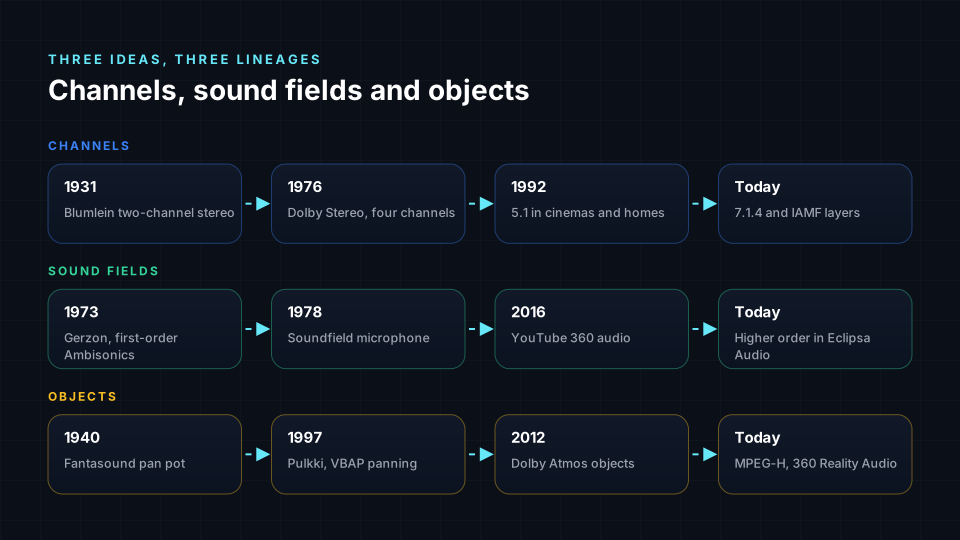
The formats that succeeded combined good sound with practical production, playback on equipment people owned or wanted, and a clear reason to choose them. With playback now widely available, the remaining barrier is production, which source separation and automatic placement address. For the trade-offs, see Stereo vs stems.
Where Spatial9 builds on the research
The review's central position is that production value depends less on any single model and more on keeping creative intent explicit, editable and testable from the first source file to final playback. Spatial9 describes itself in the review as an AI spatial production system centered on controllable creative intent. No single research family owns the whole process; each supplies a specialized contribution.
Seven principles
The same seven positions are applied to every paper and to Spatial9's own architecture.
| Area | Position | Practical implication |
|---|---|---|
| Placement and planning | Instructions need acoustic grounding | Source, decision and affected interval remain identifiable |
| Source fidelity | Preservation has an explicit meaning | Identity, transparency and bit identity are distinguished |
| Scene revision | A local request has a local scope | Unrelated choices remain part of retained intent |
| Musical motion | Movement serves the composition | Stationary choices, timing and path design have separate roles |
| Export behavior | The delivered representation defines the handoff | Object state, sound-field rendering and player support are explicit |
| Room reconstruction | Calibration belongs to the operating contract | Inference is distinguished from a measured room match |
| Listener variation | Results depend on reproduction conditions | HRTF fit, devices and listener behavior affect interpretation |
Engineering patterns from the review
The review's fifteen code examples connect papers to explicit engineering decisions, such as validating a spatial instruction before changing the scene, decoding ACCDOA activity and direction separately, and penalizing directional damage in a spatial codec. Official API examples use public interfaces such as HTDemucs and SAM Audio. The others are original illustrative patterns, not extracts from Spatial9's private implementation.
Delivery standards
Standards are delivery context, not academic models. The review covers the ITU-R Audio Definition Model, the basis of ADM BWF masters, and the Alliance for Open Media Immersive Audio Model and Formats (IAMF), the format behind Eclipsa Audio. Spatial9 judges a handoff by what these structures actually carry. For details, see ADM BWF and Eclipsa Audio and IAMF.
Next steps
- Spatial inference to see how placement decisions are generated and reviewed.
- Psychoacoustics for the hearing cues that rendering and HRTF research target.
- Formats overview to compare channel, scene and object delivery formats.
- Ambisonics for the sound-field lineage behind Eclipsa Audio.