
AI Spatial Audio Research, Summarized: 124 Papers in One Map
Spatial9 Engineering Team · · 14 min read
Key takeaways
- The Spatial9 Engineering Team reviewed 124 academic records on AI spatial audio, grouped into twelve research branches from source separation to codecs and evaluation.
- The central finding: production value depends less on any single model and more on keeping creative intent explicit, editable and testable from the source file to final playback.
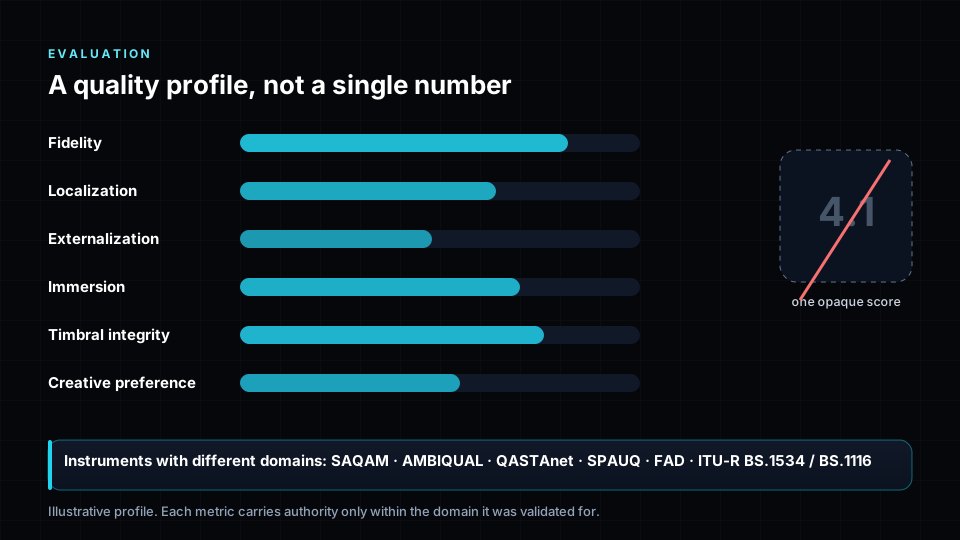
- Quality in spatial audio is a profile, not a single score: fidelity, localization, externalization, timbre and delivery have to be measured separately.
- Every section of this summary links straight to the matching chapter of the full review, where each paper has its own assessment and verdict.
The full review is long by design. It discusses all ninety-six records of the original research catalog plus twenty-eight additions, and includes fifteen short code examples. This summary is for readers who want the argument first and the evidence on demand. Use it as a map: read a section here, then follow the link when you want the papers behind it.
At a glance
| Question | Answer |
|---|---|
| What was reviewed? | 124 academic records on AI spatial and immersive audio |
| How is it organized? | Twelve research branches, from separation to evaluation and delivery |
| How is each paper judged? | Research contribution, Spatial9 assessment and a direct verdict |
| What else is included? | Fifteen code examples, fourteen assessment criteria and four delivery standards |
| Central position | Creative intent must remain explicit, editable and testable from source to playback |
| Who wrote it? | The Spatial9 Engineering Team |
| Where is the detail? | Start with how to read the full review |
The core argument in three ideas
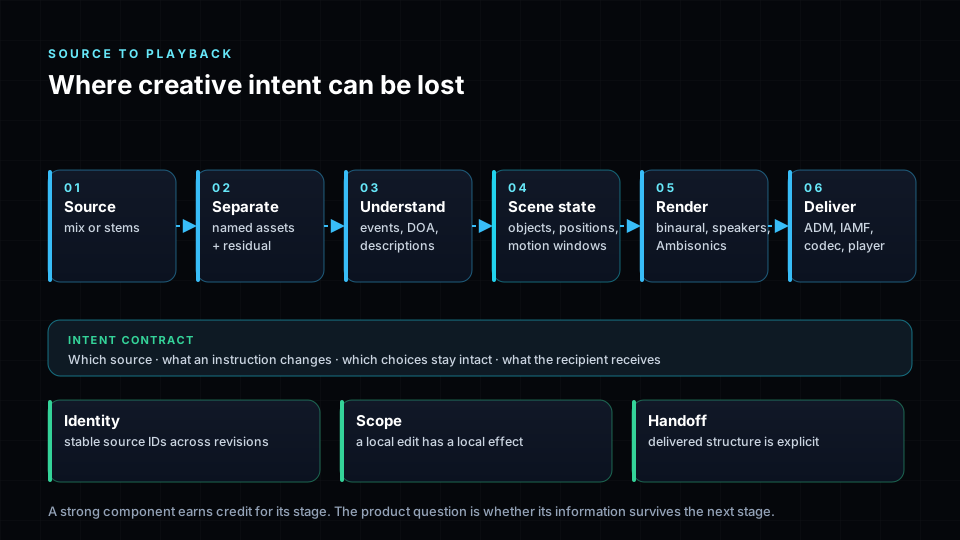
Spatial audio is a chain, not a model. The same waveform may be analyzed for source identity, turned into editable objects, rendered for a listener and then compressed for delivery. Research can improve any one of these steps without solving the others. See the task map.
Each capability answers a different question. Inferring where an existing source sits, generating a requested event, describing a scene, modeling a room and choosing intentional movement are distinct jobs. The review gives each one a clear role instead of ranking them on one scale. See what the papers collectively change.
Quality is a profile, not a number. Fidelity, localization, externalization, immersion and artistic preference are related but distinct. No single metric settles them all. See why one quality score is not enough.
The twelve research branches
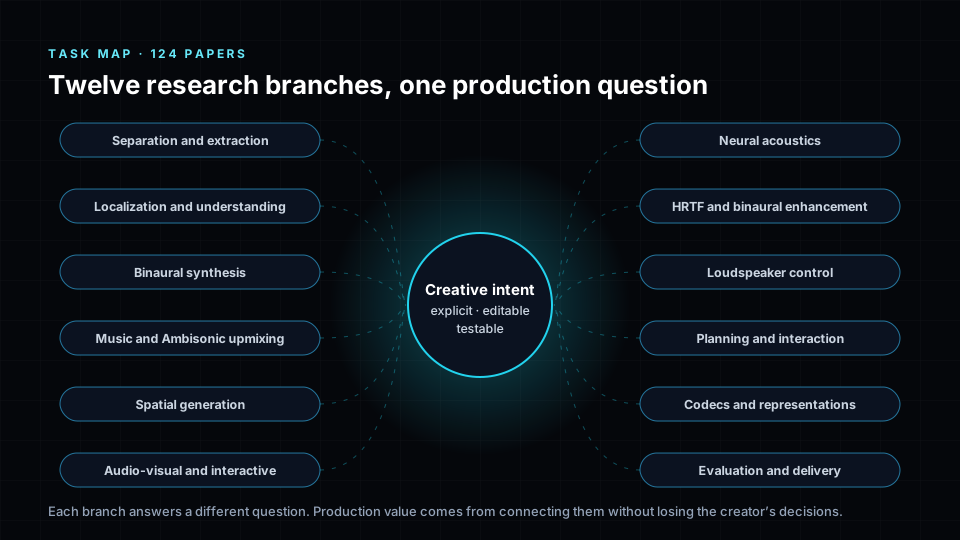
Each branch delivers something different and raises its own production question. This is the task map from the full review, shortened to one line per branch.
| Branch | What the research delivers | Question for production |
|---|---|---|
| Separation and extraction | Sources or stems from mixtures | Are the intended sources complete, stable and suitable for independent control? |
| Localization and understanding | Events, positions, descriptions or answers | Are decisions grounded in acoustic evidence under overlap and changing conditions? |
| Binaural synthesis | Signals for the two ears | Do cues remain convincing across motion, listeners and content? |
| Music and Ambisonic upmixing | Additional channels or a sound-field representation | Does the transformation preserve source identity and support the requested arrangement? |
| Spatial generation | New spatial sound scenes or effects | Are content, position and trajectory controllable without unwanted events? |
| Audio-visual and interactive systems | Sound aligned with visual or dynamic scene context | What happens with off-screen sources, camera motion and user movement? |
| Neural acoustics | Room responses or acoustic fields | How much calibration is required, and what changes invalidate the model? |
| HRTF and binaural enhancement | Listener filters or enhanced ear signals | Does reconstruction improve perceived location, externalization and useful listening? |
| Loudspeaker control | Drive signals or sound-zone filters | Does performance survive real rooms, listener movement and output constraints? |
| Planning and production interaction | Editable parameters, intentions and workflows | Can a user reach and revise the desired result efficiently? |
| Codecs and representations | Compressed signals or learned tokens | Which cues and editing information survive reconstruction? |
| Evaluation and delivery | Metrics, protocols and interoperable structures | Does the final playback preserve the intended behavior? |
Chapter by chapter
Each summary below states the position the full review takes in that chapter. The link under each one opens the chapter itself, with every paper, verdict and code example.
Planning and creative control
Planning is judged at the point where intention becomes a decision a creator can use. Text, a reference recording and a detected musical event supply different kinds of context. DDSP and differentiable mixing establish a lineage of learned control through structured processing, and the review regards explicit parameters as important because the result stays understandable and revisable when the brief changes.
Read the planning chapter, 10 papers and 3 code examples.
Source separation and stable production assets
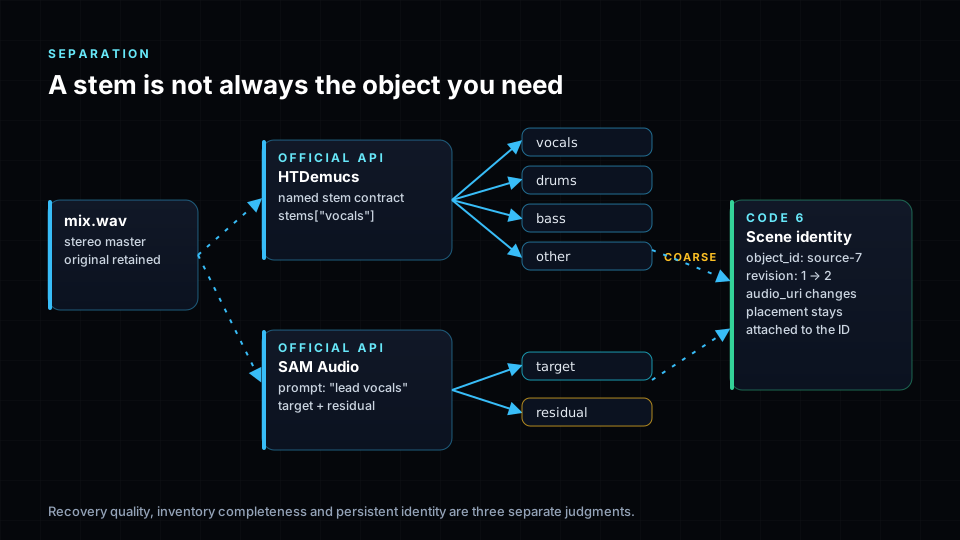
Source recovery is the beginning of an immersive production contract. Broad stems, prompted targets and discovered sources are useful outputs with different granularity and completeness. A creator needs to know whether an apparent object is one instrument, a grouped stem or a candidate extraction whose identity still needs resolution. The chapter includes official HTDemucs and SAM Audio usage.
Read the separation chapter, 11 papers and 3 code examples.
Spatial detection, localization and reference data
Detected geometry is evidence about a recording. Authored geometry is an expression of intent. Keeping those apart lets the same perception method serve faithful reconstruction and deliberate creative placement. Activity is not distance, a direction is not a persistent identity, and an estimated position is not automatically the producer's preferred presentation.
Read the localization chapter, 6 papers and the ACCDOA code example.
Spatial representations and audio-language reasoning
Spatial perception combined with language is established and rapidly expanding research. That makes "an LLM plus spatial audio" insufficient as a distinctive position. The review's emphasis is the contract between understanding and action: which source an instruction names, which reference frame it uses, when it applies, and what the creator can inspect or correct.
Read the audio-language chapter, 14 papers.
Spatial generation, upmixing and moving scenes
New-content generation, stereo upmixing and revision of a persistent object scene are related categories with different fidelity contracts. A creative brief defines which material may change and which must remain authoritative. The review favors a clear distinction between a generated presentation and an inspectable authoring state.
Read the generation chapter, 7 papers and the FOA convention example.
Binaural rendering and listener-dependent reproduction
Binaural rendering turns an audio representation into the signals delivered to two ears. Its quality matters directly, but it does not decide which source belongs where or how an engineer revises a scene. A renderer can be excellent within a defined contract while the surrounding system stays responsible for source identity and creative intent.
Read the binaural rendering chapter, 5 papers and 1 code example.
Visual evidence and spatial sound generation
Visual information is evidence about a scene, with different roles in reconstruction and invention. A system can infer where supplied sound belongs, or it can create a plausible soundscape for images. An approved soundtrack carries preservation obligations that a silent-video generation brief does not.
Read the visual evidence chapter, 10 papers.
Stereo upmixing and Ambisonic representations
Stereo upmixing, mono-to-stereo generation and Ambisonic order expansion start from different spatial evidence. More output channels do not erase those differences. The review asks what is retained, what is estimated and what is deliberately authored, which matters when a higher-order format appears to imply knowledge the input never had.
Read the upmixing chapter, 8 papers.
Binaural enhancement and preservation of spatial cues
Enhancement becomes a spatial problem whenever processing changes the relationship between a source and its environment. A clean speaker, a preserved environment and an intact musical scene are different targets. Cleaner ear signals can still carry changed spatial cues, so preservation is treated as multi-dimensional.
Read the enhancement chapter, 7 papers and the cue preservation example.
Acoustic fields and room reconstruction
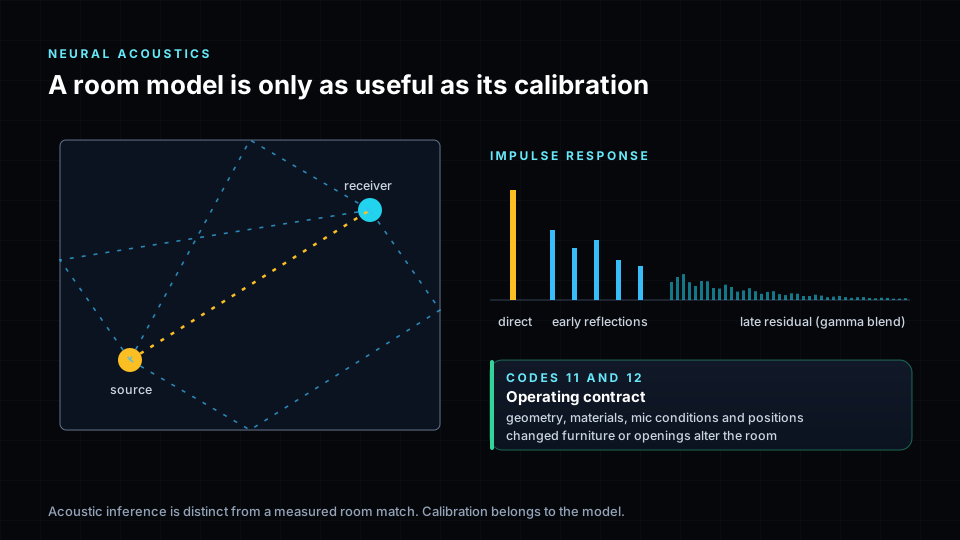
Three acoustic promises are kept separate: suggesting a convincing room character, replaying a captured scene and reconstructing a particular physical venue. A picture, a rough mesh and measured responses are not interchangeable inputs. An acoustic system earns clarity by stating which promise it makes.
Read the room acoustics chapter, 19 papers and 2 code examples.
Listener personalization and binaural filtering
Personalization is its own layer. The creator defines the scene; the listener profile and playback system decide how that scene reaches the ears. Measurement, scanning, retrieval and generation are different ways to acquire a profile. The review prefers keeping profile acquisition separate from playback, with magnitude, timing and headphone assumptions stated.
Read the HRTF chapter, 9 papers and the two-ear timing example.
Loudspeaker sound-field control and personal sound zones
Loudspeaker control is the physical continuation of spatial authoring. The room, the array and the listener positions decide what an installation can realize. Isolation, sound-field accuracy and perceived placement are different achievements, and format compatibility alone does not supply calibration.
Read the sound zones chapter, 4 papers and 1 code example.
Representations and spatial evidence
Observed acoustic evidence is kept apart from plausible inference about missing information. An embedding may expose a direction, a language system may answer a grounded question and a codec may preserve channel relationships. Each gets credit for its demonstrated role, with downstream assumptions kept visible.
Read the representations chapter, 5 papers and the spatial codec example.
Evaluation and the meaning of a quality claim
Evaluation is a set of instruments with defined purposes. A reference metric diagnoses damage, a distributional distance compares collections and an audiovisual benchmark examines alignment. Creative preference is another question again. Each result is given the meaning its assumptions support, not turned into a universal judgment.
Read the evaluation chapter, 9 papers.
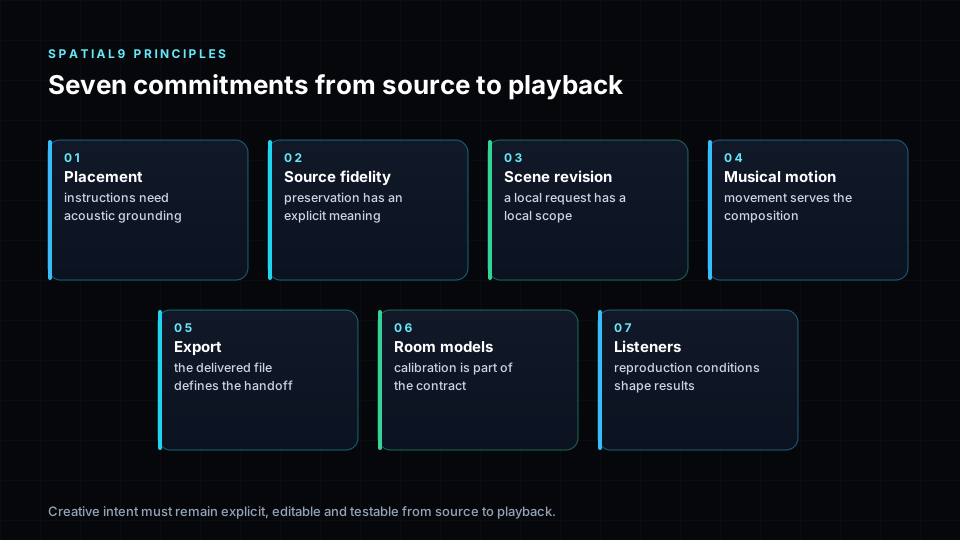
The seven principles Spatial9 applies
The review closes the loop by stating how it interprets the literature for Spatial9's own architecture. The same seven positions are applied to every paper.
| Area | Our position | Practical implication |
|---|---|---|
| Placement and planning | Instructions need acoustic grounding | The source, decision and affected interval remain identifiable |
| Source fidelity | Preservation has an explicit meaning | Identity, transparency and bit identity are distinguished |
| Scene revision | A local request has a local scope | Unrelated choices remain part of the creator's retained intent |
| Musical motion | Movement serves the composition | Stationary choices, timing and path design have separate roles |
| Export behavior | The delivered representation defines the handoff | Object state, sound-field rendering and player support are explicit |
| Room reconstruction | Calibration belongs to the model's operating contract | Acoustic inference is distinguished from a measured room match |
| Listener variation | A spatial result depends on reproduction conditions | HRTF fit, devices and listener behavior affect interpretation |
Read what the review means for Spatial9.
The fourteen assessment criteria
Every verdict in the review draws on fourteen production criteria. A method does not need to meet all of them to make a valuable contribution; the relevant ones follow from the task it promises to solve.
- Task and input parity.
- Content fidelity.
- Separation and identity.
- Audible direction, height and distance.
- Motion and musical intention.
- Complete song and scene continuity.
- Downmix and alternate playback.
- Latency and production cost.
- Room modeling.
- HRTF and listener variation.
- Export and playback verification.
- Listening studies.
- Metric validity.
- Editable delivery and recovery.
Read how each criterion is applied.
The fifteen code examples
The code in the full review connects selected papers to explicit engineering decisions. Each example is short and inspectable. The titles alone show the theme: keep meaning explicit at every interface.
| # | Example | Chapter |
|---|---|---|
| 1 | Keep a learned control connected to an explicit DSP operation | Planning |
| 2 | Validate a spatial instruction before changing the scene | Planning |
| 3 | Turn a movement window into a continuous trajectory | Planning |
| 4 | HTDemucs and the named stem output contract | Separation |
| 5 | SAM Audio and a prompted extraction with its residual | Separation |
| 6 | Keep scene identity across waveform revisions | Separation |
| 7 | Decode ACCDOA activity and direction separately | Localization |
| 8 | Make the FOA channel convention explicit | Generation and upmixing |
| 9 | Reconcile coordinates before neural binaural rendering | Binaural rendering |
| 10 | Expose a concrete binaural cue preservation invariant | Binaural enhancement |
| 11 | Keep coordinates explicit at the neural field interface | Room acoustics |
| 12 | Keep reflection parameters tied to acoustic paths | Room acoustics |
| 13 | Preserve both ears timing when a profile reaches playback | HRTF |
| 14 | A sound zone objective must see the calibrated acoustic paths | Sound zones |
| 15 | Penalize directional damage in a spatial codec | Codecs |
Jump straight to a few of them: HTDemucs stems, ACCDOA decoding and the spatial codec penalty.
Standards and where the market fits
Standards are included for delivery context, not counted as academic models. The review covers four, including the ITU-R Audio Definition Model and the Alliance for Open Media Immersive Audio Model and Formats (IAMF), the format behind Eclipsa Audio. For the files themselves, see what an ADM BWF file is and how Eclipsa Audio compares with Dolby Atmos.
Spatial9's market position, as stated in the review, is an AI spatial production system centered on controllable creative intent. The research supplies specialized contributions to each part of that workflow; no single research family owns the whole process.
Read the standards chapter or the market positioning.
The conclusion
Spatial audio now has a substantial set of specialized capabilities across perception, generation, acoustic modeling and control. The production challenge is connecting them while keeping the meaning of sources, decisions and representations intact through ambiguity, revision and delivery. A creator needs to know which source is controlled, what an instruction changes, which intentions remain intact and what the recipient receives.
Read the full conclusion. To see these principles at work in agent workflows, read our guide to agentic AI and the Spatial9 MCP and API.
Frequently asked questions
What is AI spatial audio?
AI spatial audio is the use of machine learning to analyze, create, place, render or deliver sound in three-dimensional space. In the Spatial9 review it spans twelve research branches, including source separation, sound-event localization, binaural and Ambisonic rendering, spatial generation, neural room acoustics, HRTF personalization, loudspeaker sound-zone control, neural codecs and quality metrics.
How many papers does the Spatial9 research review cover?
It covers 124 academic records: the ninety-six records of the original research catalog plus twenty-eight additions on spatial reasoning, binaural enhancement, loudspeaker control, production interaction and differentiable processing. Four standards are discussed separately as delivery context.
What is the main conclusion of the review?
Production value depends less on any single model and more on keeping creative intent explicit, editable and testable from the first source file to final playback. Each research family contributes a specialized capability, and the product challenge is connecting them without losing the meaning of sources and decisions.
Why is one quality score not enough for spatial audio?
Fidelity, localization, externalization, immersion and artistic preference are related but distinct attributes. Metrics such as SAQAM and AMBIQUAL measure different things in different domains, so the review favors an interpretable profile of outcomes over a single unexplained score.
Does the full review include code?
Yes. It includes fifteen short code examples, from the official HTDemucs and SAM Audio interfaces to ACCDOA decoding, FOA channel conventions, two-ear timing for HRTF profiles, sound-zone objectives and a spatial codec penalty.
Where can I read the paper-by-paper verdicts?
In the full research review. Its contents list opens every chapter, and each chapter lists its papers with a research contribution, a Spatial9 assessment and a verdict.
Sources
- [Full review] Spatial9 Engineering Team. AI Spatial Audio: From Research to Creative Control. Spatial9, October 2026. The source for every statement on this page.
- [2] DDSP: Differentiable Digital Signal Processing. 2020. ICLR 2020. Primary record
- [17] Bowen Shi et al. SAM Audio: Segment Anything in Audio. 2026. ICML 2026. Primary record
- [23] Kazuki Shimada et al. ACCDOA: Activity-Coupled Cartesian Direction of Arrival Representation for Sound Event Localization and Detection. 2021. ICASSP 2021. Primary record
- [79] Learning Neural Acoustic Fields. 2022. NeurIPS 2022. Primary record
- [98] HRTF Field: Unifying Measured HRTF Magnitude Representation with Neural Fields. 2023. IEEE ICASSP 2023. Primary record
- [116] SAQAM: Spatial Audio Quality Assessment Metric. 2022. Interspeech 2022. Primary record
- [125] ITU-R BS.2076-3 Audio Definition Model. 2025. ITU-R Recommendation BS.2076-3. Primary record
- [126] Immersive Audio Model and Formats v2.0.0. 2026. Alliance for Open Media. Primary record
- [138] Demucs official Python API documentation. Primary record
Source numbers match the numbering in the full review.