What Is Immersive Audio? A Plain-English Guide to 3D Sound
Spatial9 Team · · Updated · 7 min read
Key takeaways
- Immersive audio is sound that surrounds the listener in three dimensions: in front, to the sides, behind and above, instead of on a line between two speakers.
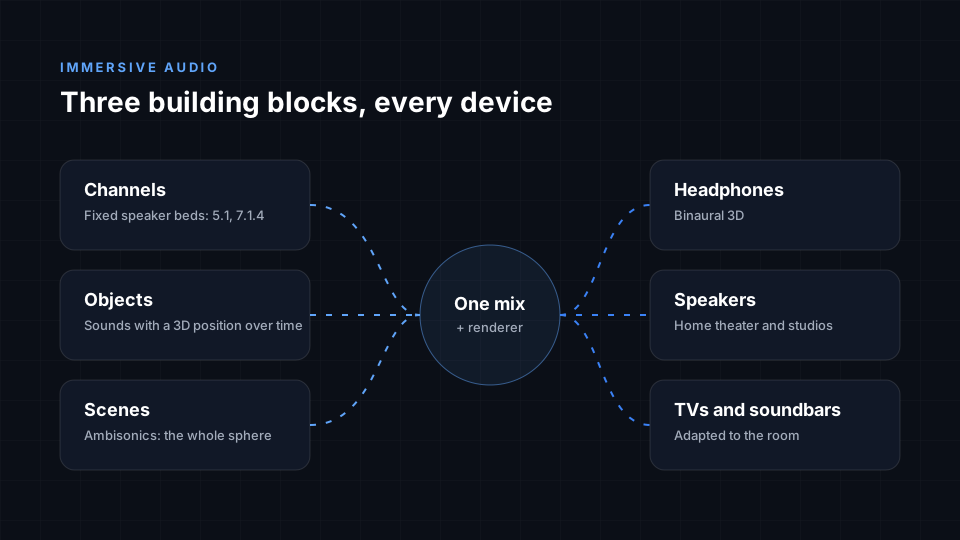
- It is built from three blocks: channels for fixed speakers, objects that carry their own position, and scenes that capture a whole sphere of sound.
- A renderer fits the same immersive mix to headphones (as binaural sound), to speaker rooms such as 7.1.4, or to TVs and soundbars.
- The main formats are Dolby Atmos, Eclipsa Audio (IAMF), Sony 360 Reality Audio, MPEG-H 3D Audio and Ambisonics, with ADM BWF as the master file format.
- You can make immersive audio by mixing stems in 3D, by spatializing a stereo song with AI, or by converting an existing Atmos master.
Close your eyes in a forest and you can point to every sound: the stream to your left, a bird somewhere above, footsteps behind you. Now put on a stereo recording of the same forest. Everything collapses onto a thin line between your ears.
Immersive audio is the technology that gives recordings their space back.
What is immersive audio?
Immersive audio is sound that surrounds the listener in three dimensions, coming from in front, from the sides, from behind and from above, instead of from a line between two speakers. Each sound can have its own place in space, and that place can move, so a mix feels like a room you are standing in rather than a picture you are looking at.
You can hear immersive audio on ordinary headphones, on phones, TVs and soundbars, and in rooms with speakers placed around and above the listener. The same mix is adapted to each one.
Immersive, spatial, 3D or surround: what is the difference?
These words overlap, and people often use them for the same thing. Here is how they are usually meant.
| Term | What it usually means |
|---|---|
| Stereo | Two channels, left and right. Sound sits on a line between two speakers. |
| Surround | Speakers around the listener at ear level, such as 5.1 or 7.1. Sound circles you but has no height. |
| Immersive audio | Surround plus height: sound in a full 3D space, from formats such as Dolby Atmos and Eclipsa Audio. The term the industry and standards bodies most often use. |
| Spatial audio | The everyday term for the same idea, popularized by Apple. It also covers head tracking on headphones. |
| 3D audio | A general term for any sound with direction and height. |
| Binaural | Immersive sound prepared for two ears, so headphones can play it. |
In short: immersive audio and spatial audio describe the same experience. Surround is the ring around you. Immersive audio adds the sky. For a deeper look at the overlap, read What Is Spatial Audio? and Stereo vs Immersive Sound.
How immersive audio works
Your brain finds the direction of a sound from tiny clues. A sound on your left reaches your left ear a fraction of a millisecond earlier, and slightly louder. The folds of your outer ear change its tone depending on whether it comes from above, below, in front or behind. Immersive audio keeps the information needed to recreate those clues.
The three building blocks
- Channels. One signal for each speaker in a fixed layout, such as 5.1 or 7.1.4. In 7.1.4, seven speakers sit at ear level, one subwoofer carries the low end, and four speakers sit overhead.
- Objects. A single sound, such as a voice or a guitar, saved with its position in space, which can change over time. The player works out which speakers or which ear should reproduce it. Learn more in beds and objects explained.
- Scenes. A recording or mix of the whole sphere of sound around a point, known as Ambisonics. It can be turned in any direction, which makes it ideal for 360 video and virtual reality. See Ambisonics explained.
The renderer
A renderer turns these blocks into the signals your device can play. On headphones it creates binaural sound, applying the same timing and tone clues your ears would hear in a real room, so two earpieces can sound like a full sphere. On a speaker system it sends each sound to the right speakers. On a TV or soundbar it creates virtual height and width from fewer speakers.
This is the big idea behind immersive audio: you mix once, and the renderer fits the mix to every listener.
The main immersive audio formats
| Format | Who is behind it | Built from | Where you hear it |
|---|---|---|---|
| Dolby Atmos | Dolby, licensed | Beds (channels) and objects | Apple Music, Amazon Music, TIDAL, cinemas, many TVs and soundbars |
| Eclipsa Audio (IAMF) | Google and Samsung, on an open AOMedia standard, royalty-free | Channels and Ambisonics scenes | YouTube, Samsung 2025 TVs and soundbars, open players |
| Sony 360 Reality Audio | Sony, licensed | Objects on a sphere | Amazon Music, some Sony devices |
| MPEG-H 3D Audio | MPEG standard, licensed | Channels, objects and scenes | Broadcast TV in some countries |
| Ambisonics | Open technique | Scenes | 360 video, VR, games |
| ADM BWF | ITU standard for masters | Any of the above, with metadata | Delivery and archiving, not listening |
ADM BWF deserves a special mention. It is not a listening format but the master file that immersive mixes are delivered in: the audio plus a map of where every sound sits and how it moves. See What Is an ADM BWF File?
The format that has changed the most recently is Eclipsa Audio. It is open and royalty-free, and YouTube plays it. Spatial9 released the first music on YouTube in Eclipsa Audio on January 3, 2025. Read the full story in What Is Eclipsa Audio?
Why immersive audio matters
- More room for every sound. In stereo, every instrument competes for the same narrow space. In 3D, a vocal can sit in front, a choir can rise above and a synth can circle behind, and each one is easier to hear.
- Closer to real life. We hear in three dimensions all day. Immersive audio brings recordings closer to how the world actually sounds.
- New ways to tell a story. Sound can move with a film scene, follow a player in a game or place a podcast guest beside you.
- One mix that grows with the listener. The same file sounds good on earbuds today and better on a home cinema tomorrow.
Hear it for yourself. Put on headphones and compare a stereo song with its immersive version.
Listen to the before and after music examples (best on headphones).
Do I need special equipment?
No. Any pair of headphones can play immersive audio in its binaural form. Speaker systems, soundbars and TVs with Dolby Atmos or Eclipsa Audio support add real or virtual speakers around and above you. Headphones and speakers each have strengths, which we compare in headphone vs speaker spatial audio.
Common myths about immersive audio
- "It is just a wider stereo effect." No. Stereo widening only stretches the line between two speakers. Immersive audio stores real positions, including height.
- "It only works with expensive gear." No. The binaural version plays on everyday headphones.
- "It is only for films." No. Music, podcasts, games, live events and video creators all use it, and you can publish immersive music on many platforms.
- "Making it takes a studio full of speakers." Not any more. AI tools and open formats have put immersive mixing within reach of every creator.
How to make immersive audio
- Mix from stems in 3D. Place each instrument in a DAW with an immersive panner, such as Google's open-source Eclipsa Audio plugin or a Dolby Atmos renderer.
- Spatialize a stereo song with AI. The Spatializer for Music separates a finished song into its instruments, places each one in 3D, and exports Eclipsa Audio for YouTube and Dolby Atmos for Apple Music, Amazon Music and TIDAL. Read how to create spatial audio from stereo.
- Convert a mix you already have. If you have a Dolby Atmos ADM master, the free ADM to Eclipsa converter turns it into Eclipsa Audio for YouTube without remixing.
- Check before you release. Try your current files to see whether a file is really immersive and hear it in a virtual 7.1.4 room.
Frequently asked questions
What is immersive audio in simple terms?
Immersive audio is sound that comes from all around you, including above, so a recording feels like a space you are standing in. It works on headphones as well as on speaker systems.
Is immersive audio the same as spatial audio?
Mostly, yes. Both describe 3D sound that surrounds the listener. Immersive audio is the term the industry uses most. Spatial audio is the everyday term popularized by Apple, which also covers head tracking on headphones.
What is the difference between immersive audio and surround sound?
Surround sound places speakers around you at ear level, as in 5.1 or 7.1. Immersive audio adds height, with sound from above, and often stores sounds as objects with their own positions.
What are the main immersive audio formats?
The main formats are Dolby Atmos, Eclipsa Audio (built on the open IAMF standard), Sony 360 Reality Audio, MPEG-H 3D Audio and Ambisonics. ADM BWF is the standard master file used to deliver immersive mixes.
Can I listen to immersive audio on normal headphones?
Yes. A renderer turns the mix into binaural sound, which creates the 3D effect for two ears on any pair of headphones.
How do I turn a stereo song into immersive audio?
Use an AI spatializer, such as the Spatializer for Music, which separates the song into its instruments and places each one in 3D. Or bring the stems into a DAW and mix them with an immersive panner.
Sources
- Recommendation ITU-R BS.2051, Advanced sound system for programme production, International Telecommunication Union.
- Recommendation ITU-R BS.2076, Audio Definition Model, International Telecommunication Union.
- Immersive Audio Model and Formats (IAMF) specification, Alliance for Open Media.
- Introducing Eclipsa Audio: immersive audio for everyone, Google Open Source Blog, January 15, 2025.
- Dolby Atmos, Dolby Laboratories.
- Jens Blauert, Spatial Hearing: The Psychophysics of Human Sound Localization, revised edition, MIT Press, 1997.