Spatial Audio & Immersive Music for Drill: Complete Guide
Spatial9 Team · · Updated
Part of the series Spatial audio and immersive music by genre.
Drill grew from Chicago and London into a global sound, with scenes in New York, Brooklyn, Paris and beyond. It is defined by sliding 808 basslines, skippy hi-hats, dark melodies and a cold, menacing mood. In spatial audio, drill does not need to be huge or airy. It needs to feel close, dark and heavy. This guide covers how spatial audio for drill works, where to place each element and how to make an immersive drill mix. For the basics, see what spatial audio is.
Why drill needs a tight, dark 3D mix
Drill's power comes from the 808 and the voice. Spreading them out would weaken the track. Instead, a good immersive drill mix keeps the core centred and uses the space around it for dark textures and ad-libs that surprise the listener.
The rule: 808 and vocal never leave the centre. The space around them stays dark and tight.
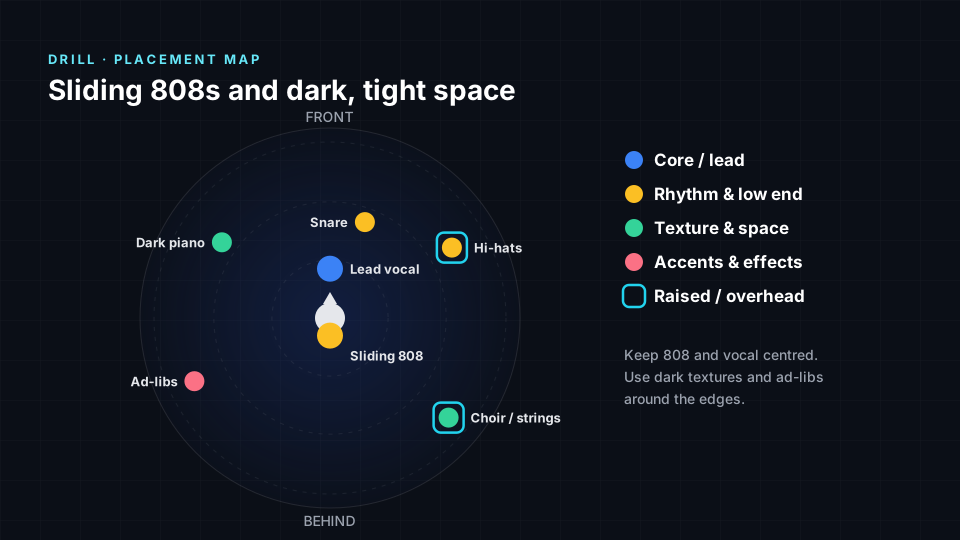
Immersive music for drill: what listeners hear
- 808s that slide through you. The bass stays centred and physical.
- A voice up close. The rapper sits right in front, dry and direct.
- Hats with height. Skippy hi-hats rise slightly above.
- Darkness around the edges. Piano, choir and ad-libs create a menacing atmosphere.
Where to place each element in a drill mix
| Element | Position | Height | Why it works |
|---|---|---|---|
| Lead vocal | Front centre | Ear level | Direct and dominant |
| Sliding 808 | Centre | Ear level | The signature low end |
| Snare | Front right | Ear level | Sharp, off-kilter hits |
| Hi-hats | Right | Raised | Skippy energy above |
| Dark piano | Front left | Ear level | Menacing melody |
| Ad-libs | Behind left, moving | Ear level | Surprise hits |
| Choir and strings | Behind right | Raised | Dark, cinematic depth |
The psychoacoustics behind drill placement
Every position in the table above follows how the ear and brain locate sound. Here is the reason behind the main choices for drill.
- Lead vocal in front. The ear's directional resolution is finest in front of the face and much coarser to the sides and behind, so the part you must follow belongs in front. Drill verses are dense, so the voice needs the sharpest position.
- Sliding 808 centred. Deep bass is the hardest sound for the ear to locate. Its wavelengths are several metres long, far larger than your head, so both ears receive almost the same level and only a tiny timing difference. The 808 already moves in pitch, and moving it in space as well would only muddy the low end.
- Hi-hats raised on the right. Height is heard mainly through treble: the folds of the outer ear colour frequencies above roughly 4 kHz differently for each elevation, so airy, bright parts are the ones that truly sound overhead. Fast, bright hats are among the easiest sounds to hear above you.
- Ad-libs moving behind left. The ear needs a larger angle to notice movement than to notice position, so slow, wide moves are followed easily while fast ones blur into a wash. Short moves behind the listener make ad-libs pop without stepping on the verse.
The immersion profile for drill
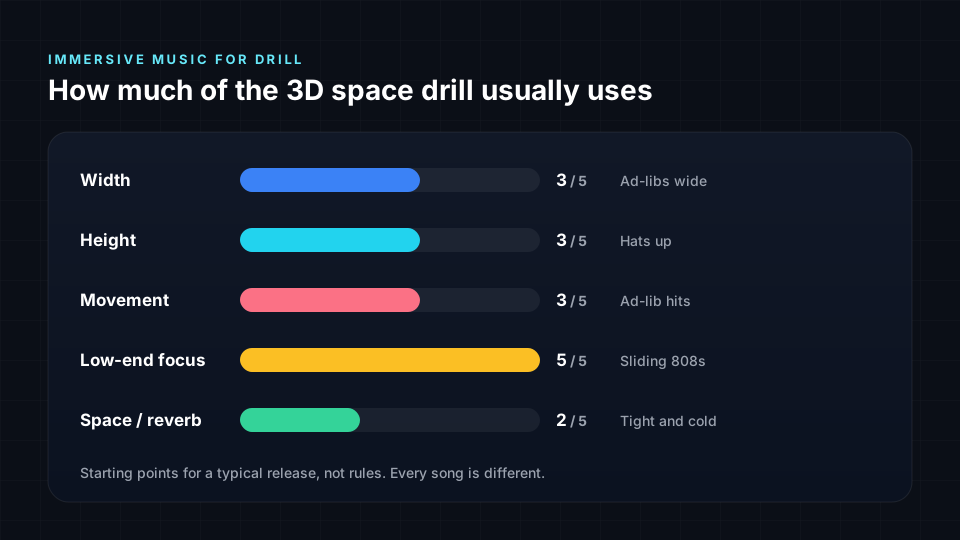
Low-end focus is at maximum because the sliding 808 defines drill. The space is deliberately tight and dry to keep the cold, close feel.
Tips for an immersive drill mix
- Keep the 808 centred and mono. Its slides must stay clear on phones and cars.
- Keep the vocal dry. Drill vocals are direct, not washed in reverb.
- Throw the ad-libs. Short hits from behind add energy and surprise.
- Use dark textures for width. Piano and choir fill the sides without crowding the centre.
- Avoid big rooms. A tight space suits drill's cold mood.
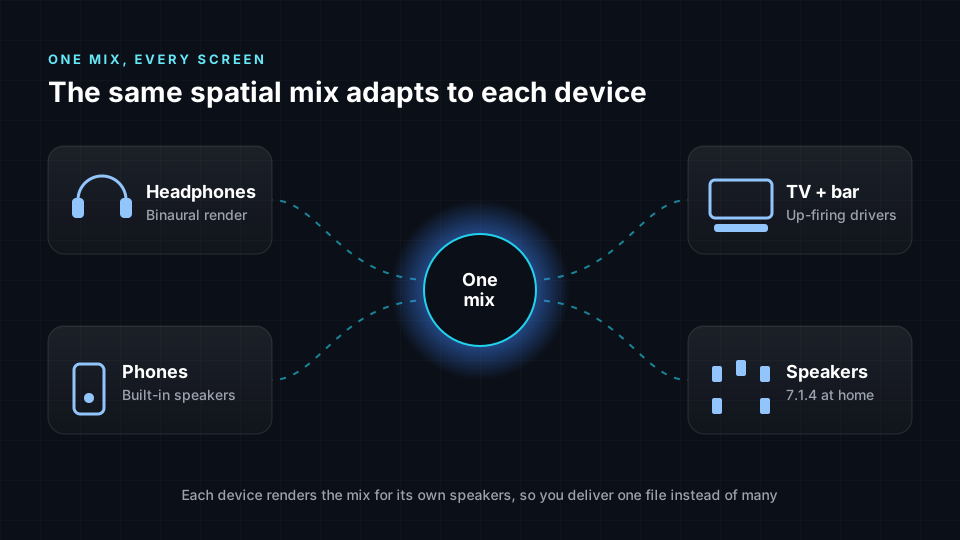
How to make immersive drill from stereo
Spatial9 can create spatial audio from a stereo track in a few steps:
- Upload your stereo master or your stems.
- Spatial9's AI separates and places each part, keeping the 808 and vocal centred.
- Preview it in binaural on headphones.
- Export Eclipsa Audio, ADM, binaural or Ambisonics.
- Publish a video. Create a YouTube-ready video with your immersive audio and publish it directly.
For related guides, read spatial audio for trap and spatial audio for grime. Every guide is listed in spatial audio and immersive music by genre.
Frequently asked questions
Can I make a drill mix in Dolby Atmos or Eclipsa Audio?
Yes. The placements in this guide work for both. Spatial9 exports ADM, the standard file used by Dolby Atmos studios, as well as Eclipsa Audio for YouTube, so one immersive drill mix covers both. You may also hear this called a 3D drill mix or drill in spatial audio.
Is spatial audio good for drill?
Yes, when the 808 and vocal stay centred. Dark textures and ad-libs around the listener make the track feel more menacing.
Should the 808 be spread in 3D?
No. Keep it centred and mono so its slides stay powerful on every system.
How is drill different from trap in spatial audio?
Drill uses a tighter, darker space and more off-kilter rhythms. Trap can be wider and more spacious.
Can I convert a finished drill track to spatial audio?
Yes. Spatial9 uses AI to generate an immersive mix from a stereo master and exports it as Eclipsa Audio, ADM, binaural or Ambisonics.
Does immersive drill work on normal headphones?
Yes. The mix is rendered binaurally, so the 3D effect works on any regular headphones.
Dolby and Dolby Atmos are trademarks of Dolby Laboratories. Spatial9 is not affiliated with or endorsed by Dolby Laboratories.
Sources
- Blauert, J. (1997). Spatial Hearing: The Psychophysics of Human Sound Localization, revised edition. MIT Press. Low-frequency, elevation, distance and motion cues.
- Mills, A. W. (1958). On the minimum audible angle. Journal of the Acoustical Society of America, 30(4), 237-246.
- Hebrank, J. and Wright, D. (1974). Spectral cues used in the localization of sound sources on the median plane. Journal of the Acoustical Society of America, 56(6), 1829-1834.
- Bronkhorst, A. W. (2000). The cocktail party phenomenon: a review of research on speech intelligibility in multiple-talker conditions. Acta Acustica united with Acustica, 86, 117-128.
- Litovsky, R. Y., Colburn, H. S., Yost, W. A. and Guzman, S. J. (1999). The precedence effect. Journal of the Acoustical Society of America, 106(4), 1633-1654.
- Barron, M. and Marshall, A. H. (1981). Spatial impression due to early lateral reflections in concert halls. Journal of Sound and Vibration, 77(2), 211-232.
- Neuhoff, J. G. (1998). Perceptual bias for rising tones. Nature, 395, 123-124.
- Bregman, A. S. (1990). Auditory Scene Analysis: The Perceptual Organization of Sound. MIT Press.
Make your 808s hit harder
Upload a track to Spatial9 and hear your drill close in around you in minutes. Then export it or publish it straight to YouTube.