Spatial Audio & Immersive Music for Hypnotic Techno: Complete Guide
Spatial9 Team · · Updated
Part of the series Spatial audio and immersive music by genre.
Hypnotic techno is about trance-like repetition. Tracks change very little over long periods, using subtle shifts in texture and space to keep the listener locked in. In spatial audio, those shifts can become physical: a loop that slowly circles your head is the purest form of hypnotic movement. This guide covers how spatial audio for hypnotic techno works, where to place each element and how to make an immersive hypnotic techno mix. For the basics, see what spatial audio is.
Why hypnotic techno is perfect for slow movement
Because so little changes in the arrangement, every change in position is noticed. One loop orbiting over sixteen bars is enough to transform a track. Too many moving parts, on the other hand, break the spell.
The rule: move one thing at a time, and move it slowly. Repetition plus slow motion creates the trance.
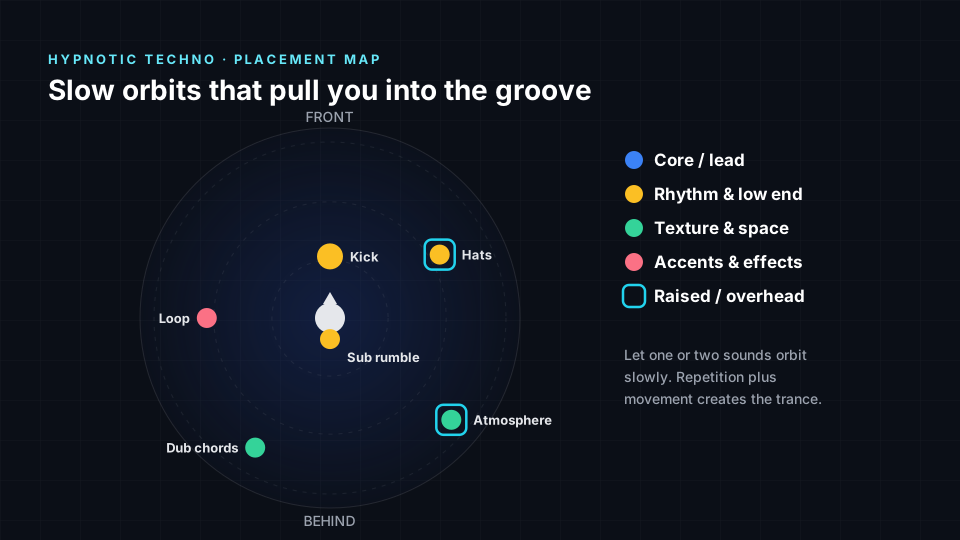
Immersive music for hypnotic techno: what listeners hear
- A deep, steady floor. Kick and sub rumble never move.
- A loop that circles. One percussive loop slowly travels around the head.
- Chords in the fog. Dub chords drift behind the listener with long echoes.
- A dark, endless room. Atmosphere and hats float above in the distance.
Where to place each element in a hypnotic techno mix
| Element | Position | Height | Why it works |
|---|---|---|---|
| Kick | Front centre | Ear level | The steady pulse |
| Sub rumble | Centre | Ear level | Deep, physical weight |
| Loop | Left, orbiting | Ear level | The main hypnotic movement |
| Hats | Front right | Raised | Light energy above |
| Dub chords | Behind left, drifting | Ear level | Depth and mystery |
| Atmosphere | Behind right | Raised | A dark, endless room |
The psychoacoustics behind hypnotic techno placement
Every position in the table above follows how the ear and brain locate sound. Here is the reason behind the main choices for hypnotic techno.
- Kick and sub rumble centred. Deep bass is the hardest sound for the ear to locate. Its wavelengths are several metres long, far larger than your head, so both ears receive almost the same level and only a tiny timing difference. Hypnosis depends on a low end that never moves.
- Loop orbiting on the left. Moving sounds grab attention because the brain is wired to track change, so motion works best when it is slow, deliberate and kept away from the anchor parts. Slow orbits are easy to track and turn repetition into a trance-like journey.
- Loop and kick on separate paths. The brain groups sounds that come from the same place into one stream and splits sounds from different places into separate ones (Bregman, 1990). A moving loop stays a separate stream from the static kick, so the groove stays clear.
- Dub chords and atmosphere drifting behind. Behind you, the ear relies on subtle treble cues, so placement is vaguer. That vagueness becomes an advantage for ambience and textures that should feel all around. Vague rear placement suits textures that should feel like a space rather than a source.
The immersion profile for hypnotic techno
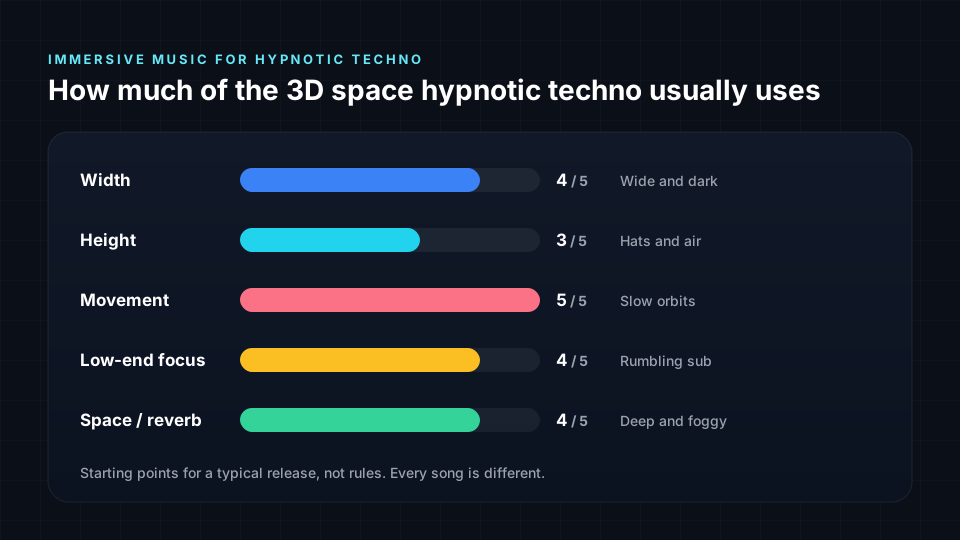
Movement is at maximum, but it is slow, continuous movement rather than fast effects. Space is deep and dark, while height is used only for atmosphere and hats.
Tips for an immersive hypnotic techno mix
- Pick one main mover. Let a single loop carry the orbit.
- Go slower than you think. A full circle over 8 or 16 bars feels hypnotic.
- Lock motion to the tempo. Synced movement deepens the trance, random movement breaks it.
- Use echo for depth. Dub-style delays on chords push them far behind the listener.
- Keep the low end untouched. Kick and sub stay centred and mono.
How to make immersive hypnotic techno from stereo
Spatial9 can create spatial audio from a stereo track in a few steps:
- Upload your stereo master or your stems.
- Spatial9's AI separates and places each part, with slow movement that follows the groove.
- Preview it in binaural on headphones.
- Export Eclipsa Audio, ADM, binaural or Ambisonics.
- Publish a video. Create a YouTube-ready video with your immersive audio and publish it directly.
For related guides, read spatial audio for techno and spatial audio for minimal techno. Every guide is listed in spatial audio and immersive music by genre.
Frequently asked questions
Can I make a hypnotic techno mix in Dolby Atmos or Eclipsa Audio?
Yes. The placements in this guide work for both. Spatial9 exports ADM, the standard file used by Dolby Atmos studios, as well as Eclipsa Audio for YouTube, so one immersive hypnotic techno mix covers both. You may also hear this called a 3D hypnotic techno mix or hypnotic techno in spatial audio.
Is spatial audio good for hypnotic techno?
Yes. Slow, repeating movement in 3D is one of the most powerful ways to create a hypnotic effect.
How many sounds should move in a hypnotic techno mix?
Usually one or two. Too many moving parts break the focus that hypnotic techno depends on.
How fast should a loop orbit?
Slowly. One full circle over 8 to 16 bars works well for most tracks.
Can I convert a finished hypnotic techno track to spatial audio?
Yes. Spatial9 uses AI to generate an immersive mix from a stereo master and exports it as Eclipsa Audio, ADM, binaural or Ambisonics.
Does immersive hypnotic techno work on normal headphones?
Yes. The mix is rendered binaurally, so the orbiting movement works on any regular headphones.
Dolby and Dolby Atmos are trademarks of Dolby Laboratories. Spatial9 is not affiliated with or endorsed by Dolby Laboratories.
Sources
- Blauert, J. (1997). Spatial Hearing: The Psychophysics of Human Sound Localization, revised edition. MIT Press. Low-frequency, elevation, distance and motion cues.
- Mills, A. W. (1958). On the minimum audible angle. Journal of the Acoustical Society of America, 30(4), 237-246.
- Hebrank, J. and Wright, D. (1974). Spectral cues used in the localization of sound sources on the median plane. Journal of the Acoustical Society of America, 56(6), 1829-1834.
- Bronkhorst, A. W. (2000). The cocktail party phenomenon: a review of research on speech intelligibility in multiple-talker conditions. Acta Acustica united with Acustica, 86, 117-128.
- Litovsky, R. Y., Colburn, H. S., Yost, W. A. and Guzman, S. J. (1999). The precedence effect. Journal of the Acoustical Society of America, 106(4), 1633-1654.
- Barron, M. and Marshall, A. H. (1981). Spatial impression due to early lateral reflections in concert halls. Journal of Sound and Vibration, 77(2), 211-232.
- Neuhoff, J. G. (1998). Perceptual bias for rising tones. Nature, 395, 123-124.
- Bregman, A. S. (1990). Auditory Scene Analysis: The Perceptual Organization of Sound. MIT Press.
Pull your listeners deeper
Upload a track to Spatial9 and hear your loops orbit around you in minutes. Then export it or publish it straight to YouTube.