
Spatial Audio & Immersive Music for Slap House: Complete Guide
Spatial9 Team · · 7 min read
Part of the series Spatial audio and immersive music by genre.
Key takeaways
- In a spatial slap house mix the kick, slap bass and pop vocal stay in the centre, while the pluck lead, shaker, vocal echoes, pads and risers are placed around the listener.
- Vocal echoes work best behind the listener in slap house, because the brain locates a voice by its first arrival, so delayed repeats from the rear add space without pulling the vocal away from the front.
- Frequencies below roughly 80 to 100 Hz give very little sense of direction, so the deep fundamental of a slap house bass loses nothing by staying centred and mono.
- The slap house immersion profile scores width 3, height 2, movement 2, low-end focus 5 and space 3 out of 5.
Slap house is a slower, heavier branch of house that grew out of Brazilian bass and deep house in the late 2010s and spread fast through streaming playlists and short-video platforms. Its sound is instantly recognisable: a deep, sliding bass with a hard, slapping attack, a simple kick and clap, short plucked leads and a pop vocal, often a reworked hook from a well-known song, sometimes pitched down. The genre is often called car music, because it was made to sound huge on car systems and phone speakers. That focus on a strong centre makes slap house a different challenge for spatial audio: the job is to add depth without weakening the hook. This guide covers how spatial audio for slap house works, where to place each element and how to make an immersive slap house mix. For the basics, see what spatial audio is.
Why slap house is ideal for spatial audio
Slap house tracks are simple, and that is their strength. With only a few parts, each one can be heard clearly in an immersive mix. The bass and vocal carry the track from the centre, while the space around them can be opened up with echoes, pads and plucks that stereo would squash into the same two speakers.
The rule: a heavy centre, a deep room. The slap bass and vocal never move, and everything else adds depth around them.
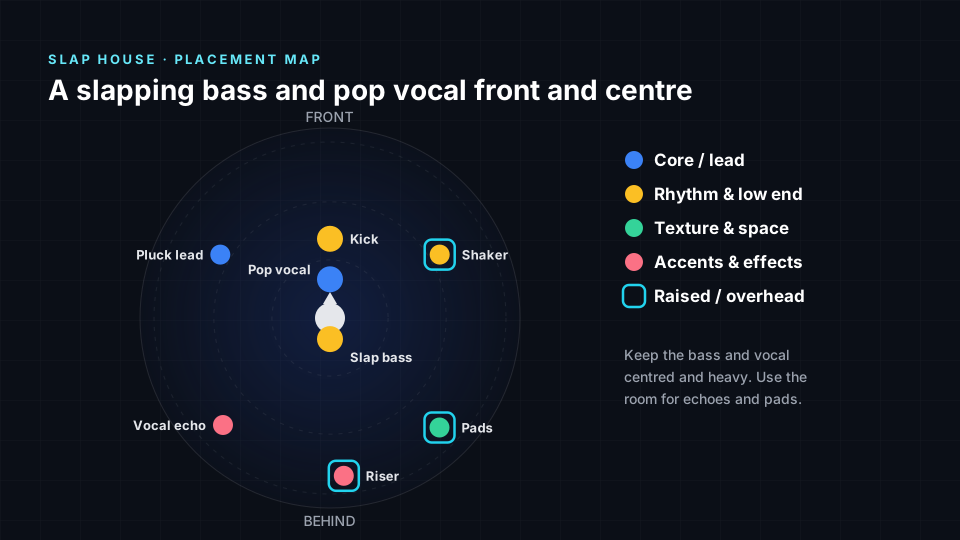
Immersive music for slap house: what listeners hear
- A bass that hits like a car system. The slap bass stays centred, heavy and mono.
- A vocal right in front. The hook stays clear and close.
- Echoes behind you. Vocal repeats drift gently around the rear.
- A deeper room. Pads and risers open the space above and behind.
Where to place each element in a slap house mix
| Element | Position | Height | Why it works |
|---|---|---|---|
| Kick | Front centre | Ear level | Simple, steady pulse |
| Slap bass | Centre | Ear level | The heavy, sliding hook |
| Pop vocal | Front centre | Ear level | The song everyone knows |
| Pluck lead | Front left | Ear level | Melodic answer to the vocal |
| Shaker | Front right | Raised | Light top-end groove |
| Vocal echo | Behind left, moving | Ear level | Space around the hook |
| Pads | Behind right | Raised | Soft, wide depth |
| Riser | Behind | Raised | Lift into the drop |
The psychoacoustics behind Slap House placement
Every position in the table above follows how the ear and brain locate sound. Here is the reason behind the main choices for Slap House.
- Slap bass stays centred. The ear gets very little direction from frequencies below roughly 80 to 100 Hz, which is why one subwoofer can serve a full speaker system. The deep fundamental of a slap house bass sits right in that range, so keeping it centred and mono keeps it huge on cars, clubs and headphones alike.
- Vocal echoes behind. When a sound and its delayed copies arrive close together, the brain locates the sound by the first arrival. This is the precedence effect. Sending the echoes of the pop vocal to the rear adds depth while the voice itself stays firmly in front.
- Shaker raised front right. Height is heard mostly through treble: the outer ear shapes frequencies above roughly 4 kHz differently for each elevation. A shaker is almost all treble, so it rises naturally and adds air without touching the bass.
- Pads behind. Direction behind the head is less precise, and front-back mix-ups are common. That makes the rear ideal for soft pads that should surround the listener rather than point at them, while the bass and vocal own the front.
The immersion profile for slap house
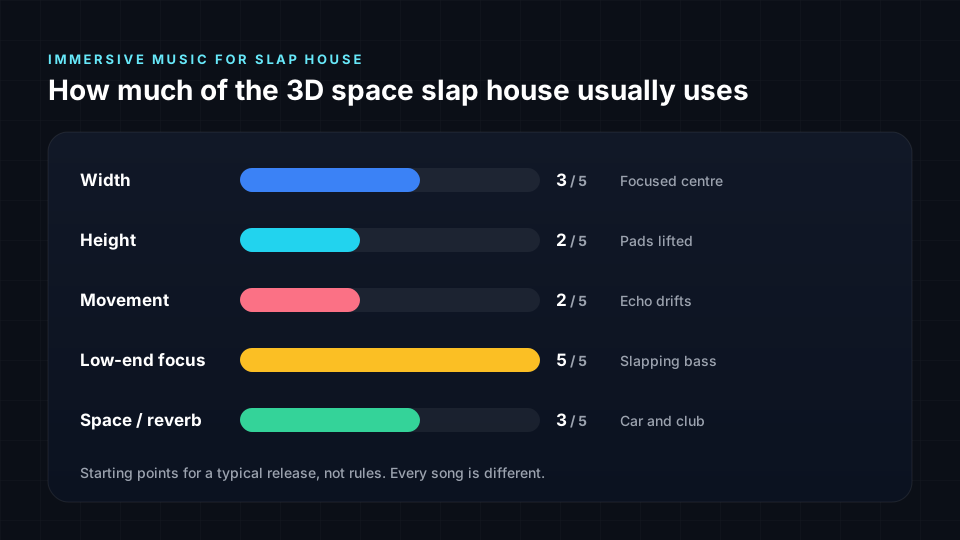
Low-end focus is at maximum because the slap bass is the hook. Width, height and movement stay modest: slap house works best when the centre is strong and the space around it adds depth rather than distraction.
Tips for an immersive slap house mix
- Never move the bass. The slap bass is the hook and must stay centred and mono.
- Keep the vocal close. A dry, upfront vocal keeps the pop hook strong.
- Use echoes for space. Delays behind the listener add depth without clutter.
- Keep it simple. A few well-placed parts beat a crowded room in this genre.
- Check small speakers. The mix should still hit hard when folded down to stereo or mono.
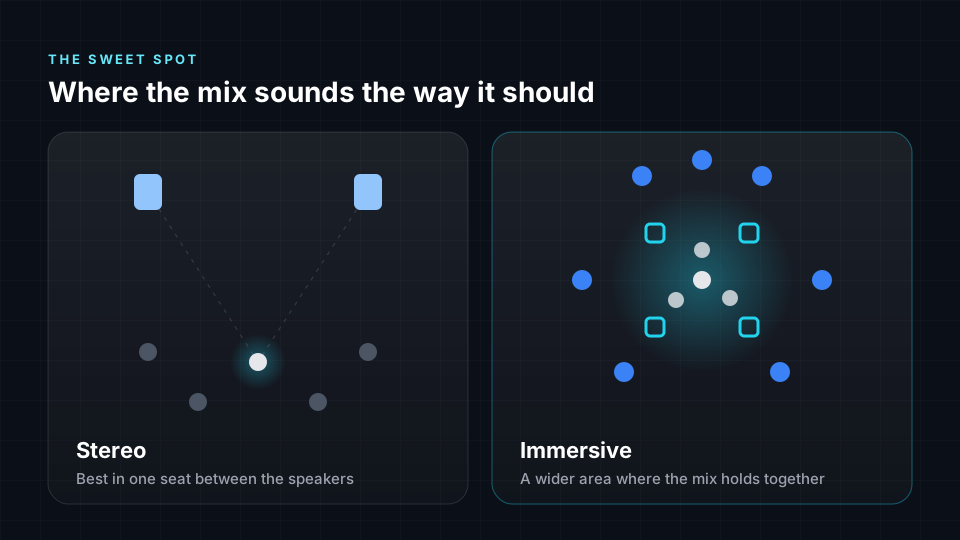
How to make immersive slap house from stereo
Spatial9 can create spatial audio from a stereo track in a few steps:
- Upload your stereo master or your stems.
- Spatial9's AI separates and places each part, keeping the slap bass and vocal centred and opening the space around them.
- Preview it in binaural on headphones.
- Export Eclipsa Audio, ADM, binaural or Ambisonics.
- Publish a video. Create a YouTube-ready video with your immersive audio and publish it directly.
For related guides, read spatial audio for future house and spatial audio for tropical house. Every guide is listed in spatial audio and immersive music by genre.
Frequently asked questions
Can I make a slap house mix in Dolby Atmos or Eclipsa Audio?
Yes. The placements in this guide work for both. Spatial9 exports ADM, the standard file used by Dolby Atmos studios, as well as Eclipsa Audio for YouTube, so one immersive slap house mix covers both. If you plan to release the Atmos version on Apple Music, build it from your original stems or multitracks, because Apple does not accept Atmos made from a finished stereo master. See where to publish spatial audio. You may also hear this called a 3D slap house mix or slap house in spatial audio.
Is spatial audio good for slap house?
Yes. Slap house has only a few parts, so each one stays clear in an immersive mix, and the space around the bass and vocal adds depth that stereo cannot.
Will spatial audio weaken the slap bass?
No, as long as the bass stays centred and mono. Spatial audio should open the space around it, not spread the bass itself.
Does slap house still work as car music in spatial audio?
Yes. A good immersive mix keeps the bass and vocal in the centre, so the track still hits hard when played back in stereo on a car system.
Can I convert a finished slap house track to spatial audio?
Yes. Spatial9 uses AI to generate an immersive mix from a stereo master and exports it as Eclipsa Audio, ADM, binaural or Ambisonics.
Does immersive slap house work on normal headphones?
Yes. The mix is rendered binaurally, so the heavy bass and wide room work on any regular headphones.
Dolby and Dolby Atmos are trademarks of Dolby Laboratories. Spatial9 is not affiliated with or endorsed by Dolby Laboratories.
Sources
- Blauert, J. (1997). Spatial Hearing: The Psychophysics of Human Sound Localization, revised edition. MIT Press. Low-frequency, elevation, distance and motion cues.
- Mills, A. W. (1958). On the minimum audible angle. Journal of the Acoustical Society of America, 30(4), 237-246.
- Hebrank, J. and Wright, D. (1974). Spectral cues used in the localization of sound sources on the median plane. Journal of the Acoustical Society of America, 56(6), 1829-1834.
- Bronkhorst, A. W. (2000). The cocktail party phenomenon: a review of research on speech intelligibility in multiple-talker conditions. Acta Acustica united with Acustica, 86, 117-128.
- Litovsky, R. Y., Colburn, H. S., Yost, W. A. and Guzman, S. J. (1999). The precedence effect. Journal of the Acoustical Society of America, 106(4), 1633-1654.
- Barron, M. and Marshall, A. H. (1981). Spatial impression due to early lateral reflections in concert halls. Journal of Sound and Vibration, 77(2), 211-232.
- Neuhoff, J. G. (1998). Perceptual bias for rising tones. Nature, 395, 123-124.
- Bregman, A. S. (1990). Auditory Scene Analysis: The Perceptual Organization of Sound. MIT Press.
Give your slap house track a deeper room
Upload a track to Spatial9 and hear your bass and vocal hit from the centre while the space opens around you in minutes. Then export it or publish it straight to YouTube.