Spatial Audio & Immersive Music for Midtempo: Glitch Hop, Darksynth & Cyberpunk Bass
Spatial9 Team · · 8 min read
Part of the series Spatial audio and immersive music by genre.
Key takeaways
- In an immersive midtempo mix the kick, snare and sub bass stay in the centre while distorted bass, lead synth, arpeggios, metallic FX and dark pads surround the listener.
- The distorted growl bass works best on the left with a slow sweep, while its sub layer stays centred, because only the upper harmonics of a bass sound carry useful direction.
- The ear locates sound most precisely in front and much less precisely to the sides and behind, so an arpeggio moving behind the listener feels smooth and ominous rather than pinpointed.
- The midtempo immersion profile scores width 4, height 3, movement 4, low-end focus 5 and space 3 out of 5.
Midtempo is a bass music style that grew through the 2010s, sitting around 100 to 110 BPM, slower than dubstep's double-time energy and faster than downtempo. It borrows from electro, industrial and dark synthwave: heavy, punchy drums, gritty distorted basslines, cold arpeggios, robotic textures and cinematic sound design. The pace leaves space between every hit, and that space is exactly what a 3D mix can fill. This guide covers how spatial audio for midtempo works, where to place each element and how to make an immersive midtempo mix. For the basics, see what spatial audio is.
Why midtempo is ideal for spatial audio
Midtempo is slow enough that each sound has time to travel. In stereo, a heavy distorted bass and a lead synth fight for the same mid range and the mix gets crowded. Around the listener, the bass can sweep the sides, the lead can hold its own place and the FX can lurk behind.
The rule: a heavy centre, a prowling edge. Drums and sub stay planted while the grit moves around them.
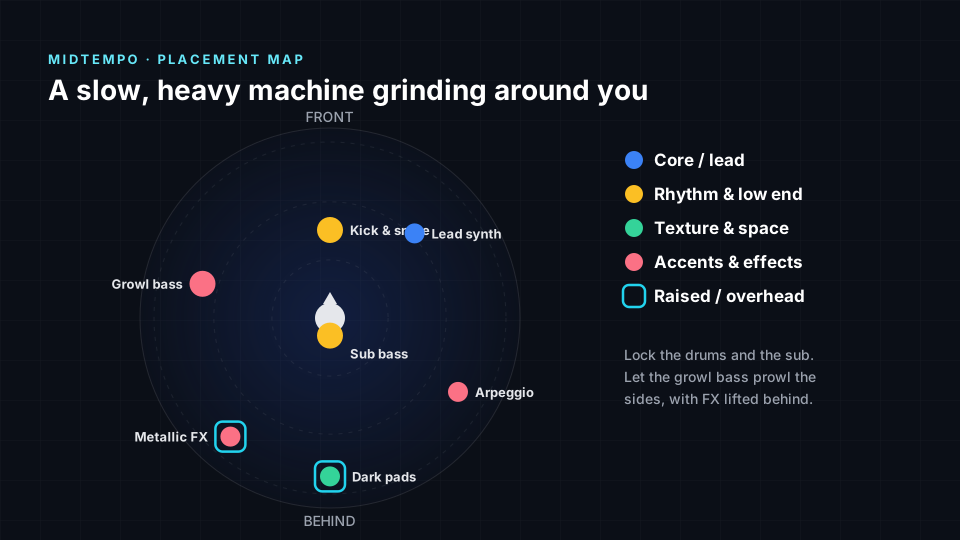
Immersive music for midtempo: what listeners hear
- Drums that land like weights. Kick and snare hit hard from the front.
- Bass that circles you. The distorted growl sweeps slowly across the side.
- Something moving behind. Arpeggios and metallic FX lurk at the back.
- A dark, solid floor. The sub stays deep and centred under everything.
Where to place each element in a midtempo mix
| Element | Position | Height | Why it works |
|---|---|---|---|
| Kick & snare | Front centre | Ear level | Slow, heavy impact |
| Sub bass | Centre | Ear level | The foundation |
| Growl bass | Left, sweeping | Ear level | Gritty motion at the side |
| Lead synth | Front right | Ear level | Clear melodic hook |
| Arpeggio | Behind right, moving | Ear level | Cold, hypnotic motion |
| Metallic FX | Behind left | Raised | Industrial detail above |
| Dark pads | Behind | Raised | Cinematic depth |
The psychoacoustics behind Midtempo placement
Every position in the table above follows how the ear and brain locate sound. Here is the reason behind the main choices for Midtempo.
- Sub bass centred, growl bass at the side. Sound below roughly 80 to 100 Hz carries very little direction, while the gritty upper harmonics of a distorted bass are easy to locate. Splitting the bass into a centred sub and a moving growl layer gives you weight and motion at the same time.
- Growl bass left, lead synth right. Two sounds that overlap in frequency are easier to tell apart when they come from different directions, an effect called spatial release from masking. Midtempo leads and distorted basses often clash in the mids, so opposite sides keep both readable.
- Metallic FX raised. The outer ear filters frequencies above roughly 4 kHz differently at each elevation, and that is the main cue for height. Clanks, hisses and metallic hits are rich in treble, so they sound convincingly overhead.
- Arpeggio moving behind. The ear judges direction most precisely straight ahead and much less precisely at the sides and behind. Motion at the back is felt rather than pinpointed, which gives a moving arpeggio a smooth, ominous quality.
The immersion profile for midtempo
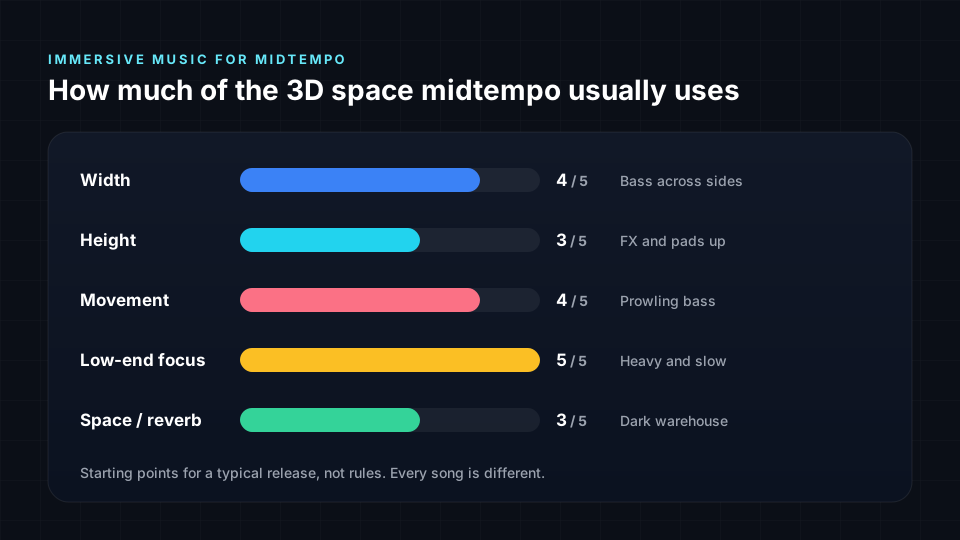
Low-end focus is at maximum because the heavy drums and sub carry the genre. Movement is high from the prowling bass and arpeggios, while the space stays dark and controlled so every hit keeps its weight.
Tips for an immersive midtempo mix
- Split your bass. Keep the sub centred and mono, and move only the distorted upper layer.
- Move slowly. The tempo is unhurried, so sweeps should be long and heavy.
- Hide detail behind. Metallic FX and arps feel more menacing from the back.
- Keep the drums dry. Short rooms keep the kick and snare punchy at a slow tempo.
- Use the gaps. Let a single FX hit fly through the space in the pauses between beats.
Midtempo styles: glitch hop, darksynth and cyberpunk bass
The core placement from this guide still applies to every midtempo style: kick, snare and sub bass stay centred while the grit moves around them. Here is what changes from one style to the next.
Glitch hop
Glitch hop blends hip hop breakbeats with stuttered edits, chopped samples and funky, wobbling bass at a similar unhurried tempo. In a spatial mix the drums stay dry and front centre, but the glitch edits become the moving layer: short stutters and cut-up fragments can jump between the sides and the rear in the gaps between hits. Keep the growl bass sweep shorter and bouncier than in darker midtempo, and use less reverb so the funk stays tight.
Darksynth
Darksynth is the aggressive, horror-tinged side of synthwave: distorted analogue-style leads, pounding drums, cold arpeggios and menacing pads. Here the dark pads and arpeggio carry more of the mix, so raise the pads a little higher behind and let the arpeggio circle slowly from behind right towards the left. The lead synth can move closer to front centre. Allow a slightly larger, darker space than standard midtempo, while the kick and sub remain planted.
Cyberpunk bass
Cyberpunk bass leans hardest into heavy, distorted bass design and industrial, sci-fi textures, with robotic voices and machine noises over a slow, crushing beat. Push the metallic FX further around the listener, raised behind left and spilling to the sides, so the machine room feels bigger. The growl bass sweep on the left can widen across both sides, but keep the clean sub mono in the centre. Drums stay dry and close for maximum weight.
How to make immersive midtempo from stereo
Spatial9 can create spatial audio from a stereo track in a few steps:
- Upload your stereo master or your stems.
- Spatial9's AI separates and places each part, keeping drums and sub centred and moving the distorted bass and FX around you.
- Preview it in binaural on headphones.
- Export Eclipsa Audio, ADM, binaural or Ambisonics.
- Publish a video. Create a YouTube-ready video with your immersive audio and publish it directly.
For related guides, read spatial audio for dubstep and spatial audio for synthwave. Every guide is listed in spatial audio and immersive music by genre.
Frequently asked questions
Does this guide cover glitch hop, darksynth and cyberpunk bass?
Yes. All three keep the kick, snare and sub bass centred and dry. Glitch hop moves its stuttered edits and chopped samples quickly between the sides and rear with little reverb. Darksynth lifts the dark pads higher behind and lets the arpeggio circle slowly in a slightly larger space. Cyberpunk bass spreads metallic FX and robotic textures further around the listener and widens the distorted growl bass.
Can I make a midtempo mix in Dolby Atmos or Eclipsa Audio?
Yes. The placements in this guide work for both. Spatial9 exports ADM, the standard file used by Dolby Atmos studios, as well as Eclipsa Audio for YouTube, so one immersive midtempo mix covers both. If you plan to release the Atmos version on Apple Music, build it from your original stems or multitracks, because Apple does not accept Atmos made from a finished stereo master. See where to publish spatial audio. You may also hear this called a 3D midtempo mix or midtempo in spatial audio.
Is spatial audio good for midtempo?
Yes. Midtempo leaves room between its heavy hits, and spatial audio fills that room with bass and FX that move around the listener.
Should the distorted bass move in a midtempo mix?
The upper, gritty layer can sweep slowly across one side. The sub layer underneath should stay centred and still.
How much reverb does midtempo need?
Moderate. Dark pads and FX can sit in a large, shadowy space behind, but the drums and bass should stay fairly dry to keep their impact.
Can I convert a finished midtempo track to spatial audio?
Yes. Spatial9 uses AI to generate an immersive mix from a stereo master and exports it as Eclipsa Audio, ADM, binaural or Ambisonics.
Does immersive midtempo work on normal headphones?
Yes. The mix is rendered binaurally, so the prowling bass and lurking FX work on any regular headphones.
Dolby and Dolby Atmos are trademarks of Dolby Laboratories. Spatial9 is not affiliated with or endorsed by Dolby Laboratories.
Sources
- Blauert, J. (1997). Spatial Hearing: The Psychophysics of Human Sound Localization, revised edition. MIT Press. Low-frequency, elevation, distance and motion cues.
- Mills, A. W. (1958). On the minimum audible angle. Journal of the Acoustical Society of America, 30(4), 237-246.
- Hebrank, J. and Wright, D. (1974). Spectral cues used in the localization of sound sources on the median plane. Journal of the Acoustical Society of America, 56(6), 1829-1834.
- Bronkhorst, A. W. (2000). The cocktail party phenomenon: a review of research on speech intelligibility in multiple-talker conditions. Acta Acustica united with Acustica, 86, 117-128.
- Litovsky, R. Y., Colburn, H. S., Yost, W. A. and Guzman, S. J. (1999). The precedence effect. Journal of the Acoustical Society of America, 106(4), 1633-1654.
- Neuhoff, J. G. (1998). Perceptual bias for rising tones. Nature, 395, 123-124.
- Bregman, A. S. (1990). Auditory Scene Analysis: The Perceptual Organization of Sound. MIT Press.
Put your listeners inside the machine
Upload a track to Spatial9 and hear your bass and FX grind around you in minutes. Then export it or publish it straight to YouTube.