
Spatial Audio & Immersive Music for Melodic House: Complete Guide
Spatial9 Team · · 7 min read
Part of the series Spatial audio and immersive music by genre.
Key takeaways
- In an immersive melodic house mix the kick, bass and vocal stay in the centre while the lead synth, arpeggio, plucks and pads spread in a wide arc around and above the listener.
- The arpeggio works best on the right side with gentle movement, because separating it from the lead synth in direction helps the brain hear two clear melodic lines instead of one blurred one.
- Height is heard mainly through treble above roughly 4 kHz, so the airy tops of melodic house pads are the most convincing parts to lift overhead.
- The melodic house immersion profile scores width 4, height 4, movement 4, low-end focus 3 and space 5 out of 5.
Melodic house sits between deep house, progressive house and melodic techno. It grew through the 2010s around labels such as Anjunadeep and the sunrise and open-air sets that made the sound popular. Tracks run at a steady house tempo with warm rolling basslines, emotive chord progressions, arpeggiated synths, soft plucks, long pads and breathy vocals, often with a long breakdown before the groove returns. The music lives on atmosphere, and spatial audio gives every melodic layer its own place. This guide covers how spatial audio for melodic house works, where to place each element and how to make an immersive melodic house mix. For the basics, see what spatial audio is.
Why melodic house is ideal for spatial audio
Melodic house stacks several melodic parts at once: a lead, an arpeggio, plucks and pads. In stereo they compete for the same space between two speakers, and the emotion gets lost in a wash. Spread around the listener, every line can be followed and the chords feel larger without getting louder.
The rule: a calm centre, an open sky. The groove stays grounded in front while the melodies and pads drift around and above.
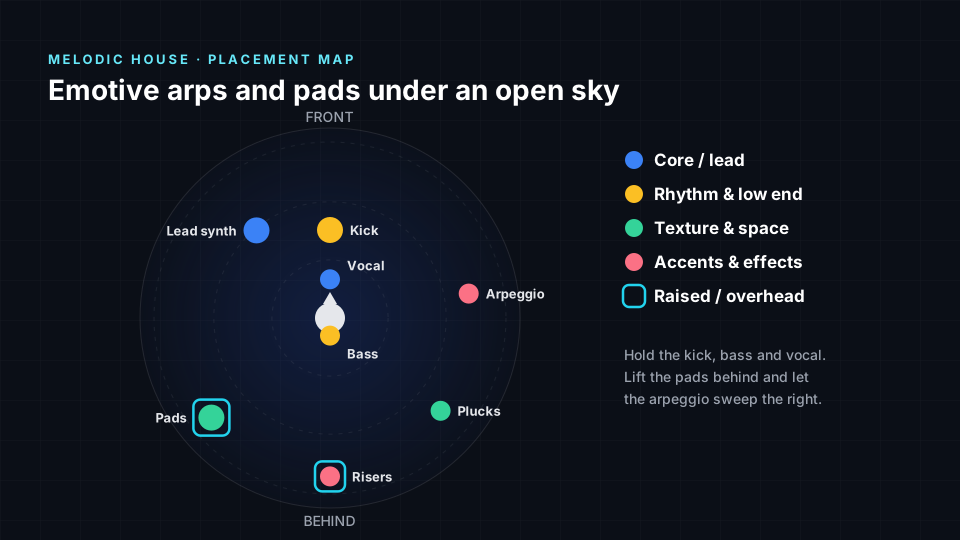
Immersive music for melodic house: what listeners hear
- A sky of chords. Pads float above and behind, so the harmony surrounds you.
- Melodies with room to breathe. The lead and the arpeggio come from different directions.
- A groove that never drifts. Kick and bass stay solid and centred.
- Breakdowns that open up. Risers and reverb lift the space before the drop returns.
Where to place each element in a melodic house mix
| Element | Position | Height | Why it works |
|---|---|---|---|
| Kick | Front centre | Ear level | The steady house pulse |
| Bass | Centre | Ear level | Warm and rolling |
| Vocal | Front centre | Ear level | Close, breathy focus |
| Lead synth | Front left | Ear level | The main melodic hook |
| Arpeggio | Right, moving | Ear level | Gentle motion beside the lead |
| Plucks | Behind right | Ear level | Rhythmic sparkle in the back |
| Pads | Behind left | Raised | Emotive chords overhead |
| Risers | Behind | Raised | Lift into the drop |
The psychoacoustics behind Melodic House placement
Every position in the table above follows how the ear and brain locate sound. Here is the reason behind the main choices for Melodic House.
- Kick and bass stay centred. Below roughly 80 to 100 Hz the ear gets almost no reliable direction from a sound, so moving the bass gains nothing and only weakens the groove.
- Lead front left, arpeggio on the right. The brain sorts a mix into separate streams using cues such as pitch, timing and direction. Melodic house leads and arpeggios often share the same register, so giving them different directions helps the ear hear two melodic lines instead of one tangle.
- Pads raised behind. The outer ear shapes frequencies above roughly 4 kHz differently depending on elevation, and that is the main cue for height. The airy top end of a wide pad carries those cues well, so it convincingly sounds overhead.
- Risers behind and above. Listeners tend to hear rising sounds as approaching and growing faster than falling ones. A riser that climbs from behind feels like a wave arriving, which makes the return of the groove land harder.
The immersion profile for melodic house
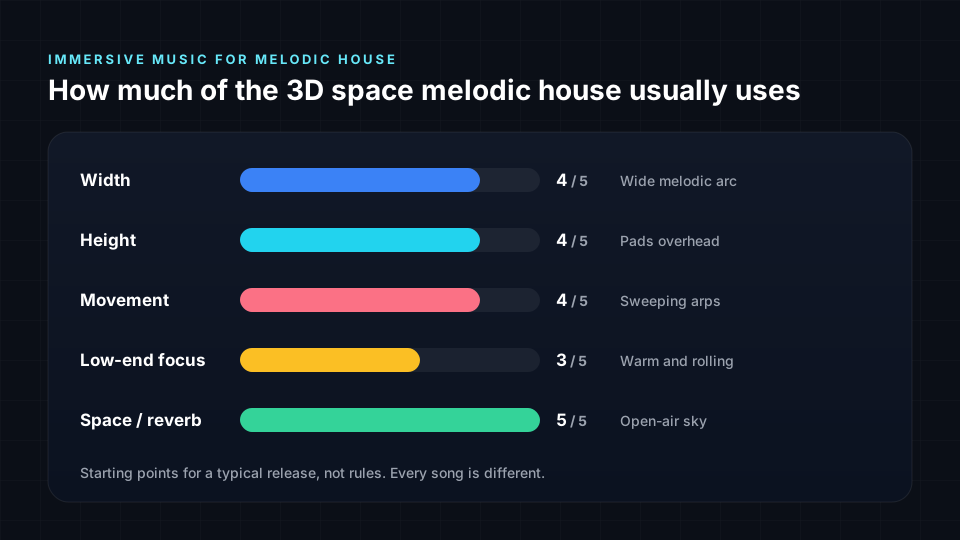
Space is at maximum because long reverbs and pads define the genre. Movement comes from slowly sweeping arpeggios, and the low end is warm rather than heavy.
Tips for an immersive melodic house mix
- Give each melody its own direction. Lead, arpeggio and plucks should never share a position.
- Keep the groove still. Kick and bass are the anchor that lets everything else move.
- Lift the pads, not the drums. Height suits sustained chords far better than percussion.
- Move slowly. Long, smooth sweeps fit the mood. Fast panning feels out of place.
- Open the space in the breakdown. Widen the reverb and raise the risers, then pull back as the kick returns.
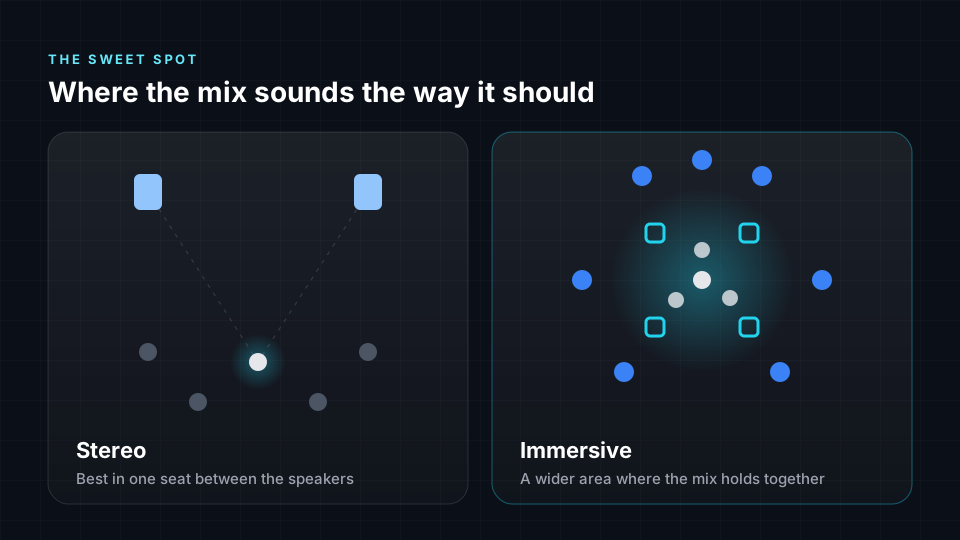
How to make immersive melodic house from stereo
Spatial9 can create spatial audio from a stereo track in a few steps:
- Upload your stereo master or your stems.
- Spatial9's AI separates and places each part, lifting pads overhead and spreading melodies around you.
- Preview it in binaural on headphones.
- Export Eclipsa Audio, ADM, binaural or Ambisonics.
- Publish a video. Create a YouTube-ready video with your immersive audio and publish it directly.
For related guides, read spatial audio for melodic techno and spatial audio for progressive house. Every guide is listed in spatial audio and immersive music by genre.
Frequently asked questions
Can I make a melodic house mix in Dolby Atmos or Eclipsa Audio?
Yes. The placements in this guide work for both. Spatial9 exports ADM, the standard file used by Dolby Atmos studios, as well as Eclipsa Audio for YouTube, so one immersive melodic house mix covers both. If you plan to release the Atmos version on Apple Music, build it from your original stems or multitracks, because Apple does not accept Atmos made from a finished stereo master. See where to publish spatial audio. You may also hear this called a 3D melodic house mix or melodic house in spatial audio.
Is spatial audio good for melodic house?
Yes. Melodic house layers several melodies and long pads, and spreading them around the listener makes each one clear.
Should the arpeggio move in an immersive melodic house mix?
It can, but slowly. A gentle sweep along one side adds life. Keep the lead synth still so the listener always has a clear melodic reference.
How much reverb does melodic house need in spatial audio?
More than most house styles, but placed with care. Put long reverb tails behind and above the listener and keep the kick, bass and vocal fairly dry so the groove stays defined.
Can I convert a finished melodic house track to spatial audio?
Yes. Spatial9 uses AI to generate an immersive mix from a stereo master and exports it as Eclipsa Audio, ADM, binaural or Ambisonics.
Does immersive melodic house work on normal headphones?
Yes. The mix is rendered binaurally, so the open sky of pads and melodies works on any regular headphones.
Dolby and Dolby Atmos are trademarks of Dolby Laboratories. Spatial9 is not affiliated with or endorsed by Dolby Laboratories.
Sources
- Blauert, J. (1997). Spatial Hearing: The Psychophysics of Human Sound Localization, revised edition. MIT Press. Low-frequency, elevation, distance and motion cues.
- Mills, A. W. (1958). On the minimum audible angle. Journal of the Acoustical Society of America, 30(4), 237-246.
- Hebrank, J. and Wright, D. (1974). Spectral cues used in the localization of sound sources on the median plane. Journal of the Acoustical Society of America, 56(6), 1829-1834.
- Bronkhorst, A. W. (2000). The cocktail party phenomenon: a review of research on speech intelligibility in multiple-talker conditions. Acta Acustica united with Acustica, 86, 117-128.
- Litovsky, R. Y., Colburn, H. S., Yost, W. A. and Guzman, S. J. (1999). The precedence effect. Journal of the Acoustical Society of America, 106(4), 1633-1654.
- Barron, M. and Marshall, A. H. (1981). Spatial impression due to early lateral reflections in concert halls. Journal of Sound and Vibration, 77(2), 211-232.
- Neuhoff, J. G. (1998). Perceptual bias for rising tones. Nature, 395, 123-124.
- Bregman, A. S. (1990). Auditory Scene Analysis: The Perceptual Organization of Sound. MIT Press.
Put your listeners under the open sky
Upload a track to Spatial9 and hear your melodies and pads surround you in minutes. Then export it or publish it straight to YouTube.