
Spatial Audio & Immersive Music for Jersey Club: Baltimore Club & Philly Club
Spatial9 Team · · 9 min read
Part of the series Spatial audio and immersive music by genre.
Key takeaways
- In a spatial jersey club mix the kick pattern and 808 bass stay centred and mono, while vocal chops, claps, bed squeaks, sample loops, ad-libs and hats spread around the listener.
- Separating the bed squeak and other effects from the kick lets the brain hear them as their own rhythm, an effect known as auditory stream segregation.
- Jersey club works best with a short, dry room, so the fast kick runs stay sharp and movement comes from effects and ad-libs rather than reverb.
- The jersey club immersion profile scores width 4, height 3, movement 4, low-end focus 4 and space 2 out of 5.
Jersey club grew out of Newark, New Jersey, around the turn of the 2000s, when local DJs took the Baltimore club sound, pushed the tempo up and built it around their own dance scene. DJ Tameil is widely credited as one of its early pioneers. The sound is fast and playful, usually somewhere around 130 to 145 BPM: a bouncing kick pattern that fires in quick runs, often five kicks in a row, chopped and looped vocal samples lifted from R&B, hip-hop and pop, sharp claps, and sound effects such as the famous bed squeak. Since the late 2010s it has crossed into mainstream hip-hop and pop, yet it is still made for dancing in a crowded room. Because almost every part is short and percussive, a stereo mix piles them on top of each other in the middle. Space lets each chop and hit land in its own spot. This guide covers how spatial audio for jersey club works, where to place each element and how to make an immersive jersey club mix. For the basics, see what spatial audio is.
Why jersey club needs a tight, bouncing 3D mix
Jersey club lives on call and response between the kick, the vocal chop and the sound effects. In stereo the kick run, the claps and the squeaks all fight for the same narrow strip between the speakers, so the bounce turns into clutter. In an immersive mix the kick stays in front of you while the chops and effects answer from the sides and from above, and the rhythm becomes a conversation you can follow.
The rule: a fixed kick, a room that bounces. The kick pattern and 808 never move, while squeaks and ad-libs jump around the listener.
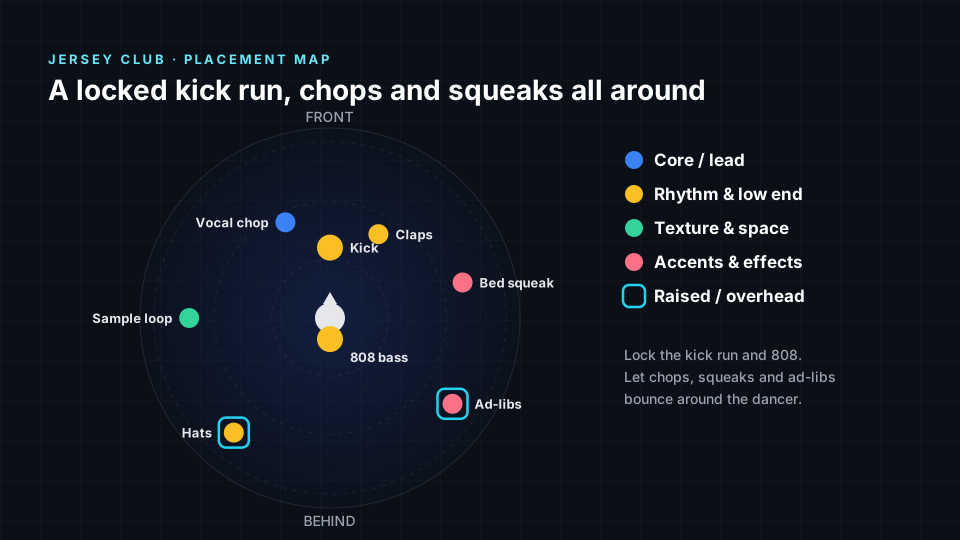
Immersive music for jersey club: what listeners hear
- A kick run that hits dead ahead. The bouncing kick pattern stays centred, punchy and easy to dance to.
- Chops that talk to you. The looped vocal sample sits close and slightly to the left, like someone calling out in the crowd.
- Squeaks that jump across the room. The bed squeak and other effects bounce on the right side instead of masking the kick.
- Hype from above. Ad-libs and hats float behind and over your head, so the energy surrounds you.
Where to place each element in a jersey club mix
| Element | Position | Height | Why it works |
|---|---|---|---|
| Kick | Front centre | Ear level | The bouncing engine of the track |
| 808 bass | Centre | Ear level | Weight under every kick run |
| Vocal chop | Front left | Ear level | The hook, close and clear |
| Claps | Front right | Ear level | Sharp backbeat beside the kick |
| Bed squeak | Right, moving | Ear level | Playful effect that bounces |
| Sample loop | Left | Ear level | Melody away from the chops |
| Ad-libs | Behind right, moving | Raised | Crowd energy around you |
| Hats | Behind left | Raised | Fast top end overhead |
The psychoacoustics behind jersey club placement
Every position in the table above follows how the ear and brain locate sound. Here is the reason behind the main choices for jersey club.
- Kick and 808 stay centred. The ear finds almost no direction in frequencies below roughly 80 to 100 Hz, so the 808 gains nothing from being spread. Keeping the low end centred and mono keeps every kick run heavy and in time on phones, headphones and club systems alike.
- Squeaks and kicks on different sides. The brain groups sounds into separate streams when they differ in direction as well as pitch and timing. This is auditory stream segregation. Moving the bed squeak away from the kick turns two busy rhythms into two clear parts, so the syncopation reads instead of blurring.
- Vocal chop and sample loop split left and right. Two sounds in the same frequency range mask each other far less when they arrive from different directions. This is spatial release from masking. Chopped vocals and R&B sample loops both live in the mids, so separating them keeps the hook readable.
- Small offsets in front. We hear the smallest changes in direction straight ahead, a limit known as the minimum audible angle. That is why the vocal chop and claps only need to sit slightly left and right of the kick to feel clearly separate, without losing the punch of a front-focused mix.
The immersion profile for jersey club
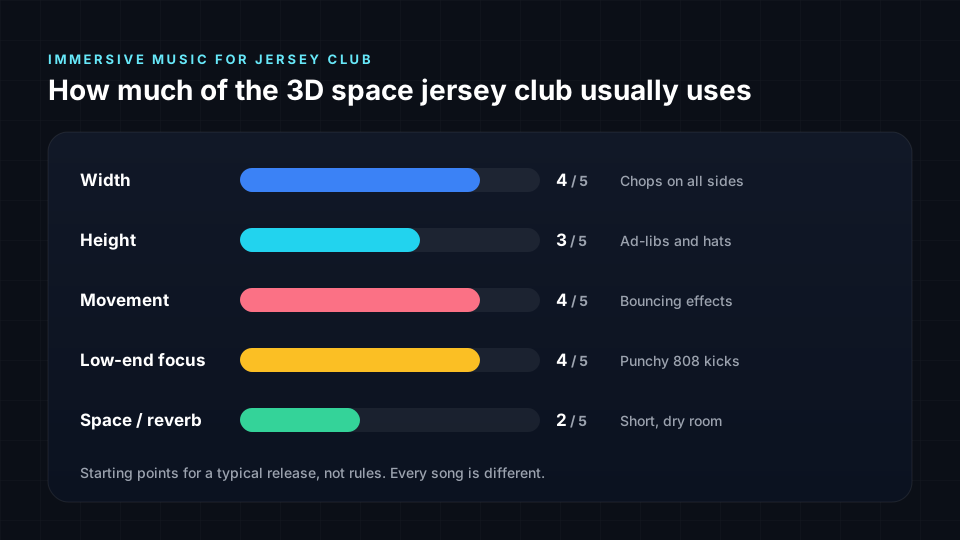
Movement and width are high because chops, squeaks and ad-libs are built to bounce, and spatial audio lets them do it across the whole room. Low-end focus is strong, since the kick run and 808 carry the dance, but the tracks rely more on punch than on a long, rolling sub. Space stays low on purpose. Jersey club is dry and tight, and big reverbs would smear the fast kick patterns that dancers follow.
Tips for an immersive jersey club mix
- Lock the kick run. Keep the kick and 808 centred and mono so the five-kick bursts hit the same way everywhere.
- Let the effects do the moving. Move squeaks and ad-libs, not the kick or the main chop.
- Keep the room short. Use small, dry spaces so every hit stays sharp at speed.
- Give the chop the front. The vocal sample is the hook, so keep it close and clear.
- Leave gaps. Jersey club relies on stops and drop-outs, and silence in one direction makes the next hit feel bigger.
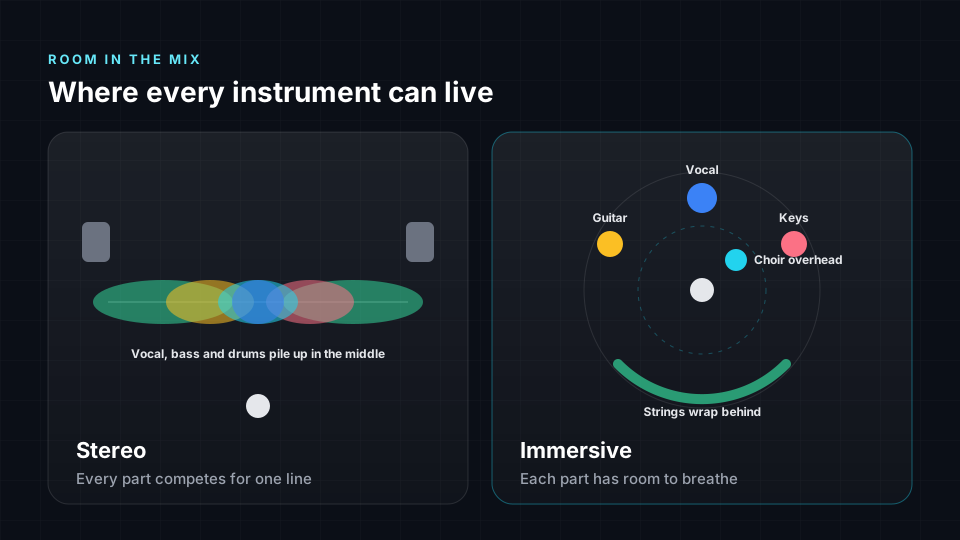
Jersey Club styles: Baltimore club and Philly club
The core placement still applies to the wider club family: kick and bass in the middle, chops in front, effects and hype around the listener. What changes is the drum source, the tempo and how hard the track hits.
Baltimore Club
Baltimore club came first, growing out of Baltimore in the early 1990s. It is built on chopped breakbeats, with the "Think" break as a classic source, plus short vocal loops repeated until they become rhythm. Because the drums often come from one sampled break, keep its main kick and snare together in the centre rather than splitting them. Open hats and ghost hits from the break can spread slightly wider. Repeated vocal phrases sit front and close, and call-and-response chants can answer from left and right. The low end is usually lighter than in jersey club, so the room can feel a little more open.
Philly Club
Philly club is Philadelphia's branch of the same club sound, sharing the chopped vocals, fast kick patterns and battle-ready energy, often with a harder, more aggressive edge. Treat its heavier kicks exactly like jersey club: centred, mono and dry. Harder sound effects and stabs can sit wide on the sides, where they add impact without masking the kick. Ad-libs and crowd shouts suit raised positions behind the listener. Keep reverb short, because the punch of the drums is the whole point of the style.
Newer blends such as Jersey drill and sexy drill borrow jersey club kick patterns and lay them under drill vocals and sliding 808s. The same idea works: lock the 808 and kicks, keep the rapper in front, and let effects and ad-libs move.
How to make immersive jersey club from stereo
Spatial9 can create spatial audio from a stereo track in a few steps:
- Upload your stereo master or your stems.
- Spatial9's AI separates and places each part, locking the kick pattern and 808 and spreading vocal chops, sound effects and ad-libs around you.
- Preview it in binaural on headphones.
- Export Eclipsa Audio, ADM, binaural or Ambisonics.
- Publish a video. Create a YouTube-ready video with your immersive audio and publish it directly.
For related guides, read spatial audio for footwork and spatial audio for drill. Every guide is listed in spatial audio and immersive music by genre.
Frequently asked questions
Does this guide cover Baltimore club and Philly club?
Yes. Baltimore club keeps its sampled break solid in the centre, with repeated vocal loops in front and chants answering from the sides. Philly club hits harder, so its heavy kicks stay centred and dry while stabs, effects and ad-libs spread around the listener.
Can I make a jersey club mix in Dolby Atmos or Eclipsa Audio?
Yes. The placements in this guide work for both. Spatial9 exports ADM, the standard file used by Dolby Atmos studios, as well as Eclipsa Audio for YouTube, so one immersive jersey club mix covers both. If you plan to release the Atmos version on Apple Music, build it from your original stems or multitracks, because Apple does not accept Atmos made from a finished stereo master. See where to publish spatial audio. You may also hear this called a 3D jersey club mix or jersey club in spatial audio.
Is spatial audio good for jersey club?
Yes. Jersey club is full of short chops and sound effects, and spatial audio gives each one its own place, so the bounce stays clear even when the kick runs get busy.
How is jersey club different from footwork in spatial audio?
Jersey club sits around 130 to 145 BPM with a bouncing feel broken up by fast kick runs, so the mix stays tight and front-focused. Footwork runs faster, around 160 BPM, with sparse, off-kilter triplet patterns, so its percussion can move more freely around the listener.
Where should the bed squeak go in immersive jersey club?
To one side, usually the right, with gentle movement. That keeps it away from the kick and the vocal chop, so it reads as a playful answer rather than a clash.
Can I convert a finished jersey club track to spatial audio?
Yes. Spatial9 uses AI to generate an immersive mix from a stereo master and exports it as Eclipsa Audio, ADM, binaural or Ambisonics.
Does immersive jersey club work on normal headphones?
Yes. The mix is rendered binaurally, so the bouncing kicks, chops and squeaks work on any regular headphones.
Dolby and Dolby Atmos are trademarks of Dolby Laboratories. Spatial9 is not affiliated with or endorsed by Dolby Laboratories.
Sources
- Blauert, J. (1997). Spatial Hearing: The Psychophysics of Human Sound Localization, revised edition. MIT Press. Low-frequency, elevation, distance and motion cues.
- Mills, A. W. (1958). On the minimum audible angle. Journal of the Acoustical Society of America, 30(4), 237-246.
- Hebrank, J. and Wright, D. (1974). Spectral cues used in the localization of sound sources on the median plane. Journal of the Acoustical Society of America, 56(6), 1829-1834.
- Bronkhorst, A. W. (2000). The cocktail party phenomenon: a review of research on speech intelligibility in multiple-talker conditions. Acta Acustica united with Acustica, 86, 117-128.
- Litovsky, R. Y., Colburn, H. S., Yost, W. A. and Guzman, S. J. (1999). The precedence effect. Journal of the Acoustical Society of America, 106(4), 1633-1654.
- Barron, M. and Marshall, A. H. (1981). Spatial impression due to early lateral reflections in concert halls. Journal of Sound and Vibration, 77(2), 211-232.
- Neuhoff, J. G. (1998). Perceptual bias for rising tones. Nature, 395, 123-124.
- Bregman, A. S. (1990). Auditory Scene Analysis: The Perceptual Organization of Sound. MIT Press.
Put the bounce all around you
Upload a track to Spatial9 and hear your chops and squeaks bounce around a locked kick in minutes. Then export it or publish it straight to YouTube.