Spatial Audio & Immersive Music for Footwork: Juke & Ghetto House
Spatial9 Team · · 9 min read
Part of the series Spatial audio and immersive music by genre.
Key takeaways
- In a spatial footwork mix the kick and 808 sub stay centred and mono, while the vocal chop, snare, triplet toms, sample loop, hats and synth stabs each get their own direction.
- Placing the triplet toms away from the kick lets the brain follow both patterns at once, an effect known as auditory stream segregation.
- Footwork works best in a dry room with short reverb, so the gaps between the fast hits stay sharp and the movement comes from toms and stabs.
- The footwork immersion profile scores width 4, height 2, movement 5, low-end focus 5 and space 2 out of 5.
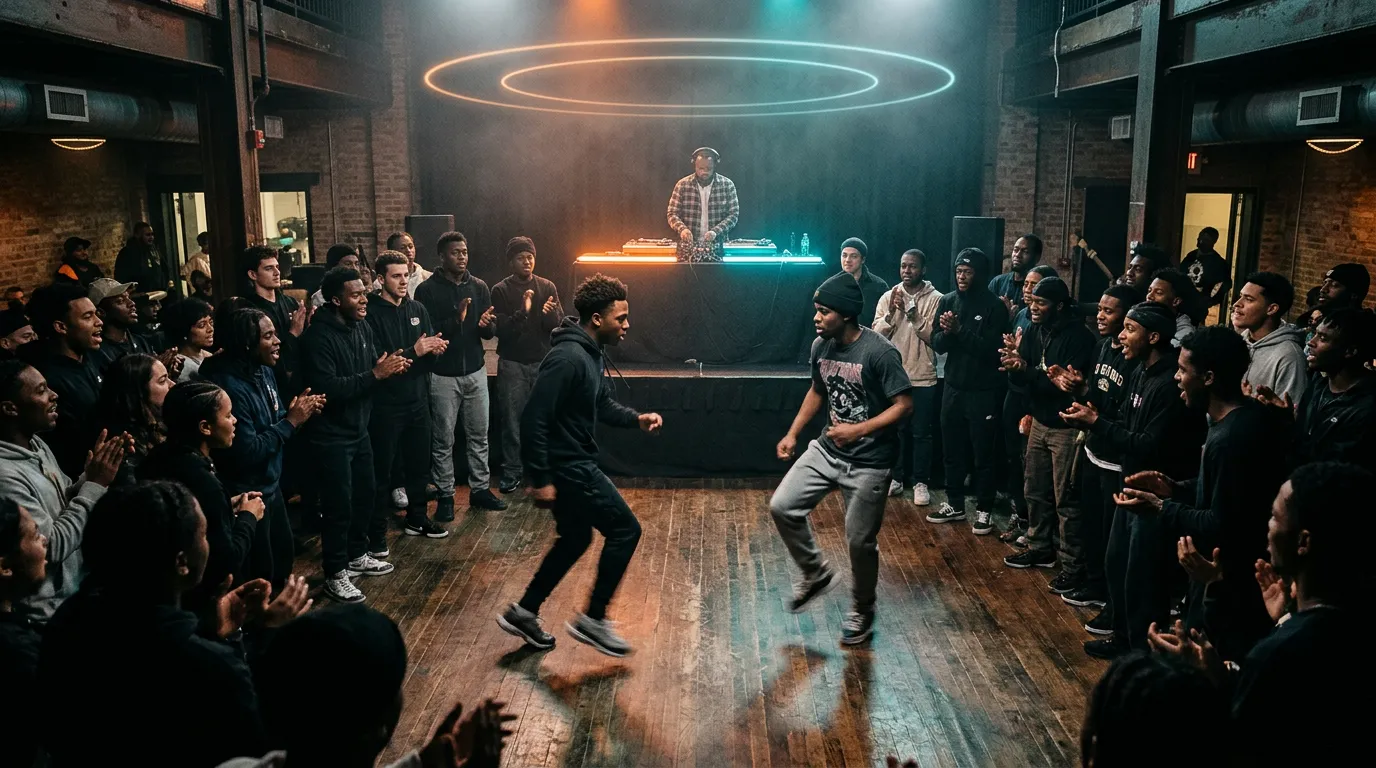
Footwork comes from Chicago, where it grew out of ghetto house and juke in the late 1990s and 2000s as the soundtrack to footwork dance battles. Producers such as RP Boo are widely credited with shaping its early sound, and DJ Rashad helped carry it to an international audience. Footwork runs around 160 BPM but often feels half-time. Its kicks and 808 sub land in syncopated, triplet patterns, toms and rims stutter against them, and a short vocal phrase is chopped and repeated until it becomes another drum. Samples from soul, R&B, jazz and hip-hop sit on top, often with lots of empty space between the hits. That mix of speed and gaps is what makes it thrilling, and also what makes it easy to blur in a crowded stereo mix. This guide covers how spatial audio for footwork works, where to place each element and how to make an immersive footwork mix. For the basics, see what spatial audio is.
Why footwork works in spatial audio
Footwork is built from interlocking rhythms. The kick plays one pattern, the toms play another and the vocal chop plays a third, and the groove lives in the way they collide. In stereo those patterns stack up in a narrow strip between the speakers, so the off-kilter feel can sound like noise. In an immersive mix each rhythm gets its own direction, and the polyrhythm suddenly becomes readable.
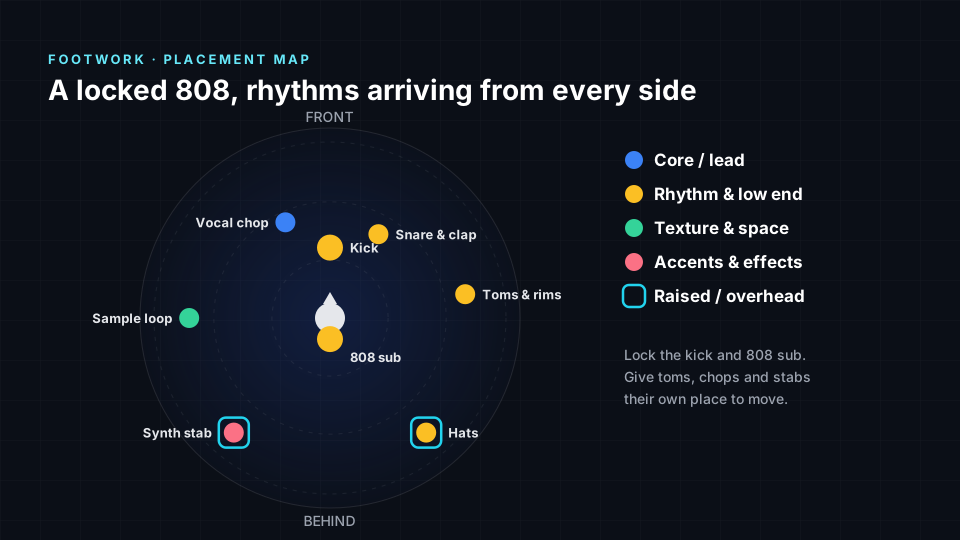
The rule: a fixed sub, rhythms from every side. The kick and 808 stay still, while toms, chops and stabs each speak from their own place.
Immersive music for footwork: what listeners hear
- A sub that never wavers. The 808 stays deep and centred, however strange the kick pattern gets.
- A voice that turns into a drum. The looped vocal chop sits close and front, so every repeat lands clearly.
- Toms that run past you. Triplet toms and rims move across the right side, separate from the kick.
- Space between the hits. Hats and stabs float above and behind, and the gaps feel wide instead of empty.
Where to place each element in a footwork mix
| Element | Position | Height | Why it works |
|---|---|---|---|
| Kick | Front centre | Ear level | Syncopated pulse for the dancers |
| 808 sub | Centre | Ear level | Deep weight under the triplets |
| Vocal chop | Front left | Ear level | The repeated hook, close and clear |
| Snare & clap | Front right | Ear level | Half-time backbeat beside the kick |
| Toms & rims | Right, moving | Ear level | Stuttering rhythm with its own lane |
| Sample loop | Left | Ear level | Soul or jazz colour away from the chop |
| Hats | Behind right | Raised | Fast top end overhead |
| Synth stab | Behind left, moving | Raised | Accents that drift through the gaps |
The psychoacoustics behind footwork placement
Every position in the table above follows how the ear and brain locate sound. Here is the reason behind the main choices for footwork.
- Kick and 808 stay centred. The ear finds almost no direction in frequencies below roughly 80 to 100 Hz, so the long footwork 808 gains nothing from being spread. Keeping it centred and mono keeps the sub solid on any system, which matters when the kick pattern itself keeps shifting.
- Toms on their own side. The brain sorts sounds into separate streams when they come from different places, as well as when they differ in pitch and timing. This is auditory stream segregation. Placing the triplet toms away from the kick lets the ear follow both patterns at once, which is the whole point of a footwork groove.
- Vocal chop in front. We can follow one voice among many competing sounds when it comes from a clear direction, the cocktail party effect. With percussion all around, a front-left vocal chop stays easy to pick out, so each repeat works as a hook rather than getting lost in the drums.
- Hats raised. The outer ear shapes high frequencies differently depending on elevation, and these spectral cues are what tell us a sound comes from above. Bright footwork hats carry lots of high-frequency energy, so they lift convincingly overhead and leave the ear-level ring to the drums and chops.
The immersion profile for footwork
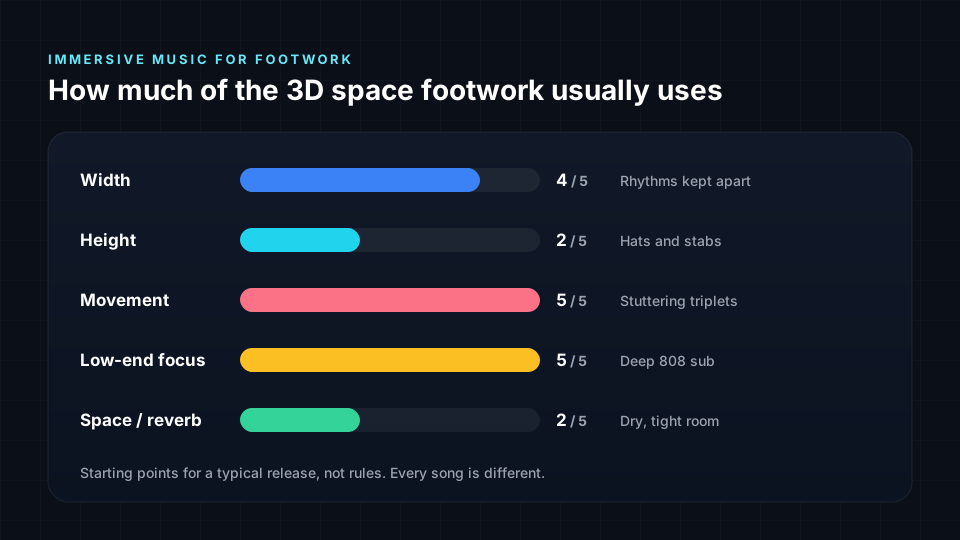
Movement is at maximum because footwork is made of interlocking, shifting rhythms, and spatial audio lets each one travel. Low-end focus is also at maximum, since the 808 sub is the deepest and most physical part of the track. Width is high to keep the polyrhythm apart. Height and space stay low: most of the action belongs at ear level, and long reverbs would smear the fast triplets and wipe out the gaps that give footwork its tension.
Tips for an immersive footwork mix
- Keep the 808 mono. The sub must stay identical from every direction, even when the kick pattern jumps.
- Give each rhythm a lane. Kick, toms and vocal chop should each come from a different place.
- Move the toms, not the kick. Let the stuttering parts carry the motion around the listener.
- Protect the gaps. Keep reverbs short so silence between the hits stays sharp.
- Keep the chop close. The repeated vocal is the hook, so place it front and dry.
Footwork styles: juke and ghetto house
The core placement still applies to footwork's Chicago roots: kick and sub in the middle, vocal chops in front, percussion and samples around the listener. What changes is the tempo, how straight the drums are and how raw the track sounds.
Juke
Juke grew out of ghetto house in Chicago and pushed the tempo up toward the speed of footwork, with chopped vocal loops, 808 drums and a strong party feel. Its kick pattern is usually more regular than footwork's, so the groove leans on a steady pulse rather than broken triplets. Keep the kick firmly centred and let the repeated vocal chop sit front and close. Claps and snares can stay near the front, while percussion fills and short vocal stabs swing between left and right. Use a little less movement than in footwork, because the drive comes from the steady drums.
Ghetto House
Ghetto house came from Chicago in the 1990s as a raw, stripped-back take on house music. It is built on drum machines, a pounding four-to-the-floor kick and short, often explicit chants repeated over and over. The four-to-the-floor kick and bass stay centred and mono, just like in house. Chants work best front and centre or slightly off it, where they cut through like a call to the crowd. Claps, hats and cowbells can spread wide, and a short room keeps the raw, dry character intact.
Some producers blend footwork with jungle breaks, ambient pads or hip-hop samples. The same idea holds: lock the sub, keep the vocal hook in front, and let the busiest rhythms move.
How to make immersive footwork from stereo
Spatial9 can create spatial audio from a stereo track in a few steps:
- Upload your stereo master or your stems.
- Spatial9's AI separates and places each part, locking the kick and 808 sub and spreading vocal chops, toms and samples around you.
- Preview it in binaural on headphones.
- Export Eclipsa Audio, ADM, binaural or Ambisonics.
- Publish a video. Create a YouTube-ready video with your immersive audio and publish it directly.
For related guides, read spatial audio for jersey club and spatial audio for jungle. Every guide is listed in spatial audio and immersive music by genre.
Frequently asked questions
Does this guide cover juke and ghetto house?
Yes. Juke keeps a steadier kick in the centre, with chopped vocals in front and percussion swinging side to side. Ghetto house locks its four-to-the-floor kick and bass in the middle, places its chants front and spreads claps, hats and cowbells wide in a short, dry room.
Can I make a footwork mix in Dolby Atmos or Eclipsa Audio?
Yes. The placements in this guide work for both. Spatial9 exports ADM, the standard file used by Dolby Atmos studios, as well as Eclipsa Audio for YouTube, so one immersive footwork mix covers both. If you plan to release the Atmos version on Apple Music, build it from your original stems or multitracks, because Apple does not accept Atmos made from a finished stereo master. See where to publish spatial audio. You may also hear this called a 3D footwork mix or footwork in spatial audio.
Is spatial audio good for footwork?
Yes. Footwork is built from interlocking rhythms, and spatial audio gives each one its own direction, so the off-kilter groove becomes easier to follow.
How is footwork different from drum and bass in spatial audio?
Both are fast, but drum and bass rolls on continuous breakbeats and long basslines, so its drums often carry the motion. Footwork is sparser, with triplet kicks, stuttering toms and gaps, so the mix keeps a dry room and moves the toms and chops rather than whole drum loops.
Where should the triplet toms go in immersive footwork?
To one side, usually the right, with some movement. That keeps them clear of the kick and the vocal chop, so the ear hears two separate patterns instead of one blur.
Can I convert a finished footwork track to spatial audio?
Yes. Spatial9 uses AI to generate an immersive mix from a stereo master and exports it as Eclipsa Audio, ADM, binaural or Ambisonics.
Does immersive footwork work on normal headphones?
Yes. The mix is rendered binaurally, so the triplet toms, vocal chops and deep 808 work on any regular headphones.
Dolby and Dolby Atmos are trademarks of Dolby Laboratories. Spatial9 is not affiliated with or endorsed by Dolby Laboratories.
Sources
- Blauert, J. (1997). Spatial Hearing: The Psychophysics of Human Sound Localization, revised edition. MIT Press. Low-frequency, elevation, distance and motion cues.
- Mills, A. W. (1958). On the minimum audible angle. Journal of the Acoustical Society of America, 30(4), 237-246.
- Hebrank, J. and Wright, D. (1974). Spectral cues used in the localization of sound sources on the median plane. Journal of the Acoustical Society of America, 56(6), 1829-1834.
- Bronkhorst, A. W. (2000). The cocktail party phenomenon: a review of research on speech intelligibility in multiple-talker conditions. Acta Acustica united with Acustica, 86, 117-128.
- Litovsky, R. Y., Colburn, H. S., Yost, W. A. and Guzman, S. J. (1999). The precedence effect. Journal of the Acoustical Society of America, 106(4), 1633-1654.
- Barron, M. and Marshall, A. H. (1981). Spatial impression due to early lateral reflections in concert halls. Journal of Sound and Vibration, 77(2), 211-232.
- Neuhoff, J. G. (1998). Perceptual bias for rising tones. Nature, 395, 123-124.
- Bregman, A. S. (1990). Auditory Scene Analysis: The Perceptual Organization of Sound. MIT Press.
Step into the battle circle
Upload a track to Spatial9 and hear your toms and chops race around a locked 808 in minutes. Then export it or publish it straight to YouTube.