
Spatial Audio & Immersive Music for UK Garage: 2-Step, Speed Garage, Bassline & Future Garage
Spatial9 Team · · 9 min read
Part of the series Spatial audio and immersive music by genre.
Key takeaways
- In an immersive UK garage mix the R&B vocal, 2-step drums and sub bass stay in the centre while organ chords, shuffled hats, rimshots and chopped vocals surround the listener.
- Chopped vocal samples work best to the right with light movement, because a second vocal layer in the same range as the lead is easier to hear when it comes from a different direction.
- Sub bass below roughly 80 to 100 Hz carries almost no directional information, so the deep UK garage bassline gains nothing from being moved and should stay centred.
- The UK garage immersion profile scores width 4, height 3, movement 4, low-end focus 5 and space 2 out of 5.
UK garage grew out of London's club and pirate radio scene in the late 1990s. It took the soul of American garage house and R&B and gave it a restless, swung rhythm. Its signature is the 2-step beat, where the kick skips beats instead of hitting four to the floor, under shuffled hi-hats, chopped and pitched R&B vocals, organ or chord stabs and a deep sub bass. The groove lives in tiny gaps and offbeats, and spatial audio makes each of those details easier to hear. This guide covers how spatial audio for UK garage works, where to place each element and how to make an immersive UK garage mix. For the basics, see what spatial audio is.
Why UK garage is ideal for spatial audio
UK garage packs a lot of rhythm into small spaces: skipping kicks, shuffled hats, rimshots and vocal chops that land between the beats. In stereo those parts sit on top of each other and the swing can blur. Spread around the listener, each syncopated part has its own direction and the groove bounces more.
The rule: a tight centre, a skipping circle. The vocal, drums and sub stay locked while the chops and percussion dance around them.
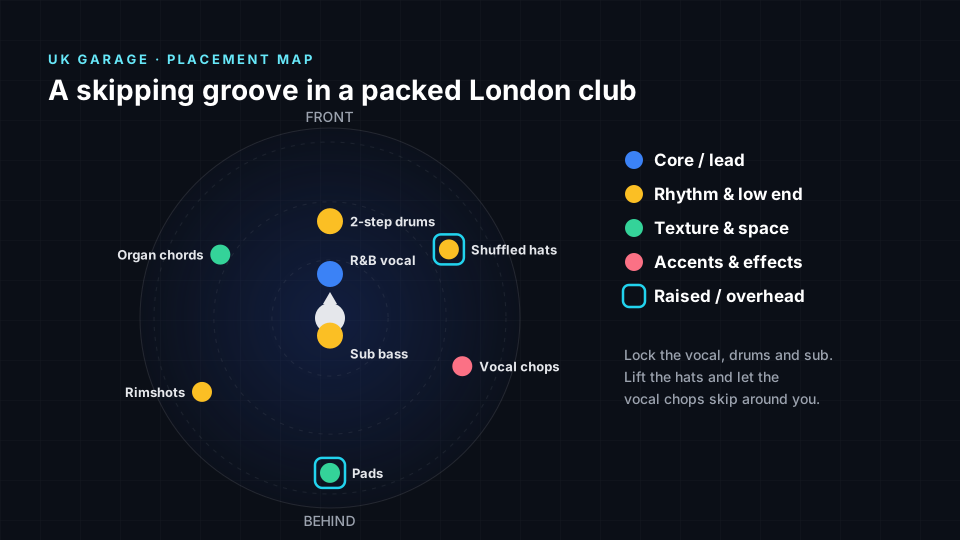
Immersive music for UK garage: what listeners hear
- A vocal that stays with you. The main R&B line is close and centred.
- A swing you can feel. Hats, rimshots and kicks each come from their own spot.
- Chops that skip past. Pitched vocal snippets bounce along the side.
- Sub bass in your chest. The low end is deep, steady and centred.
Where to place each element in a UK garage mix
| Element | Position | Height | Why it works |
|---|---|---|---|
| R&B vocal | Front centre | Ear level | The soulful focus |
| 2-step drums | Front centre | Ear level | The skipping backbone |
| Sub bass | Centre | Ear level | Deep and steady |
| Organ chords | Front left | Ear level | Classic garage stabs |
| Shuffled hats | Front right | Raised | Swing on top |
| Vocal chops | Right, moving | Ear level | Playful pitched snippets |
| Rimshots | Behind left | Ear level | Offbeat answer to the hats |
| Pads | Behind | Raised | Soft harmonic depth |
The psychoacoustics behind UK Garage placement
Every position in the table above follows how the ear and brain locate sound. Here is the reason behind the main choices for UK Garage.
- Sub bass stays centred. Frequencies below roughly 80 to 100 Hz give the brain almost no sense of direction, so a moving or off-centre sub only loses weight. The deep garage bassline should hit the same from every position on the dancefloor.
- Vocal chops away from the lead vocal. Two sounds in the same range mask each other less when they come from different directions, which researchers call spatial release from masking. Pitched chops share the lead vocal's range, so moving them to the side keeps the main line intelligible.
- Shuffled hats raised. Elevation cues come mostly from how the outer ear colours frequencies above roughly 4 kHz. Hi-hats are bright and short, so they rise convincingly and leave ear level clear for the vocal and drums.
- Hats front right, rimshots behind left. The brain groups sounds into separate streams using pitch, timing and position. Splitting the two offbeat layers across the space helps the ear hear them as interlocking patterns, which is what makes the 2-step swing feel alive.
The immersion profile for UK garage
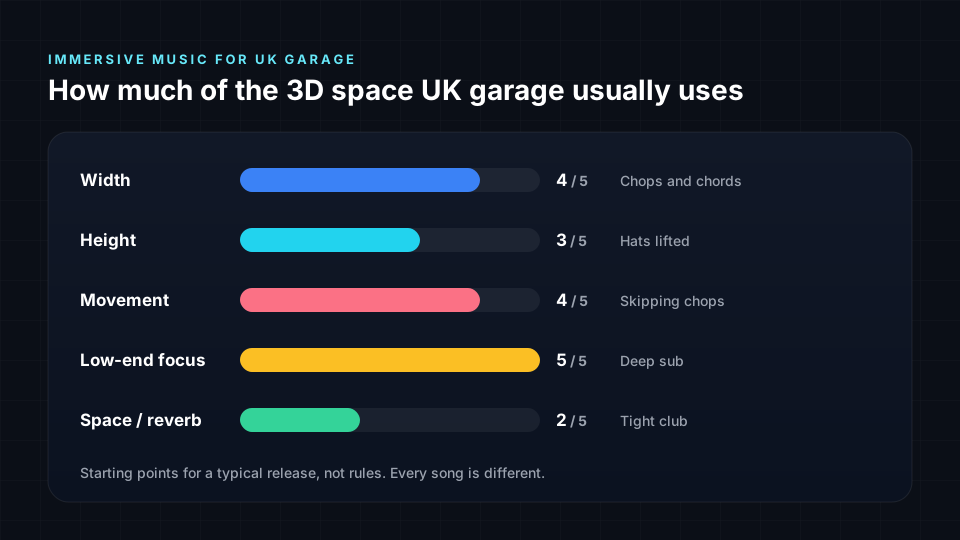
Low-end focus is at maximum because the sub bass drives the genre. Movement is high thanks to skipping chops, while the space stays tight and dry so every swung hit keeps its edge.
Tips for an immersive UK garage mix
- Keep the beat in one place. The 2-step kick and snare are the reference for the swing.
- Separate the offbeats. Hats, rimshots and shakers should each have a different direction.
- Move the chops, not the lead. Pitched snippets can skip around, the main vocal stays centred.
- Stay dry. Long reverbs smear the shuffle. Use short rooms and tight delays.
- Protect the sub. Keep it mono, centred and free of wide effects.
UK garage styles: 2-step, speed garage, bassline and future garage
The core placement from this guide still applies: the drums and sub bass stay centred, the hats sit raised at the front right and the vocal leads from front centre. What changes per style is the groove, how busy the bass is and how much space surrounds the beat.
2-step
2-step is the classic skipping garage rhythm: the kick drops beats instead of hitting four to the floor, with shuffled hats, soulful R&B vocals and pitched vocal chops. This is the style the main guide is built around. Keep the 2-step drums and sub centred, lift the shuffled hats front right, let vocal chops skip around the right side and answer the hats with rimshots behind left.
Speed garage
Speed garage runs on a steady four to the floor beat with heavy, rolling bass lines, time-stretched vocal hooks and dub-style effects. Keep the kick and the main bass centred so the rolling low end stays solid. Place organ stabs front left, keep hats raised on the right, and send short dub echoes and sirens behind so they trail around the listener. Keep the space tight and punchy, like a club.
Bassline
Bassline is a bouncy four to the floor style where a loud, wobbling mid bass riff is the main hook, often with pitched up vocals on top. The sub stays centred, but you can let the higher, buzzy layer of the riff bounce a little between front left and front right. Keep vocals front centre, keep pads low and the room dry so the riff stays loud and direct.
Future garage
Future garage takes the skipping 2-step rhythm into a darker, more atmospheric space, with washed pads, reverb heavy vocal fragments and textures like crackle and rain. This style gets the most space and height. Keep drums and sub centred, but raise the pads higher behind, let vocal fragments drift slowly around the sides and allow longer reverb tails than in the club styles.
The same approach works for UK funky and 4x4 garage. UK funky uses busy, percussive rhythms, so spread the extra percussion across the front and sides while the kick and bass stay centred. 4x4 garage keeps a straight four to the floor kick under garage vocals and organ chords, so treat it like speed garage with a lighter bass and a little more room for the vocal.
How to make immersive UK garage from stereo
Spatial9 can create spatial audio from a stereo track in a few steps:
- Upload your stereo master or your stems.
- Spatial9's AI separates and places each part, keeping the beat and sub centred and spreading chops and hats around you.
- Preview it in binaural on headphones.
- Export Eclipsa Audio, ADM, binaural or Ambisonics.
- Publish a video. Create a YouTube-ready video with your immersive audio and publish it directly.
For related guides, read spatial audio for grime and spatial audio for house. Every guide is listed in spatial audio and immersive music by genre.
Frequently asked questions
Does this guide cover 2-step, speed garage, bassline and future garage?
Yes. In every style the drums and sub bass stay centred. 2-step follows the main guide, with raised shuffled hats and vocal chops skipping around the right. Speed garage keeps a tight club room with dub echoes trailing behind. Bassline lets the buzzy upper layer of its riff bounce slightly across the front. Future garage gets the most space, with higher pads and drifting vocal fragments.
Can I make a UK garage mix in Dolby Atmos or Eclipsa Audio?
Yes. The placements in this guide work for both. Spatial9 exports ADM, the standard file used by Dolby Atmos studios, as well as Eclipsa Audio for YouTube, so one immersive UK garage mix covers both. If you plan to release the Atmos version on Apple Music, build it from your original stems or multitracks, because Apple does not accept Atmos made from a finished stereo master. See where to publish spatial audio. You may also hear this called a 3D UK garage mix or UK garage in spatial audio.
Is spatial audio good for UK garage?
Yes. UK garage is full of syncopated details, and giving each one its own direction makes the swing clearer and the groove bouncier.
Where should the 2-step drums go in an immersive UK garage mix?
Front centre at ear level. The kick and snare are the backbone of the swing, so keep them still while hats and percussion spread around them.
Can the vocal chops move in a UK garage mix?
Yes, in short hops. Chopped and pitched snippets are ideal for light movement along one side, as long as the main vocal stays fixed in front.
Can I convert a finished UK garage track to spatial audio?
Yes. Spatial9 uses AI to generate an immersive mix from a stereo master and exports it as Eclipsa Audio, ADM, binaural or Ambisonics.
Does immersive UK garage work on normal headphones?
Yes. The mix is rendered binaurally, so the skipping groove and vocal chops work on any regular headphones.
Dolby and Dolby Atmos are trademarks of Dolby Laboratories. Spatial9 is not affiliated with or endorsed by Dolby Laboratories.
Sources
- Blauert, J. (1997). Spatial Hearing: The Psychophysics of Human Sound Localization, revised edition. MIT Press. Low-frequency, elevation, distance and motion cues.
- Mills, A. W. (1958). On the minimum audible angle. Journal of the Acoustical Society of America, 30(4), 237-246.
- Hebrank, J. and Wright, D. (1974). Spectral cues used in the localization of sound sources on the median plane. Journal of the Acoustical Society of America, 56(6), 1829-1834.
- Bronkhorst, A. W. (2000). The cocktail party phenomenon: a review of research on speech intelligibility in multiple-talker conditions. Acta Acustica united with Acustica, 86, 117-128.
- Litovsky, R. Y., Colburn, H. S., Yost, W. A. and Guzman, S. J. (1999). The precedence effect. Journal of the Acoustical Society of America, 106(4), 1633-1654.
- Neuhoff, J. G. (1998). Perceptual bias for rising tones. Nature, 395, 123-124.
- Bregman, A. S. (1990). Auditory Scene Analysis: The Perceptual Organization of Sound. MIT Press.
Put your listeners on the garage dancefloor
Upload a track to Spatial9 and hear your beats and vocal chops skip around you in minutes. Then export it or publish it straight to YouTube.