
Spatial Audio & Immersive Music for Future Bounce: Melbourne Bounce, Dutch Bounce & Scouse House
Spatial9 Team · · 9 min read
Part of the series Spatial audio and immersive music by genre.
Key takeaways
- In a spatial future bounce mix the kick, sub bass and vocal stay centred, while the hopping bounce lead moves just off centre at front right and plucks, hats, vocal chops and risers surround the listener.
- The bounce lead works best close to the front, because the ear detects changes in direction most precisely straight ahead, so short hops of the lead are clearly heard without wide sweeps.
- Separating the bounce lead and the plucks in direction makes both easier to hear, because sounds sharing a frequency range mask each other less when they come from different places.
- The future bounce immersion profile scores width 4, height 3, movement 4, low-end focus 5 and space 3 out of 5.
Future bounce emerged in the second half of the 2010s, when producers fused the stomping, offbeat energy of Melbourne bounce with the cleaner sound design of future house. It runs at festival tempos with a hard, short four-to-the-floor kick, sharp claps, offbeat bass stabs and a bright lead that bends and hops between notes. Vocal chops, plucky synths and long risers build the tension, and the drop is designed to make a crowd jump in unison. Because every part is short and punchy, future bounce leaves gaps in time that spatial audio can fill with direction. This guide covers how spatial audio for future bounce works, where to place each element and how to make an immersive future bounce mix. For the basics, see what spatial audio is.
Why future bounce is ideal for spatial audio
Future bounce is a genre of quick, staccato hits. In stereo the bounce lead, the plucks and the vocal chops all fight for the same middle space, and the drop can sound crowded. In an immersive mix each short hit gets its own direction, so the groove feels lighter and every bounce lands clearly.
The rule: a hard centre, a hopping edge. The kick and sub stay locked while the lead jumps just beside them.
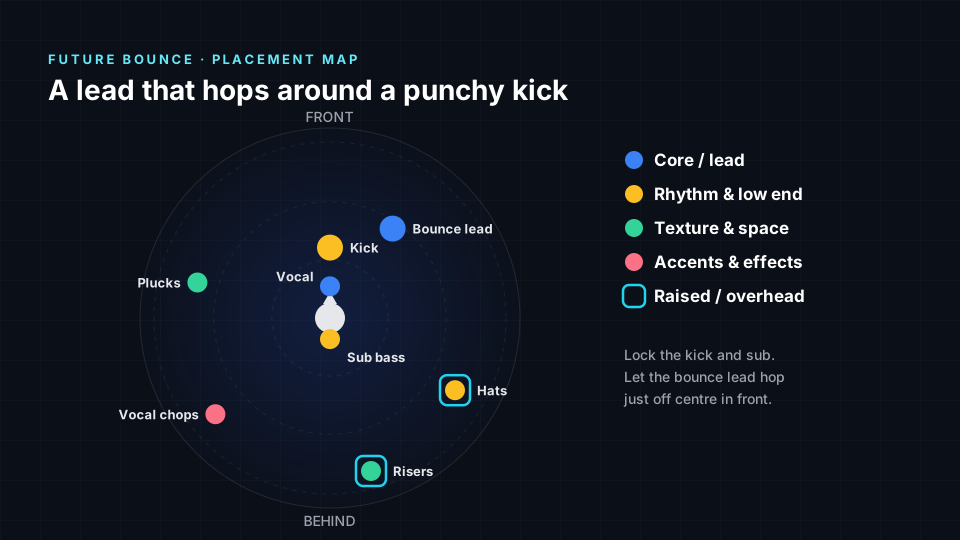
Immersive music for future bounce: what listeners hear
- A lead that jumps beside you. The pitch-bending hook hops just off centre in front.
- A kick that never moves. The punchy four-to-the-floor pulse holds the crowd together.
- Chops that answer from behind. Vocal fragments reply from the rear and shift side to side.
- Tension from above. Hats and risers lift the build before the drop.
Where to place each element in a future bounce mix
| Element | Position | Height | Why it works |
|---|---|---|---|
| Kick | Front centre | Ear level | Short, hard festival pulse |
| Sub bass | Centre | Ear level | Tight weight under the offbeat |
| Vocal | Front centre | Ear level | Hook and focus |
| Bounce lead | Front right, moving | Ear level | The hopping, pitch-bending hook |
| Plucks | Left | Ear level | Bright rhythmic harmony |
| Hats | Behind right | Raised | Crisp offbeat drive |
| Vocal chops | Behind left, moving | Ear level | Call and response with the lead |
| Risers | Behind, moving | Raised | Build-up tension |
The psychoacoustics behind Future Bounce placement
Every position in the table above follows how the ear and brain locate sound. Here is the reason behind the main choices for Future Bounce.
- Kick and sub locked in the centre. Bass under roughly 80 to 100 Hz gives the brain very little to locate, so moving the sub adds nothing except risk. A centred kick and sub keep the drop hitting equally hard across a festival field and on headphones.
- Bounce lead just off centre in front. Direction is resolved most finely straight ahead, where listeners can notice shifts of only a degree or two. Short hops of the lead near the front are clearly felt, so the bounce needs small moves rather than wide sweeps.
- Plucks left, lead right. Plucks and the bounce lead share the same bright mid range. Placing them on opposite sides reduces masking between them, an effect known as spatial release from masking, so both rhythms stay audible in a busy drop.
- Risers climbing behind and above. Treble above roughly 4 kHz carries most of the elevation cues shaped by the outer ear, and listeners are biased to hear rising tones as approaching. A bright noise riser that climbs overhead from the rear builds more tension than one that simply gets louder.
The immersion profile for future bounce
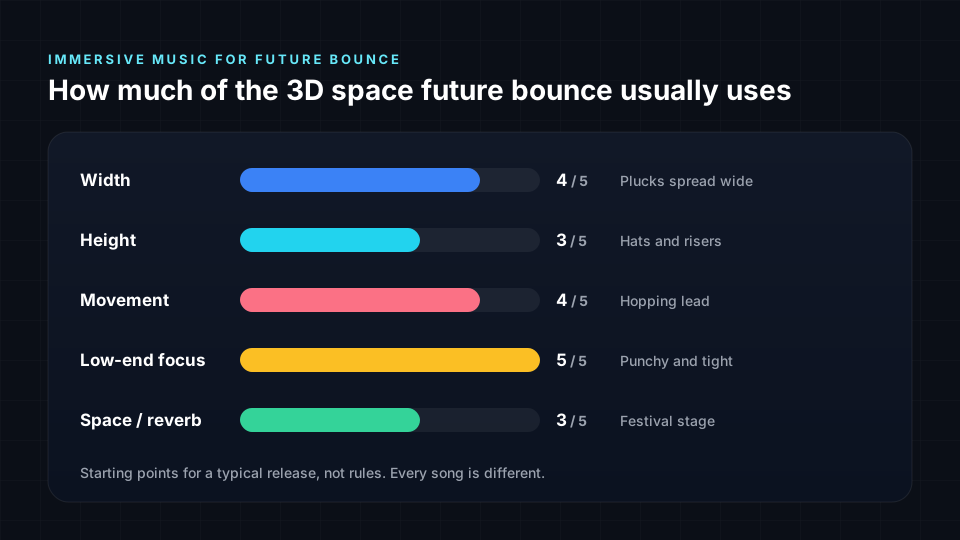
Low-end focus is at maximum because the kick and sub drive everything. Movement is high but short-range: the lead hops and the chops shift, without anything circling the head. Width is strong and the space is tight and punchy, like a festival stage with fast, controlled reverbs.
Tips for an immersive future bounce mix
- Keep the kick dry and centred. Its short, hard attack is the reference for every bounce.
- Move the lead in small hops. Match the movement to the pitch bends, not to slow pans.
- Give the plucks their own side. Opposite the lead, so the two rhythms never blur.
- Use chops as answers. Place them behind so they reply to the lead rather than sit on it.
- Save height for the build. Raise hats and risers into the drop, then let the drop hit at ear level.
Future Bounce styles: Melbourne bounce, Dutch bounce and scouse house
The core placement from this guide still applies: the kick, sub bass and vocal stay in the centre while the lead hops and the chops answer from behind. What changes per style is how far the lead moves, how hard the drop hits and how much height the build gets.
Melbourne bounce
Melbourne bounce is the punchy, stripped-back sound behind future bounce, with a hard kick, short offbeat bass and a bouncy, percussive lead. Keep the kick and offbeat bass dry and centred. Place the lead just off centre at the front right and move it in small, rhythmic hops rather than wide sweeps. Use hats raised behind for drive, and keep the space tight so every bounce stays crisp.
Dutch bounce
Dutch bounce is the harder, more playful take on the bounce sound, with staccato synth riffs, sharp percussion and plenty of quirky effects. Keep the low end locked in the centre and give the riffs a bit more freedom: let the main riff hop at the front right and place a second, answering riff at the front left. Short, tempo-synced jumps suit this style better than slow movement.
Scouse house
Scouse house is fast and euphoric, with a hard, bouncy offbeat bass, pitched-up vocals and catchy, trance-like synth riffs. Keep the kick, offbeat bass and vocal centred so the energy stays focused. Spread the synth riff wider than the bounce lead in the main guide, lift supporting chords a little higher behind and let risers climb from the rear into each drop.
How to make immersive future bounce from stereo
Spatial9 can create spatial audio from a stereo track in a few steps:
- Upload your stereo master or your stems.
- Spatial9's AI separates and places each part, locking the kick and sub and letting the bounce lead hop just off centre.
- Preview it in binaural on headphones.
- Export Eclipsa Audio, ADM, binaural or Ambisonics.
- Publish a video. Create a YouTube-ready video with your immersive audio and publish it directly.
For related guides, read spatial audio for future house and spatial audio for big room house. Every guide is listed in spatial audio and immersive music by genre.
Frequently asked questions
Does this guide cover Melbourne bounce, Dutch bounce and scouse house?
Yes. All three keep the kick, sub bass and vocal in the centre. Melbourne bounce uses small, rhythmic hops on the lead in a tight, dry space. Dutch bounce gives its staccato riffs more freedom, with two riffs answering each other across the front. Scouse house spreads its euphoric synth riffs wider and lifts supporting chords higher behind, with risers climbing into each drop.
Can I make a future bounce mix in Dolby Atmos or Eclipsa Audio?
Yes. The placements in this guide work for both. Spatial9 exports ADM, the standard file used by Dolby Atmos studios, as well as Eclipsa Audio for YouTube, so one immersive future bounce mix covers both. If you plan to release the Atmos version on Apple Music, build it from your original stems or multitracks, because Apple does not accept Atmos made from a finished stereo master. See where to publish spatial audio. You may also hear this called a 3D future bounce mix or future bounce in spatial audio.
Is spatial audio good for future bounce?
Yes. Future bounce is built from short, punchy hits, and giving each one its own direction makes the drop clearer and more energetic.
Where should the bounce lead go in an immersive future bounce mix?
Just off centre at the front, moving in small hops that follow its pitch bends. Keep it away from the vocal so the hook stays clear.
What is the difference between future bounce and Melbourne bounce in spatial audio?
Melbourne bounce leans on a raw, stomping lead and offbeat bass, while future bounce adds cleaner, more polished sound design. In an immersive mix both keep the kick centred, but future bounce benefits from tidier placement of plucks and chops around the lead.
Can I convert a finished future bounce track to spatial audio?
Yes. Spatial9 uses AI to generate an immersive mix from a stereo master and exports it as Eclipsa Audio, ADM, binaural or Ambisonics.
Does immersive future bounce work on normal headphones?
Yes. The mix is rendered binaurally, so the hopping lead and rising build work on any regular headphones.
Dolby and Dolby Atmos are trademarks of Dolby Laboratories. Spatial9 is not affiliated with or endorsed by Dolby Laboratories.
Sources
- Blauert, J. (1997). Spatial Hearing: The Psychophysics of Human Sound Localization, revised edition. MIT Press. Low-frequency, elevation, distance and motion cues.
- Mills, A. W. (1958). On the minimum audible angle. Journal of the Acoustical Society of America, 30(4), 237-246.
- Hebrank, J. and Wright, D. (1974). Spectral cues used in the localization of sound sources on the median plane. Journal of the Acoustical Society of America, 56(6), 1829-1834.
- Bronkhorst, A. W. (2000). The cocktail party phenomenon: a review of research on speech intelligibility in multiple-talker conditions. Acta Acustica united with Acustica, 86, 117-128.
- Litovsky, R. Y., Colburn, H. S., Yost, W. A. and Guzman, S. J. (1999). The precedence effect. Journal of the Acoustical Society of America, 106(4), 1633-1654.
- Barron, M. and Marshall, A. H. (1981). Spatial impression due to early lateral reflections in concert halls. Journal of Sound and Vibration, 77(2), 211-232.
- Neuhoff, J. G. (1998). Perceptual bias for rising tones. Nature, 395, 123-124.
- Bregman, A. S. (1990). Auditory Scene Analysis: The Perceptual Organization of Sound. MIT Press.
Make your drop bounce around the crowd
Upload a track to Spatial9 and hear your future bounce lead hop around you in minutes. Then export it or publish it straight to YouTube.