
Spatial Audio & Immersive Music for Big Room House: Mainstage, Big Room Techno & Speed House
Spatial9 Team · · 9 min read
Part of the series Spatial audio and immersive music by genre.
Key takeaways
- In a spatial big room house mix the kick, sub and lead stab stay front and centre, while supersaw chords are raised on both sides and the crowd chant and risers sit behind the listener.
- Big room house builds work best when risers and snare rolls climb from ear level towards the height layer, so the space itself rises with the tension before the drop.
- Listeners hear rising tones as approaching and more urgent than falling ones, which is why a riser that climbs overhead makes a big room build feel larger.
- The big room house immersion profile scores width 5, height 4, movement 3, low-end focus 5 and space 5 out of 5.
Big room house is the sound of the festival main stage. It took over large dance events in the early 2010s, built for open fields and arenas rather than small clubs. Its tracks follow a clear shape: a melodic breakdown with piano or supersaw chords, a long build of snare rolls and white noise risers, a short pause, then a stripped-back drop with a huge kick and a short, punchy lead stab. That shape is all about space and tension, which is exactly what spatial audio can exaggerate. This guide covers how spatial audio for big room house works, where to place each element and how to make an immersive big room house mix. For the basics, see what spatial audio is.
Why big room house is ideal for spatial audio
Big room house is designed to sound huge. In stereo, the drop and the breakdown still come from the same two speakers. In an immersive mix the breakdown can open into a real sky overhead, and the drop can snap back to a tight, centred punch. The contrast between the two is the whole effect.
The rule: a centred drop, a rising sky. The kick and lead hit from the front, while the build lifts the space upward.
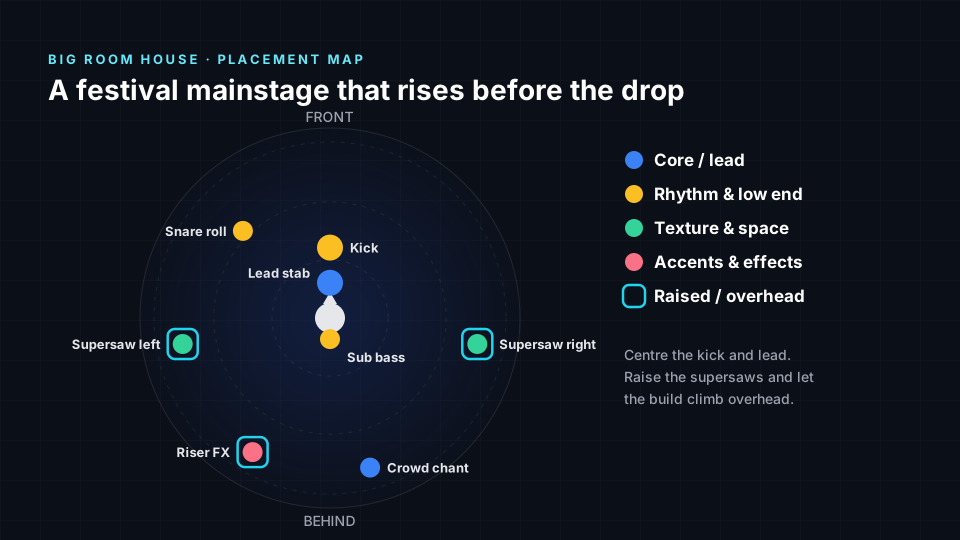
Immersive music for big room house: what listeners hear
- A sky that opens in the breakdown. Supersaw chords rise above and around you.
- A build that climbs. Snare rolls and risers lift towards the ceiling.
- A drop that hits dead ahead. Kick and lead stab land together in the centre.
- A crowd behind you. Chants and hype vocals put you in the middle of the field.
Where to place each element in a big room house mix
| Element | Position | Height | Why it works |
|---|---|---|---|
| Kick | Front centre | Ear level | The mainstage hit |
| Sub bass | Centre | Ear level | Weight under the kick |
| Lead stab | Front centre | Ear level | The drop hook, dead ahead |
| Snare roll | Front left, rising | Ear level | Drives the build upward |
| Supersaw left | Left | Raised | Breakdown chords lifted over the crowd |
| Supersaw right | Right | Raised | Mirrors the left for a full sky |
| Crowd chant | Behind | Ear level | The festival field around you |
| Riser FX | Behind left, rising | Raised | Climbs into the drop |
The psychoacoustics behind Big Room House placement
Every position in the table above follows how the ear and brain locate sound. Here is the reason behind the main choices for Big Room House.
- Kick and sub stay centred. Frequencies below roughly 80 to 100 Hz give the ear very little sense of direction, which is why festival rigs can fly their subs as one block. The big room kick has most of its weight in that range, so it should land equally hard everywhere on the field.
- Lead stab in front, reverb behind. When a sound and its reflections arrive close together, the brain locates the sound by the first arrival. This is the precedence effect. Sending the long reverb tails of a big room lead around the room keeps the stab pinned to the front.
- Supersaws raised on both sides. Sound arriving from the sides early in a reflection pattern is what makes a space feel wide and enveloping, a finding from concert hall acoustics. Lifting the supersaw chords left and right uses that lateral energy to make the breakdown feel like a stadium.
- Risers climbing behind. People are biased to hear rising tones as approaching and more urgent than falling ones. A white noise riser that climbs from behind and above uses that bias to make the build feel bigger and the drop more of a release.
The immersion profile for big room house
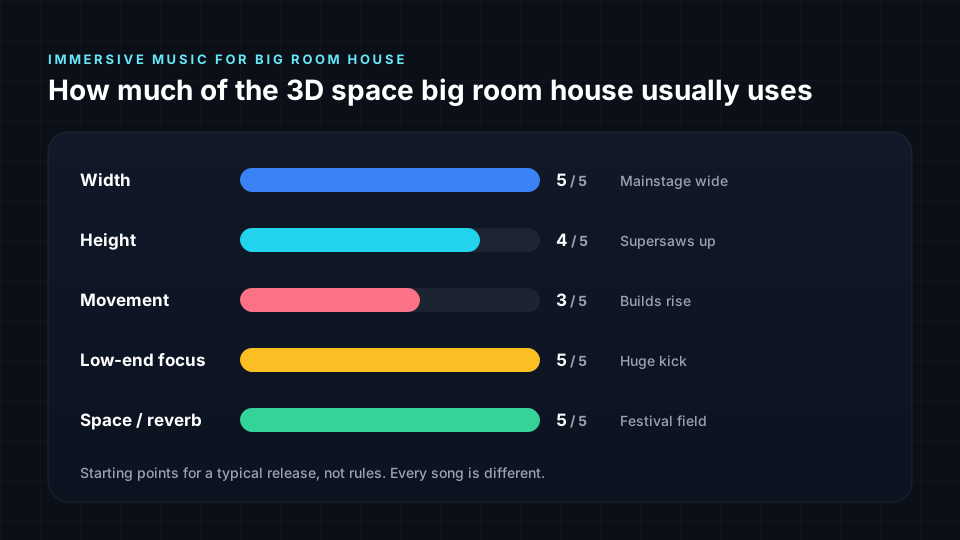
Width, space and low-end focus are at maximum because the genre is built for open fields and huge kicks. Height is high thanks to raised supersaws and rising builds. Movement stays moderate: the drama comes from the build climbing, not from sounds circling the head.
Tips for an immersive big room house mix
- Contrast breakdown and drop. Open the space wide in the breakdown, then snap it narrow for the drop.
- Keep the lead stab centred. The drop hook must hit from the front every time.
- Let the build rise. Move snare rolls and risers towards the height layer as tension grows.
- Use the silence. A short gap before the drop makes the centred kick feel enormous.
- Put the crowd behind. Chants and hype vocals at the rear make the listener part of the audience.
Big Room House styles: mainstage, big room techno and speed house
The core placement from this guide still applies: a centred drop with the kick, sub bass and lead stab dead ahead, and a sky that opens in the breakdown. What changes per style is how much height, width and space each part of the track gets.
Mainstage big room
Mainstage big room is the classic festival sound this guide is built around: piano or supersaw breakdowns, long snare roll builds and a stripped-back drop with a short, punchy lead stab. Use the full contrast. Lift the supersaws high on both sides in the breakdown, let the snare roll and risers climb overhead, then snap everything narrow so the drop hits from the front.
Big room techno
Big room techno keeps the festival scale but borrows from techno, with darker tones, rumbling low end and hypnotic, repeating synth lines in place of bright supersaws. Keep the kick and rumble centred and mono. Place the repeating synth loop slightly raised at the front, and let a filtered or echoing layer move slowly around the sides. Use less height in the breakdown and keep the space large but darker.
Speed house
Speed house is faster and more driving, with bouncy, rolling offbeat basslines and short synth stabs instead of long builds. Keep the kick and offbeat bass tightly centred so the bounce stays clear at speed. Place the stabs front left and right at ear level, keep the crowd chant behind and shorten the reverbs, because a big festival space can blur the faster groove.
How to make immersive big room house from stereo
Spatial9 can create spatial audio from a stereo track in a few steps:
- Upload your stereo master or your stems.
- Spatial9's AI separates and places each part, centring the drop and lifting supersaws and risers overhead.
- Preview it in binaural on headphones.
- Export Eclipsa Audio, ADM, binaural or Ambisonics.
- Publish a video. Create a YouTube-ready video with your immersive audio and publish it directly.
For related guides, read spatial audio for electro house and spatial audio for EDM. Every guide is listed in spatial audio and immersive music by genre.
Frequently asked questions
Does this guide cover mainstage big room, big room techno and speed house?
Yes. All three keep the kick, sub bass and drop hook centred. Mainstage big room uses the full contrast, with supersaws lifted high in the breakdown and a narrow, punchy drop. Big room techno keeps a large but darker space, with less height and slow movement on hypnotic loops. Speed house tightens everything, with stabs at ear level and shorter reverbs for the faster groove.
Can I make a big room house mix in Dolby Atmos or Eclipsa Audio?
Yes. The placements in this guide work for both. Spatial9 exports ADM, the standard file used by Dolby Atmos studios, as well as Eclipsa Audio for YouTube, so one immersive big room house mix covers both. If you plan to release the Atmos version on Apple Music, build it from your original stems or multitracks, because Apple does not accept Atmos made from a finished stereo master. See where to publish spatial audio. You may also hear this called a 3D big room house mix or big room house in spatial audio.
Is spatial audio good for big room house?
Yes. Big room house is built on scale and contrast, and spatial audio lets the breakdown open into a real sky before the drop hits hard from the centre.
Should the drop be wide or narrow in immersive big room house?
The core of the drop should be narrow: kick, sub and lead stab in the centre. Reverb and supporting layers can fill the room around them.
How should a big room house build move?
Upward. Snare rolls and risers should climb from ear level towards the height layer, then everything drops back to the centre on the downbeat.
Can I convert a finished big room house track to spatial audio?
Yes. Spatial9 uses AI to generate an immersive mix from a stereo master and exports it as Eclipsa Audio, ADM, binaural or Ambisonics.
Does immersive big room house work on normal headphones?
Yes. The mix is rendered binaurally, so the rising builds and festival space work on any regular headphones.
Dolby and Dolby Atmos are trademarks of Dolby Laboratories. Spatial9 is not affiliated with or endorsed by Dolby Laboratories.
Sources
- Blauert, J. (1997). Spatial Hearing: The Psychophysics of Human Sound Localization, revised edition. MIT Press. Low-frequency, elevation, distance and motion cues.
- Mills, A. W. (1958). On the minimum audible angle. Journal of the Acoustical Society of America, 30(4), 237-246.
- Hebrank, J. and Wright, D. (1974). Spectral cues used in the localization of sound sources on the median plane. Journal of the Acoustical Society of America, 56(6), 1829-1834.
- Bronkhorst, A. W. (2000). The cocktail party phenomenon: a review of research on speech intelligibility in multiple-talker conditions. Acta Acustica united with Acustica, 86, 117-128.
- Litovsky, R. Y., Colburn, H. S., Yost, W. A. and Guzman, S. J. (1999). The precedence effect. Journal of the Acoustical Society of America, 106(4), 1633-1654.
- Barron, M. and Marshall, A. H. (1981). Spatial impression due to early lateral reflections in concert halls. Journal of Sound and Vibration, 77(2), 211-232.
- Neuhoff, J. G. (1998). Perceptual bias for rising tones. Nature, 395, 123-124.
- Bregman, A. S. (1990). Auditory Scene Analysis: The Perceptual Organization of Sound. MIT Press.
Put your listeners in the middle of the main stage
Upload a track to Spatial9 and hear your build rise overhead and your drop hit from the front in minutes. Then export it or publish it straight to YouTube.