Spatial Audio & Immersive Music for Dark Psytrance: Forest, Hi-Tech & Psycore
Spatial9 Team · · 9 min read
Part of the series Spatial audio and immersive music by genre.
Key takeaways
- In a spatial dark psytrance mix the kick and rolling offbeat bass stay locked in the centre, while twisted leads, vocal samples, glitch FX, dark atmosphere, hats and laser sweeps surround the listener.
- Fast glitches and leads need their own directions in dark psytrance, because the brain separates sounds into streams by direction, which keeps a dense mix readable at high speed.
- Dark psytrance can take long, dark reverb on atmospheres and voices, but the kick and bass must stay dry and mono so the fast roll stays tight.
- The dark psytrance immersion profile scores width 5, height 5, movement 5, low-end focus 5 and space 4 out of 5.
Dark psytrance, often shortened to darkpsy, is the night-time side of psychedelic trance. It took shape around the early 2000s as producers pushed psytrance towards darker, faster and stranger sounds, with Germany and Russia among its early strongholds and outdoor festival and forest parties as its natural home. The sound is built on a tight kick and a rolling offbeat bassline, usually somewhere between about 145 and 160 BPM and often faster in its extreme forms. Over that engine sit twisted, squelching leads, eerie spoken or film-style vocal samples, glitchy percussion, laser-like sweeps and thick, dark atmospheres. Almost every sound is designed to move, warp and surprise, which makes the genre a natural fit for a 3D mix where effects can come from anywhere. This guide covers how spatial audio for dark psytrance works, where to place each element and how to make an immersive dark psytrance mix. For the basics, see what spatial audio is.
Why dark psytrance works in spatial audio
Dark psytrance is made of small, fast events: a glitch that flicks past one ear, a voice that whispers out of nowhere, a laser that sweeps over the crowd. In stereo those events fight for space on top of a dense rolling bass. In an immersive mix they can come from behind, from above and from either side, so the track feels like a night in the woods where something is always moving just out of sight.
The rule: a locked rolling engine, a forest full of movement. Kick and bass never move, while leads, glitches and sweeps travel all around the listener.
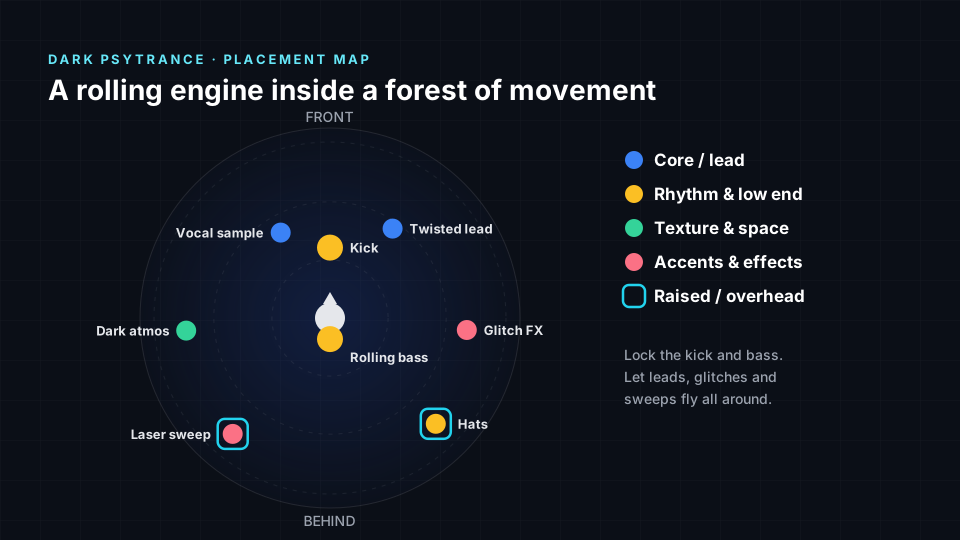
Immersive music for dark psytrance: what listeners hear
- A rolling engine that never stops. Kick and offbeat bass stay centred and tight at high speed.
- Leads that twist around you. Squelching lines bend and travel across the front.
- Voices out of the dark. Eerie samples appear close and slightly off centre.
- Something always moving overhead. Lasers, glitches and sweeps fly above and behind.
Where to place each element in a dark psytrance mix
| Element | Position | Height | Why it works |
|---|---|---|---|
| Kick | Front centre | Ear level | Tight, fast pulse |
| Rolling bass | Centre | Ear level | The offbeat engine of the track |
| Twisted lead | Front right, moving | Ear level | Squelching line that bends as it travels |
| Vocal sample | Front left | Ear level | Eerie voice, close and clear |
| Glitch FX | Right, moving | Ear level | Fast detail that flicks past the ear |
| Dark atmos | Left | Ear level | Night-time ambience that widens the room |
| Hats | Behind right | Raised | Fast, crisp top end |
| Laser sweep | Behind left, moving | Raised | Sweeps that fly over the listener |
The psychoacoustics behind dark psytrance placement
Every position in the table above follows how the ear and brain locate sound. Here is the reason behind the main choices for dark psytrance.
- Kick and rolling bass stay centred. The ear finds almost no direction in frequencies below roughly 80 to 100 Hz, so spreading the low end adds nothing. In dark psytrance the kick and bass interlock on every beat, and keeping both mono and centred keeps that roll tight on any system.
- Glitches heard as separate streams. The brain groups sounds into streams by pitch, timing and direction, a process called auditory stream segregation (Bregman). Giving fast glitches and twisted leads their own directions stops them fusing into one blur, so the listener can follow each line at high speed.
- Vocal samples close and in front. Picking out one voice among many sounds, the cocktail party effect, is far easier when the voice has its own direction (Bronkhorst). A spoken sample near the front left stays intelligible over the dense rolling bass.
- Lasers and hats raised. Spectral cues created by the outer ear tell us how high a sound is (Hebrank and Wright). Bright, high-frequency sweeps and hats carry those cues well, so lifting them overhead feels convincing and leaves the ear level free for leads.
The immersion profile for dark psytrance
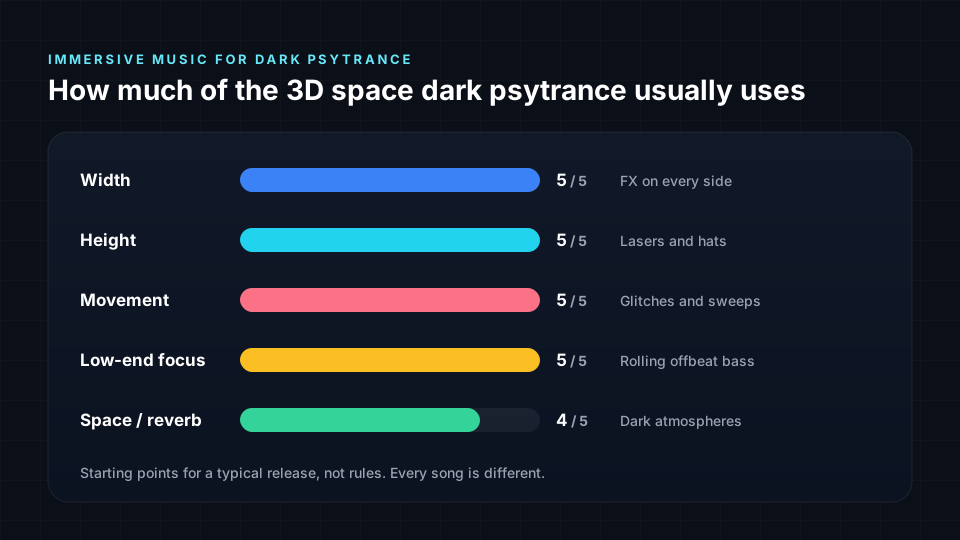
Width, height and movement are at maximum because nearly every effect in dark psytrance is meant to fly around the listener. Low-end focus is also at maximum, since the rolling bass is the core of the genre. Space scores a little higher than in full-on psytrance because dark atmospheres and night-time ambience are part of the sound. It still stops short of 5, because long reverb on the kick and bass would blur a fast roll.
Tips for an immersive dark psytrance mix
- Keep the roll mono. Kick and offbeat bass must hit together from the same place.
- Give every glitch a direction. Short FX are the perfect material for movement.
- Keep reverb off the low end. Use long, dark tails on atmospheres and voices only.
- Move fast parts quickly, slow parts slowly. Match the speed of motion to the sound.
- Leave one calm zone. Keep the vocal sample in a fixed spot so the ear has an anchor.
Dark Psytrance styles: forest, hi-tech and psycore
The core placement still applies to every dark psytrance style: kick and rolling bass locked in the centre, leads and glitches around the front and sides, sweeps overhead. What changes is the tempo, how organic or synthetic the sound is, and how much room the track can take.
Forest
Forest psytrance is the earthy, organic side of dark psy, usually at the slower end of the range. It uses crunchy, woody textures, insect-like clicks, nature recordings and deep, mysterious atmospheres. In a spatial mix it can take the most space of the three. Scatter small organic sounds around the sides and behind, as if they come from the trees, raise a soft atmosphere overhead and use a longer, darker reverb on textures. Movement should feel like wildlife, small and unpredictable, while the kick and bass stay locked.
Hi-Tech
Hi-tech is the fastest and most precise style, often well above 180 BPM, with strong scenes in Latin America and Europe. It is built on razor-sharp, highly detailed sound design: tiny glitches, fast lasers and rapid-fire percussion. In a spatial mix, precision matters more than size. Keep the room short and dry, give each micro sound a clear direction, and use quick, small movements rather than long sweeps. Keep the most important detail in front, where the ear resolves direction best, and save overhead space for lasers.
Psycore
Psycore is the darkest and most aggressive style, fast and heavy, with harsh leads, distorted textures and horror-film vocal samples. It often overlaps with hi-tech in tempo but trades precision for menace. In a spatial mix, use the space to unsettle. Let voices and screams appear suddenly behind or beside the listener, keep distorted leads wide at the sides, and raise metallic noise above. The kick and bass must stay centred and dry, because at this speed any blur weakens the drive.
Closely related styles, such as twilight psy and darker progressive psytrance, follow the same pattern, with a locked rolling bass and the strangeness carried by the effects on top.
How to make immersive dark psytrance from stereo
Spatial9 can create spatial audio from a stereo track in a few steps:
- Upload your stereo master or your stems.
- Spatial9's AI separates and places each part, locking the kick and rolling bass and sending leads, glitches and sweeps around you.
- Preview it in binaural on headphones.
- Export Eclipsa Audio, ADM, binaural or Ambisonics.
- Publish a video. Create a YouTube-ready video with your immersive audio and publish it directly.
For related guides, read spatial audio for psychedelic trance and spatial audio for raw trance. Every guide is listed in spatial audio and immersive music by genre.
Frequently asked questions
Does this guide cover forest, hi-tech and psycore?
Yes. Forest scatters organic textures around the listener in a deeper, darker room. Hi-tech uses a short, dry room with precise, fast movement for tiny glitches and lasers. Psycore places harsh leads wide and lets voices appear suddenly behind and beside the listener. All three keep the kick and rolling bass locked in the centre.
Can I make a dark psytrance mix in Dolby Atmos or Eclipsa Audio?
Yes. The placements in this guide work for both. Spatial9 exports ADM, the standard file used by Dolby Atmos studios, as well as Eclipsa Audio for YouTube, so one immersive dark psytrance mix covers both. If you plan to release the Atmos version on Apple Music, build it from your original stems or multitracks, because Apple does not accept Atmos made from a finished stereo master. See where to publish spatial audio. You may also hear this called a 3D dark psytrance mix or dark psytrance in spatial audio.
Is spatial audio good for dark psytrance?
Yes. Dark psytrance is full of fast, moving effects, and spatial audio lets each one come from its own direction around a tight, centred rolling bass.
How is dark psytrance different from psychedelic trance in spatial audio?
Full-on psytrance is brighter and more melodic, with big leads that fill the front and top. Dark psytrance is denser and stranger, so the mix relies on many small effects moving around the listener and on a darker, deeper atmosphere.
Where should vocal samples go in immersive dark psytrance?
Usually close and in front, slightly off centre, so the words stay clear over the bass. For a shock moment, a short sample can jump behind the listener, then return to its usual place.
Can I convert a finished dark psytrance track to spatial audio?
Yes. Spatial9 uses AI to generate an immersive mix from a stereo master and exports it as Eclipsa Audio, ADM, binaural or Ambisonics.
Does immersive dark psytrance work on normal headphones?
Yes. The mix is rendered binaurally, so the moving glitches, raised sweeps and rolling bass work on any regular headphones.
Dolby and Dolby Atmos are trademarks of Dolby Laboratories. Spatial9 is not affiliated with or endorsed by Dolby Laboratories.
Sources
- Blauert, J. (1997). Spatial Hearing: The Psychophysics of Human Sound Localization, revised edition. MIT Press. Low-frequency, elevation, distance and motion cues.
- Mills, A. W. (1958). On the minimum audible angle. Journal of the Acoustical Society of America, 30(4), 237-246.
- Hebrank, J. and Wright, D. (1974). Spectral cues used in the localization of sound sources on the median plane. Journal of the Acoustical Society of America, 56(6), 1829-1834.
- Bronkhorst, A. W. (2000). The cocktail party phenomenon: a review of research on speech intelligibility in multiple-talker conditions. Acta Acustica united with Acustica, 86, 117-128.
- Litovsky, R. Y., Colburn, H. S., Yost, W. A. and Guzman, S. J. (1999). The precedence effect. Journal of the Acoustical Society of America, 106(4), 1633-1654.
- Barron, M. and Marshall, A. H. (1981). Spatial impression due to early lateral reflections in concert halls. Journal of Sound and Vibration, 77(2), 211-232.
- Neuhoff, J. G. (1998). Perceptual bias for rising tones. Nature, 395, 123-124.
- Bregman, A. S. (1990). Auditory Scene Analysis: The Perceptual Organization of Sound. MIT Press.
Step into the night forest
Upload a track to Spatial9 and hear glitches and sweeps fly around a locked, rolling bass in minutes. Then export it or publish it straight to YouTube.