Spatial Audio & Immersive Music for Grime: Complete Guide
Spatial9 Team · · Updated
Part of the series Spatial audio and immersive music by genre.
Grime was born in East London in the early 2000s, built on fast MC flows, square-wave basslines, cold synth stabs and raw, minimal production. It was made on cheap equipment and played on pirate radio. That rawness is part of the sound, so a good immersive grime mix adds energy without polishing it away. This guide covers how spatial audio for grime works, where to place each element and how to make an immersive grime mix. For the basics, see what spatial audio is.
Why grime works in spatial audio
Grime beats are sparse. A few stabs, a bass, drums and an MC. That sparseness means each element can take a clear position, and quick hits from the sides or behind feel aggressive and exciting.
The rule: the MC rules the front. Every lyric must be clear, so the centre stays open for the voice.
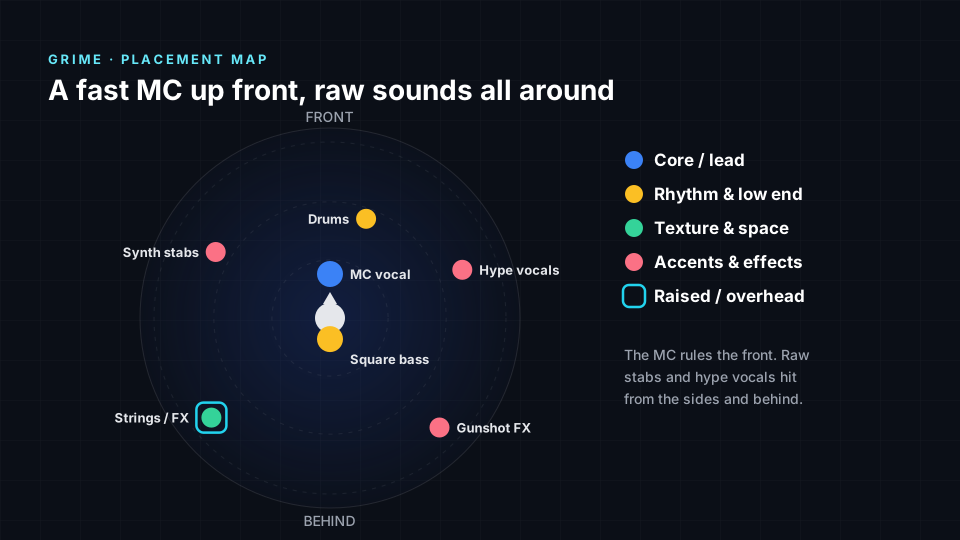
Immersive music for grime: what listeners hear
- An MC in your face. Fast flows stay sharp and centred.
- Bass that buzzes. The square-wave bass sits solid in the middle.
- Stabs that cut. Cold synth hits come from the front left.
- Hype from the sides. Backing shouts and effects hit from around the room.
Where to place each element in a grime mix
| Element | Position | Height | Why it works |
|---|---|---|---|
| MC vocal | Front centre | Ear level | Every bar must be clear |
| Square bass | Centre | Ear level | The signature low end |
| Drums | Front right | Ear level | Fast, raw rhythm |
| Synth stabs | Front left | Ear level | Cold, cutting melody |
| Hype vocals | Right, jumping | Ear level | Live crew energy |
| Strings and FX | Behind left | Raised | Dark drama |
| Effect hits | Behind right | Ear level | Classic grime punctuation |
The psychoacoustics behind grime placement
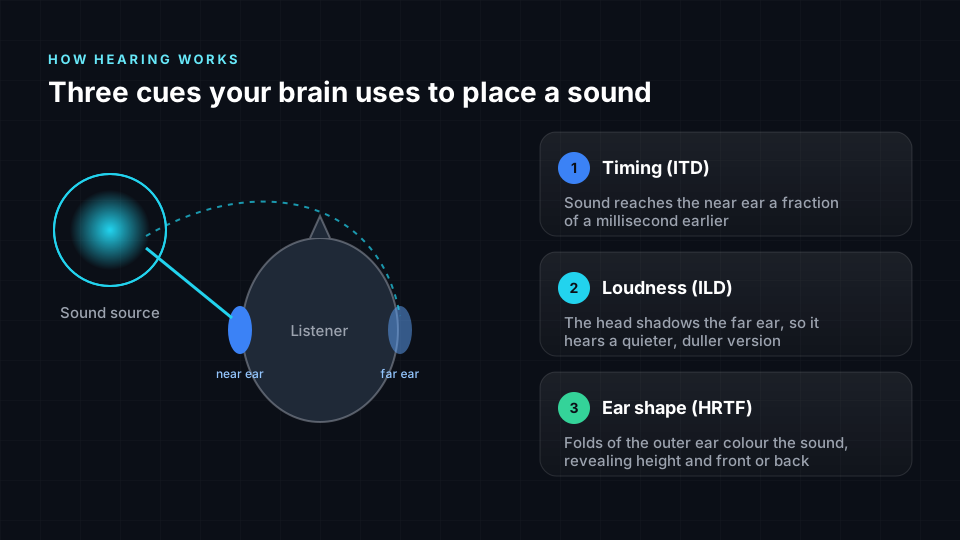
Every position in the table above follows how the ear and brain locate sound. Here is the reason behind the main choices for grime.
- MC vocal in front. The ear's directional resolution is finest in front of the face and much coarser to the sides and behind, so the part you must follow belongs in front. Fast, dense bars need the most precise position to stay clear.
- Square bass centred. Deep bass is the hardest sound for the ear to locate. Its wavelengths are several metres long, far larger than your head, so both ears receive almost the same level and only a tiny timing difference. The raw square-wave bass stays solid on every system.
- Hype vocals jumping on the right. Moving sounds grab attention because the brain is wired to track change, so motion works best when it is slow, deliberate and kept away from the anchor parts. Short jumps grab attention for a moment, then get out of the way.
- Strings and FX behind. Direction behind the head is less precise and front-back mix-ups are common, which makes the rear ideal for diffuse sounds that should wrap around you rather than point at you. Dark textures behind create tension without crowding the MC.
The immersion profile for grime
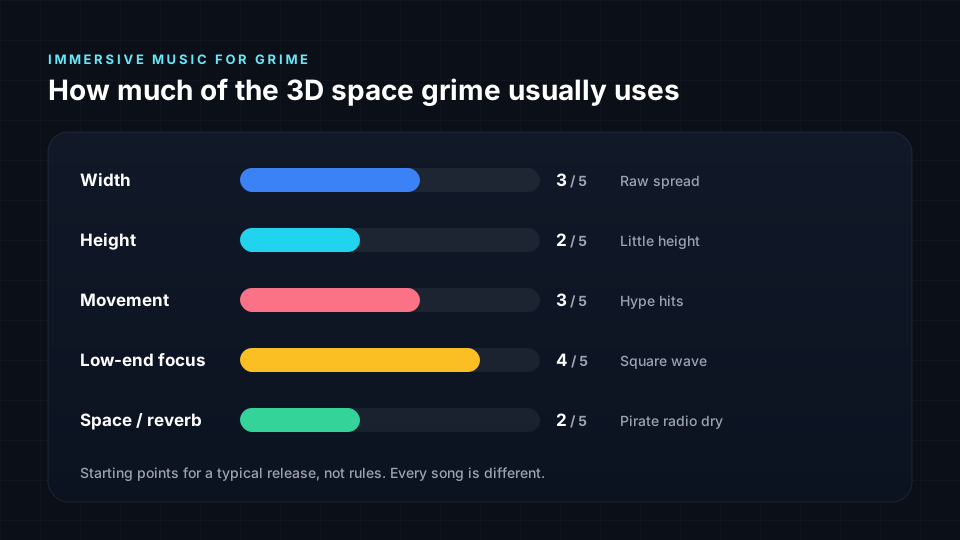
Grime is raw and dry, so height and space stay low. Movement comes from short, punchy hits rather than long sweeps.
Tips for an immersive grime mix
- Keep the MC dry and centred. Clarity beats atmosphere.
- Keep it raw. Do not polish away the rough edges with big reverbs.
- Use quick hits. Short jumps from the sides add energy.
- Centre the square bass. It must buzz cleanly on any system.
- Leave gaps. Grime's sparse beats need empty space to hit hard.
How to make immersive grime from stereo
Spatial9 can create spatial audio from a stereo track in a few steps:
- Upload your stereo master or your stems.
- Spatial9's AI separates and places each part, keeping the MC centred and clear.
- Preview it in binaural on headphones.
- Export Eclipsa Audio, ADM, binaural or Ambisonics.
- Publish a video. Create a YouTube-ready video with your immersive audio and publish it directly.
For related guides, read spatial audio for drill and spatial audio for hip-hop. Every guide is listed in spatial audio and immersive music by genre.
Frequently asked questions
Can I make a grime mix in Dolby Atmos or Eclipsa Audio?
Yes. The placements in this guide work for both. Spatial9 exports ADM, the standard file used by Dolby Atmos studios, as well as Eclipsa Audio for YouTube, so one immersive grime mix covers both. You may also hear this called a 3D grime mix or grime in spatial audio.
Is spatial audio good for grime?
Yes. Grime's sparse beats leave room for clear positions, and quick hits from around the listener add energy.
Will spatial audio make grime sound too polished?
Not if you keep it dry. Avoid big reverbs and keep the MC and bass centred to preserve the raw feel.
Where should hype vocals go?
To the sides, with short jumps. That keeps the centre clear for the MC.
Can I convert a finished grime track to spatial audio?
Yes. Spatial9 uses AI to generate an immersive mix from a stereo master and exports it as Eclipsa Audio, ADM, binaural or Ambisonics.
Does immersive grime work on normal headphones?
Yes. The mix is rendered binaurally, so the 3D effect works on any regular headphones.
Dolby and Dolby Atmos are trademarks of Dolby Laboratories. Spatial9 is not affiliated with or endorsed by Dolby Laboratories.
Sources
- Blauert, J. (1997). Spatial Hearing: The Psychophysics of Human Sound Localization, revised edition. MIT Press. Low-frequency, elevation, distance and motion cues.
- Mills, A. W. (1958). On the minimum audible angle. Journal of the Acoustical Society of America, 30(4), 237-246.
- Hebrank, J. and Wright, D. (1974). Spectral cues used in the localization of sound sources on the median plane. Journal of the Acoustical Society of America, 56(6), 1829-1834.
- Bronkhorst, A. W. (2000). The cocktail party phenomenon: a review of research on speech intelligibility in multiple-talker conditions. Acta Acustica united with Acustica, 86, 117-128.
- Litovsky, R. Y., Colburn, H. S., Yost, W. A. and Guzman, S. J. (1999). The precedence effect. Journal of the Acoustical Society of America, 106(4), 1633-1654.
- Barron, M. and Marshall, A. H. (1981). Spatial impression due to early lateral reflections in concert halls. Journal of Sound and Vibration, 77(2), 211-232.
- Neuhoff, J. G. (1998). Perceptual bias for rising tones. Nature, 395, 123-124.
- Bregman, A. S. (1990). Auditory Scene Analysis: The Perceptual Organization of Sound. MIT Press.
Bring the energy from every side
Upload a track to Spatial9 and hear your grime hit from all around in minutes. Then export it or publish it straight to YouTube.