
The Intent Fidelity Score (IFS): The Metric That Changes How Immersive Audio Is Judged
Spatial9 Research Team · · 11 min read
Key takeaways
- IFS scores immersive audio on three things at once: psychoacoustic localization (50%), creative brief alignment (30%) and format compliance (20%).
- The weights were tuned by grid search against ratings from 22 professional engineers.
- IFS agrees with expert judgement at r = 0.89, against 0.71 for compliance scoring and 0.62 for localization error alone.
- Compliance is multiplied rule by rule, so a single broken rule sets it to zero and blocks delivery.
- By rewarding stable, perceptually precise placement and cutting revision loops, IFS reduces both listener and engineer fatigue.
The problem nobody was measuring
Immersive audio has never had more ways to be delivered. Dolby Atmos, Eclipsa Audio (IAMF), binaural for headphones and Ambisonics for VR now reach phones, cars, living rooms and cinemas. What it has never had is a reliable way to say whether a mix is good.
Every existing check measures one thing in isolation:
- Localization error asks how far a sound landed from its target. It ignores whether that target was right for the song.
- Compliance scores ask whether a file obeys the format. A perfectly compliant mix can still feel wrong.
- Listening sessions capture everything, but they are slow, expensive and tiring, and they do not scale to the volume of content now being made.
The gap is the one that matters most to artists and directors: the distance between what was asked for and what was delivered. A director writes "a thunderstorm encircling the listener" or "a ghostly voice drifting upward from the left rear". An engineer has to turn those words into coordinates, trajectories, bed assignments and metadata. Nothing measured how faithfully that translation was made. IFS does.
The idea: score intent, not just position
The core insight behind IFS is simple. A spatial mix is only good when three things are true at the same time:
- It is heard correctly. Every source is perceived where it was meant to be, by real human ears.
- It means the right thing. The scene expresses the creative brief, not a generic layout.
- It works everywhere. Every technical rule of the delivery format is respected.
Miss any one and the mix fails, no matter how well it does on the other two. IFS is the first score that measures all three together, in proportions tuned to how experts actually judge.
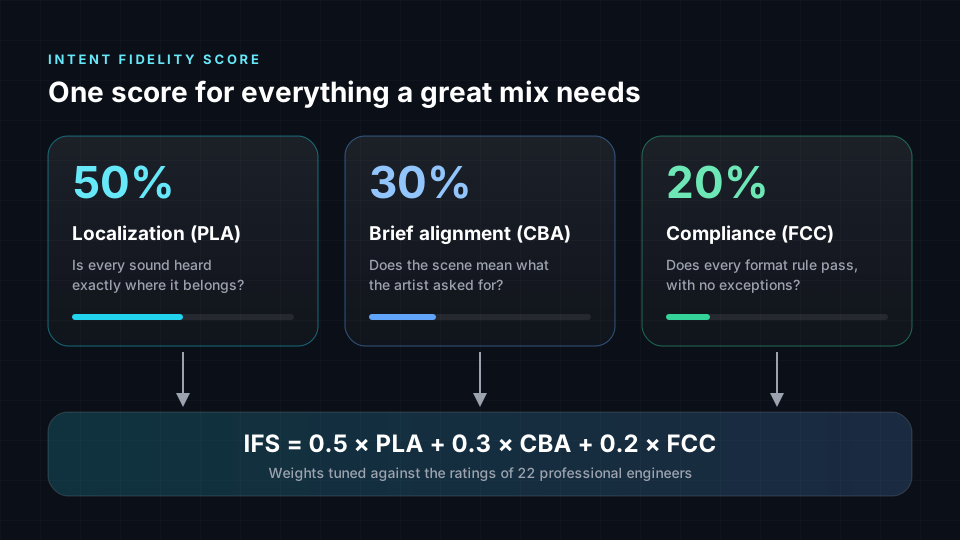
IFS = 0.5 x PLA + 0.3 x CBA + 0.2 x FCC| Part | Weight | The question it answers |
|---|---|---|
| PLA, Psychoacoustic Localization Accuracy | 50% | Is every sound heard exactly where it belongs? |
| CBA, Creative Brief Alignment | 30% | Does the scene mean what the brief said? |
| FCC, Format Compliance Checks | 20% | Does every format rule pass, with no exceptions? |
Why single checks fail
The best way to see why IFS matters is to look at scenes that pass a traditional check and still get rejected by experts.
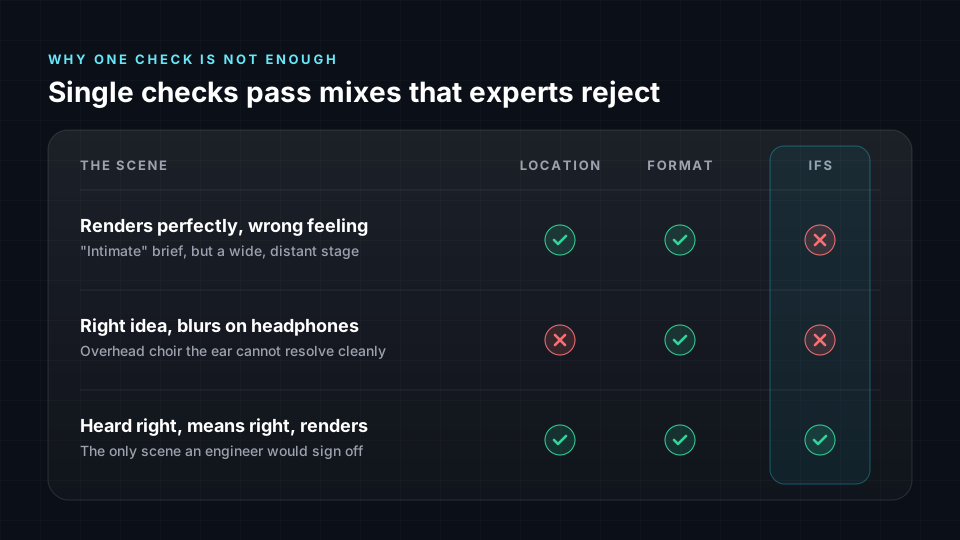
- Renders perfectly, wrong feeling. The brief asked for something intimate. The scene places everything wide and distant. Every source sits exactly where the scene says and every format rule passes, yet any listener would say it misses the point. Location and compliance checks both pass it. IFS catches it through brief alignment.
- Right idea, blurs on headphones. A choir is lifted overhead exactly as the brief described, but at positions the ear cannot resolve cleanly, so the image smears. Compliance passes it. IFS catches it through psychoacoustic localization.
- Heard right, means right, renders. This is the only scene a senior engineer would sign off, and the only one with a high IFS.
Part 1: Psychoacoustic Localization Accuracy (PLA)
PLA carries half the weight because it is the foundation: if listeners cannot hear a sound where it is meant to be, nothing else matters.
The key word is psychoacoustic. A coordinate can be perfect on paper and still be heard somewhere else. Human hearing locates sound using tiny differences in timing, level and spectrum between the two ears, shaped by the head and outer ear (the head-related transfer function, or HRTF). Some regions, such as directly overhead or straight behind, are much harder to resolve than others. PLA measures position as people perceive it.
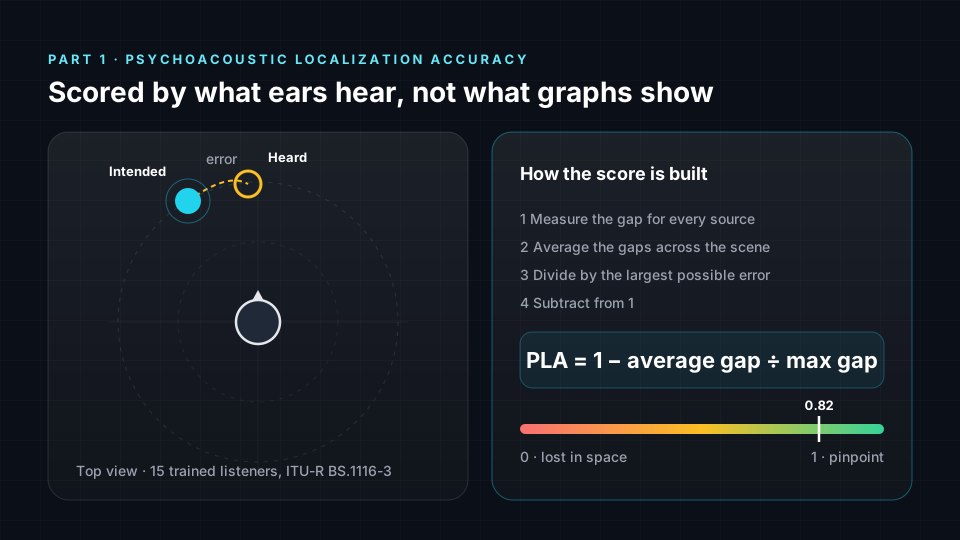
How PLA is built:
- For every source, measure the distance between the rendered position and the reference position.
- Average those distances across the whole scene.
- Divide by the largest possible error, so the result is independent of room or format size.
- Subtract from 1, so 1 means pinpoint accuracy and 0 means lost in space.
PLA = 1 - (1/N) x sum of |rendered position - reference position| / maximum errorPositions are rendered with Vector Base Amplitude Panning (VBAP), a standard method for placing sound between loudspeakers. They are confirmed in ITU-R BS.1116-3 listening tests with 15 trained listeners, the same international method used to detect small differences in audio quality. PLA is grounded in human hearing, not in a model's own opinion of itself.
Part 2: Creative Brief Alignment (CBA)
CBA brings something new to audio measurement: the artist's words become part of the score.
Every Spatial9 scene starts from a brief, such as "intimate verses, open the last chorus upward" or "a distant choir emerging from all directions". CBA compares the meaning of that brief with the meaning of the spatial metadata produced for each source. It uses semantic similarity scoring (BERTScore) together with embeddings built specifically for language and spatial audio (ELSA). The comparison asks whether the descriptions and positions in the scene express the same ideas as the brief.
CBA = average over all sources of the semantic match between the brief and that source's spatial metadataThis matters because spatial words carry precise meaning for professionals:
| Brief language | What a faithful scene does |
|---|---|
| "Intimate" | Sources closer and narrower, little height |
| "Encircling" | Sources distributed around the listener, including behind |
| "Drifting upward from the left rear" | A trajectory starting behind and left, rising toward overhead |
| "Concert hall" | More distance, width and height, a stable front stage |
| "Front and centre" | A fixed, narrow, anchored position straight ahead |
Without CBA, a system can be technically flawless and creatively deaf. With CBA, faithfulness to the brief is measured, not assumed.
Part 3: Format Compliance Checks (FCC)
FCC is the strictest part of IFS, by design. Automated checks validate every technical constraint of the target format: bed limits, object counts, height channel use, metadata structure and value ranges. The results are multiplied together, not averaged.
FCC = rule 1 x rule 2 x ... x rule K (each rule is 1 if it passes, 0 if it fails)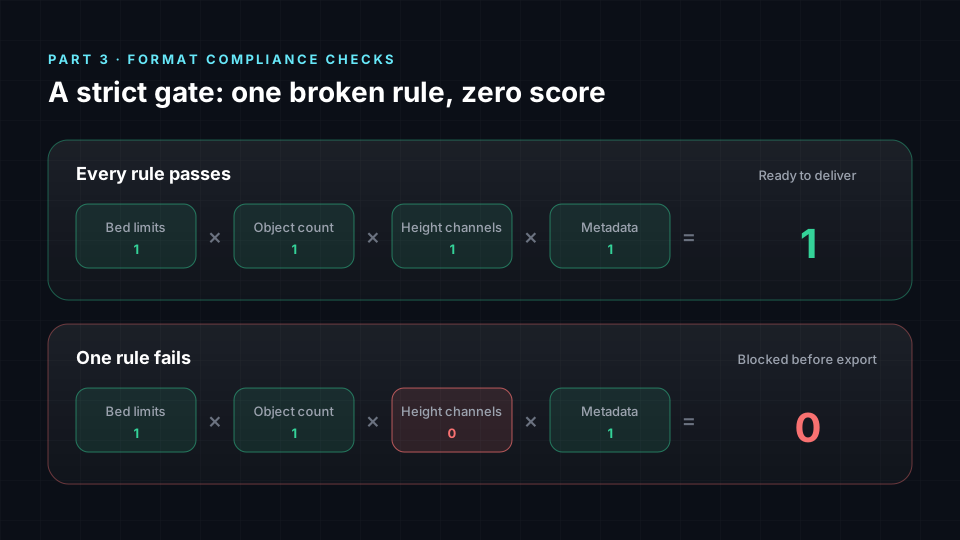
Multiplication is the genius detail. With an average, a scene that breaks one rule out of ten would still score 90% and look nearly fine. With a product, one broken rule means zero. A scene that would fail on a Dolby Atmos renderer or an Eclipsa Audio player can never sneak through with a high score. FCC carries only 20% of the weight, but it acts as a hard gate on delivery.
Tuned to how experts actually listen
The weights in IFS were not chosen by intuition. They were found by grid search against the ratings of 22 professional engineers: every combination was tested, and the one whose scores best matched expert judgement was kept. The result, 50% localization, 30% brief alignment and 20% compliance, mirrors how experienced engineers prioritize. Hear it right first, mean it second, and never ship anything broken.
The real test of any quality score is whether it agrees with the people who judge mixes for a living. On this test IFS clearly outperforms the established measures:
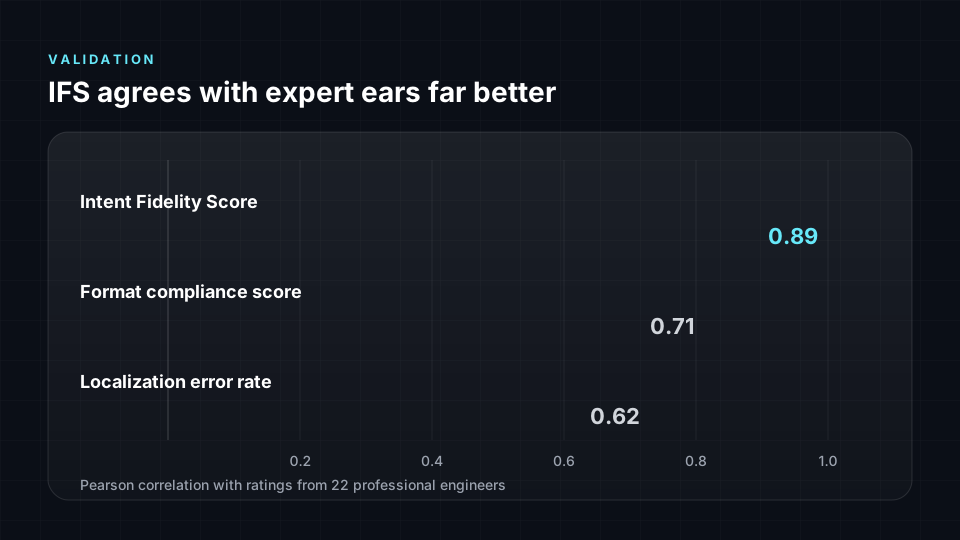
| Measure | Agreement with expert ratings (Pearson's r) |
|---|---|
| Intent Fidelity Score (IFS) | 0.89 |
| Format compliance score | 0.71 |
| Localization error rate | 0.62 |
A correlation of 0.89 means that when IFS rises, expert opinion rises with it, very consistently. That changes what is possible: quality can be checked automatically on every scene, every version and every track, with confidence that the number reflects what an expert would say.
What GravityLLM scores
GravityLLM, the Spatial9 model for spatial placement, is built and evaluated around IFS. In the published results it reached:
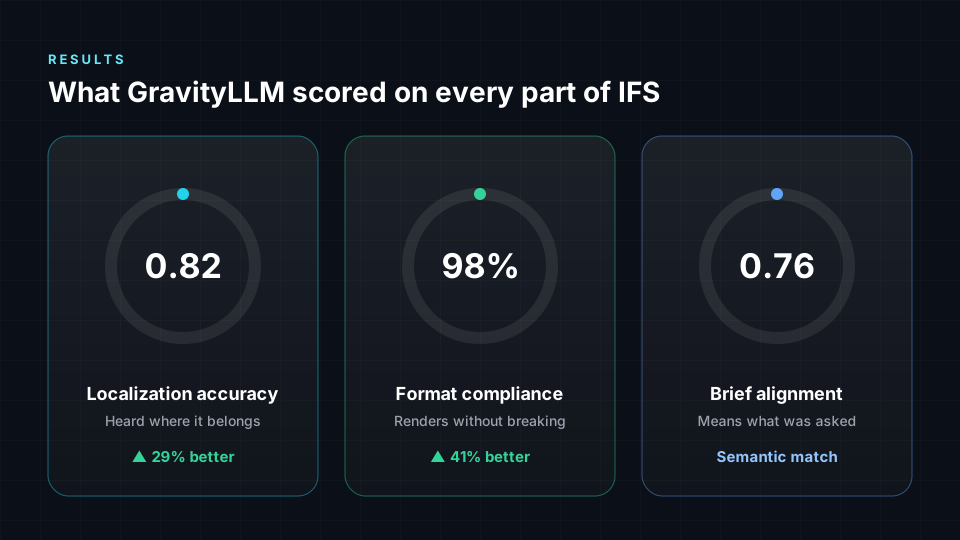
| Part of IFS | Score | Improvement |
|---|---|---|
| Psychoacoustic Localization Accuracy | 0.82 | 29% better |
| Format compliance | 98% | 41% better |
| Creative Brief Alignment | 0.76 | Measured as semantic match |
How IFS fights fatigue
Fatigue is the hidden cost of immersive audio, and it affects both sides of the speakers.
Listener fatigue
When sources wander without purpose, images blur between speakers, or elevation sits where the ear cannot resolve it, the brain works harder to build a stable picture of the scene. Over an album or a feature film, that constant extra effort becomes tiring, harsh listening, and people take their headphones off. Because PLA rewards stable, perceptually precise placement, IFS pushes scenes toward positions the ear resolves effortlessly. The result feels natural, so it can be enjoyed for hours.
Engineer fatigue
Research on the mental load of spatial audio production describes positional revision loops: engineers adjust a mix again and again to reconcile what was asked for with what the format allows. Manual object positioning averages around 5.7 hours per project, and every round of listening wears ears down further.
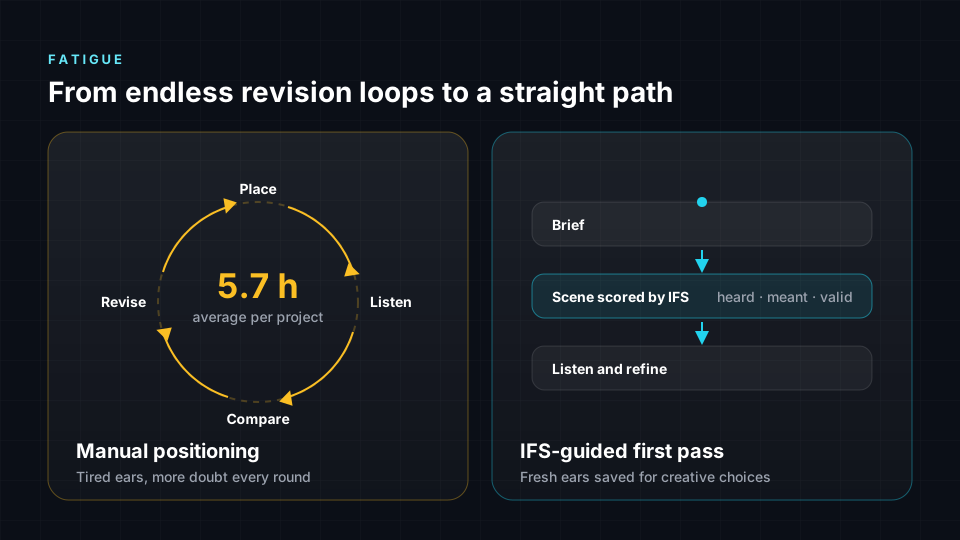
When perception, intent and compliance are all scored from the very first pass, the first scene is far closer to the final one. Fewer revision rounds means fewer hours of tired listening, and the engineer's freshest ears go to the creative choices only a person can make.
Why IFS changes everything
It makes quality measurable at scale. Immersive content is growing far faster than the number of trained immersive engineers. A score that agrees with experts at r = 0.89 lets every scene be checked automatically before a person ever listens.
It puts the artist's intent on the scoreboard. For the first time, faithfulness to the brief is a measured quantity, not a hope. That protects creative vision as production speeds up.
It makes AI accountable. A system that is optimized and judged against IFS cannot improve one number by sacrificing the others. It cannot pass the format by ignoring the brief, or hit the brief with positions nobody can hear.
It works across formats. Because FCC checks the rules of whichever format is targeted, the same score applies to Dolby Atmos beds and objects, Eclipsa Audio height channels, binaural and Ambisonics.
It gives the industry a common language. Producers, labels, platforms and engineers can talk about spatial quality with one shared, expert-validated number, instead of opinions.
How IFS fits into the Spatial9 workflow
- You write a brief and provide your stems, mix or video.
- GravityLLM proposes a spatial scene for every source.
- The scene is evaluated on localization, brief alignment and format compliance.
- Only scenes that clear the compliance gate move on to rendering in ADM, Eclipsa Audio (IAMF), binaural and Ambisonics.
- You listen, refine and approve. IFS guides quality, and the final judgement always stays with a listener.
You can hear the result with your own files, learn how the model is trained in the spatial inference docs, and read how GravityLLM compares with general AI models in GravityLLM vs general LLMs.
FAQ
What is the Intent Fidelity Score?
IFS is Spatial9's patent-pending quality score for spatial and immersive audio. It combines Psychoacoustic Localization Accuracy (50%), Creative Brief Alignment (30%) and Format Compliance Checks (20%) into one number.
Why are the weights 0.5, 0.3 and 0.2?
They were found by grid search against ratings from 22 professional engineers. That combination produced scores that best matched expert judgement.
How well does IFS agree with experts?
In peer-reviewed validation, IFS correlated with expert ratings at r = 0.89. Format compliance scoring reached 0.71 and localization error rate reached 0.62.
Why does one failed rule make compliance zero?
Compliance is calculated by multiplying the result of every rule. A broken rule means the mix may fail on a real renderer or player, so it should never be able to score well.
How is localization measured?
By comparing rendered positions with reference positions across every source, scaled against the maximum possible error. The method is grounded in ITU-R BS.1116-3 listening tests with 15 trained listeners.
Does IFS replace listening?
No. IFS makes expert-level quality checks fast and repeatable, but a person should always listen to and approve a mix before delivery.
Is IFS patented?
IFS is a Spatial9 innovation with a patent pending.
Sources
- "Leveraging Large Language Models for Intelligent Audio Object Positioning in Spatial Audio Ecosystems," AES International Conference on Machine Learning and Artificial Intelligence for Audio, London, September 2025: https://www.aes.org/e-lib
- ITU-R BS.1116-3, methods for the subjective assessment of small impairments in audio systems: https://www.itu.int/rec/R-REC-BS.1116
- Pulkki, V., "Spatial Sound Reproduction with Directional Audio Coding," Journal of the Audio Engineering Society, 2001: https://www.aes.org/e-lib
- Zhang, T. et al., "BERTScore: Evaluating Text Generation with BERT," 2020: https://arxiv.org/abs/1904.09675
- Spatial9 and AudioShake, Marcos Valle in 3D case study: https://www.audioshake.ai/case-studies/marcos-valle-in-3d-with-spatial9
- Spatial9 documentation, spatial inference: /docs/spatial-inference