Ontologies and Knowledge Graphs in Media and Entertainment: The Foundation Agentic AI Runs On
Spatial9 Research Team · · 31 min read
Key takeaways
- An ontology is a shared model of what exists in a media business (works, versions, assets, people, rights, territories, platforms) and how those things relate; a knowledge graph is that model filled with real data.
- Media and entertainment is graph-shaped by nature: one title fans out into versions, assets, languages, rights windows, credits, music and campaigns that live in many separate systems.
- AI agents rely on knowledge graphs for grounding: the language model supplies reasoning, while the graph supplies verified, connected facts that make answers traceable and actions safe.
- Vector search alone struggles with multi-step operational questions; a hybrid of knowledge graph plus vectors, exposed to agents through MCP and coordinated through A2A, is the practical architecture.
- Reuse industry standards such as EIDR, MovieLabs OMC, EBUCore, IPTC, DDEX, ISRC, ISWC, ISNI, schema.org and W3C RDF, OWL, SKOS, SHACL, PROV-O and ODRL instead of inventing terms.
- Start with one costly business question, a core model of 20 to 40 classes, one catalog slice and one agent, then scale domain by domain within a 90-day first phase.
- Spatial9 runs its own company as agentic-native; its Agentic Enterprise Transformation service applies those lessons to media companies in four stages: diagnose, blueprint, prove and scale.

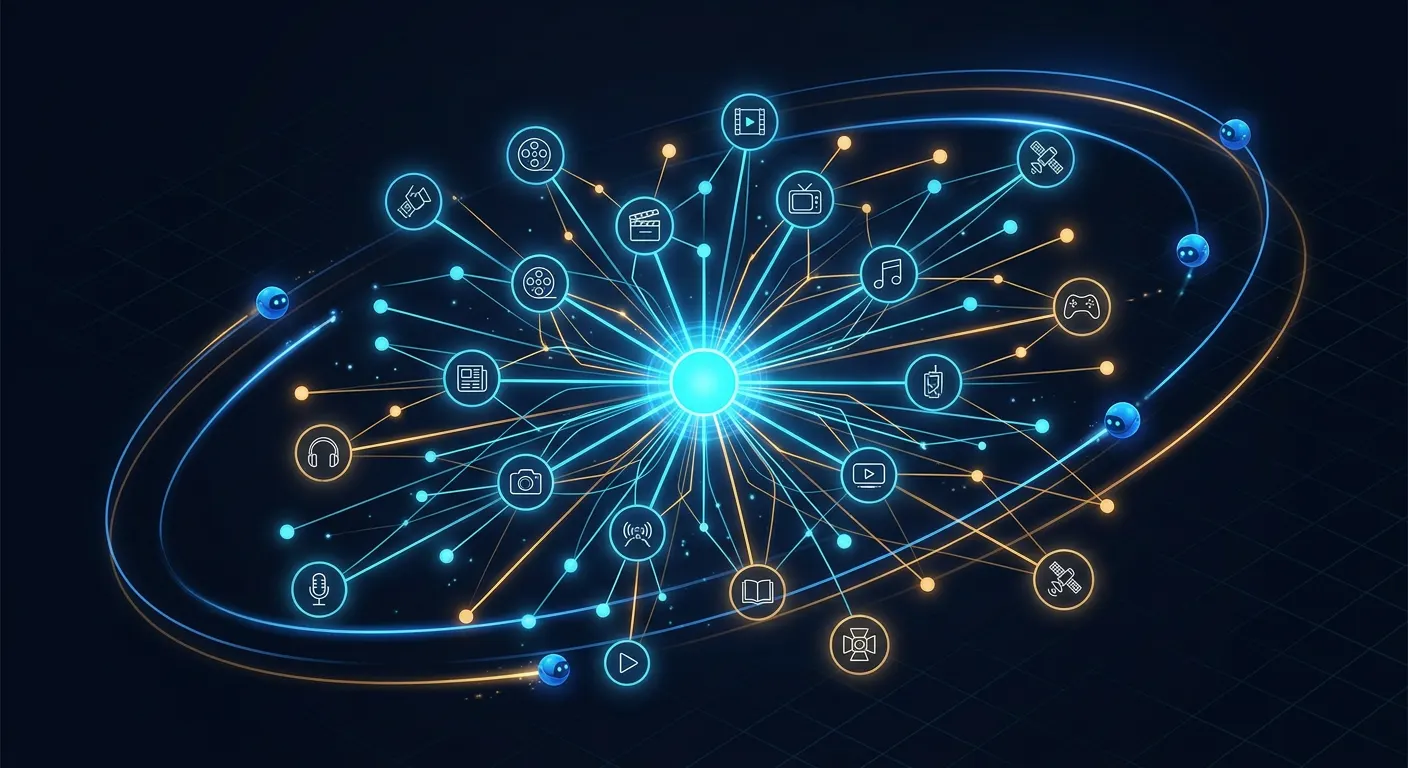
Every media company already runs on a graph. It just does not know it. A single film connects to its cuts, dubs, subtitles, trailers, key art, cast, crew, characters, soundtrack recordings, music compositions, licensing windows, territories, platforms, ad campaigns and audience segments. Each of those things lives in a different system, under a different ID, with a different meaning of the word "title".
For twenty years, that fragmentation was an integration cost. In the age of agentic AI, it becomes a competitive ceiling. An AI agent can only act as well as it understands the world it is acting in, and for a studio, streamer, broadcaster, label or publisher, that world is described by an ontology and stored in a knowledge graph.
This guide explains, in plain terms and with fourteen diagrams, what ontologies and knowledge graphs are, why media and entertainment is one of the most graph-shaped industries on earth, which standards to reuse, what leaders such as the BBC, Netflix and MovieLabs have done, how AI agents depend on all of it, and how to get started in 90 days. It is written for executives, product leaders, data teams and engineers. Code samples are included for the technical readers and can be skipped by everyone else.
At a glance
| Question | Short answer |
|---|---|
| What is an ontology? | A formal model of the kinds of things in a domain, how they relate, and the rules that must hold |
| What is a knowledge graph? | An ontology plus real data: millions of connected facts about your titles, people, rights and assets |
| Why does media need one? | Content is connected by nature: works, versions, assets, rights, people and platforms form a network |
| Why do AI agents need one? | Language models reason well but do not know your catalog; the graph supplies verified, connected facts |
| Which standards matter? | EIDR, MovieLabs OMC and MEC, EBUCore, IPTC, DDEX, ISRC, ISWC, ISNI, schema.org, W3C RDF, OWL, SKOS, SHACL |
| How do agents reach it? | Through MCP (agent to tools and data) and coordinate through A2A (agent to agent) |
| Where do I start? | One costly business question, a core model of 20 to 40 classes, one catalog slice, one agent |
| Who can help? | Spatial9 Agentic Enterprise Transformation: diagnose, blueprint, prove and scale, based on running our own company agentic-native |
What is an ontology, and what is a knowledge graph?
The word ontology comes from philosophy, where it means the study of what exists. In computer science it means writing down what exists in a domain precisely enough that software can use it. An ontology has four building blocks:
- Classes: the kinds of things. Work, Version, Person, Character, Territory.
- Properties: how things relate or what values they carry. hasVersion, playedBy, licensedIn, runtimeMinutes.
- Individuals: real examples. The Night Harbor, Theatrical cut, Brazil.
- Axioms: rules that must always hold. "Every Version belongs to exactly one Work." "A dub Track must declare a language."
A knowledge graph is what you get when you load real data into that model. Every fact becomes a small sentence of the form subject, relationship, object: "The Night Harbor hasVersion Theatrical cut." Millions of those sentences, joined by shared identifiers, form a network that people, applications and AI agents can query and reason over.
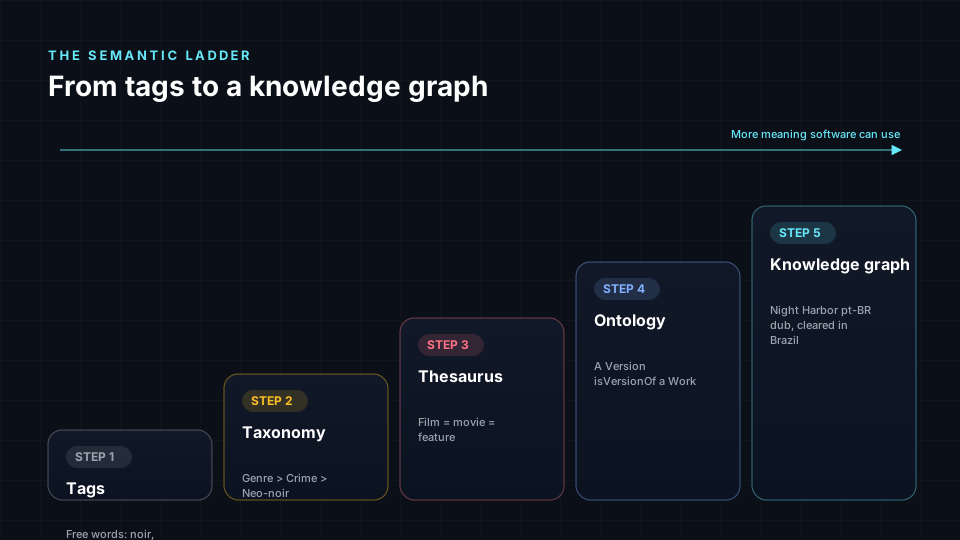
It helps to see where ontologies sit compared with things most media companies already have:
| Approach | What it captures | Media example | What an AI agent can do with it |
|---|---|---|---|
| Tags and keywords | Loose words on items | "noir", "1970s" | Keyword search, often inconsistent |
| Taxonomy | An is-a-kind-of tree | Genre > Crime > Noir | Browse and filter |
| Thesaurus (SKOS) | Synonyms and related terms | Noir = Film noir, related to Neo-noir | Find the same idea under different words |
| Relational database | Tables and keys for one application | A rights system's contracts table | Precise answers inside one system |
| Ontology (OWL) | Types, relationships and rules across systems | Film hasDirector Person | Understand what data means |
| Knowledge graph | The ontology plus all connected facts | 12 million facts about every title | Answer multi-step questions and act safely |
Why media and entertainment is a graph problem
Most industries have a few core entities. Media and entertainment has dozens, and they multiply. One work becomes many versions (theatrical, director's cut, airline edit, broadcast edit). Each version becomes many assets (picture masters, audio stems, immersive mixes, subtitles, dubs). Each asset becomes many deliveries to many platforms, each under its own rights window, territory and language. Around them sit people, characters, music, artwork, promotions, ad inventory and audience data.
These things are not rows. They are relationships. The value of a catalog lies precisely in the links: which actor appears in which titles, which music cue is cleared where, which dub exists for which cut, which audience responds to which trailer.
Three pressures make this urgent now:
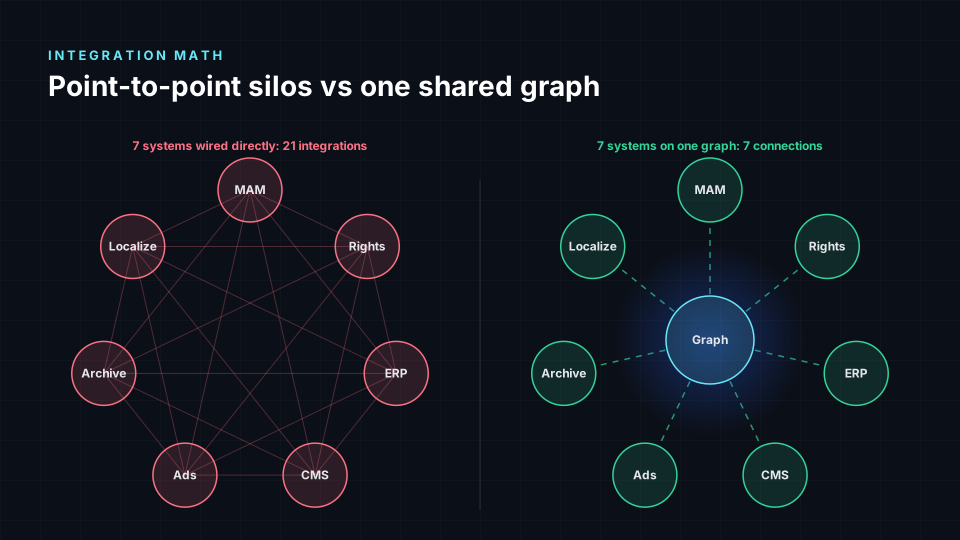
- Volume and velocity. Streaming multiplied the number of versions, languages and deliverables per title. Manual spreadsheets and point integrations do not scale with them.
- Monetization depends on precision. Rights windows, music clearances, residuals and ad targeting all depend on knowing exactly which version went where, when, and under which terms.
- AI agents need context. Generative models can write, summarize, translate and plan. They cannot know your contracts, your versions or your catalog unless something tells them, in a structure they can trust.
A core ontology for media and entertainment
You do not need a thousand classes to start. Twelve classes describe the backbone of almost any film, series, album, podcast or game.
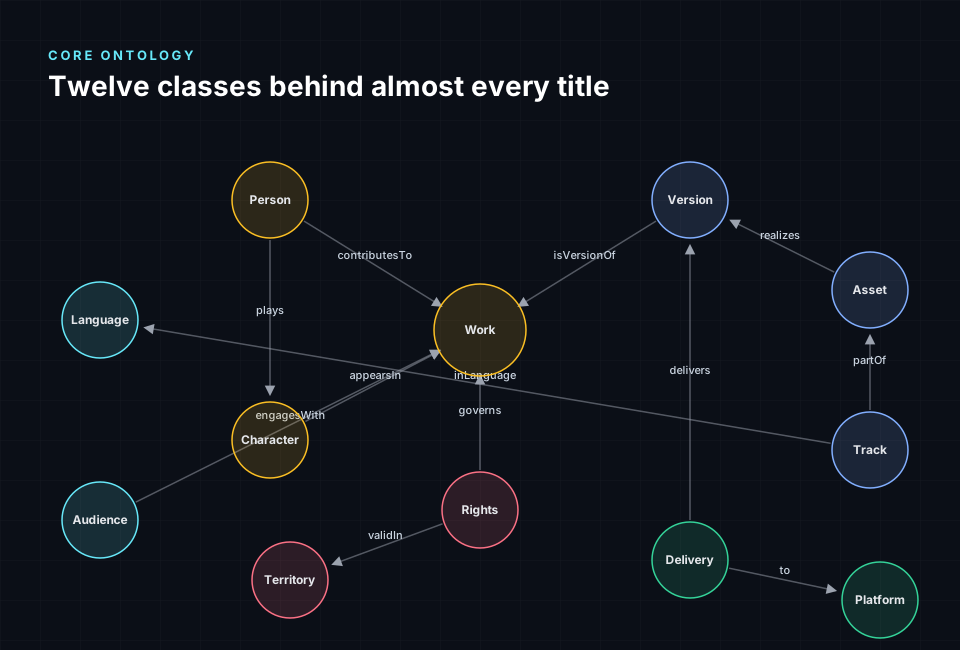
The five groups of concepts
- Creative: Work (the abstract film, series, album or game), Person (cast, crew, artists, writers), Character (roles inside the story).
- Versions and media: Version (a cut, edit, season or remaster), Asset (a concrete master file, an IMF package, an ADM audio master), Track (an audio language, a subtitle, an immersive mix).
- Business and rights: Rights (a license, window or clearance), Territory (country or region).
- Distribution: Delivery (a package or rendition sent to a platform), Platform (a streaming service, broadcaster, store or channel).
- Audience: Language (as a market, not just a file attribute), Audience (segments, ratings, age bands).
The distinction between Work, Version and Asset is the single most valuable idea in media data modelling. It mirrors long-standing library and industry thinking (the same split appears in EIDR's abstraction hierarchy and in MovieLabs' models), and it removes the most common source of confusion: people saying "title" when they mean three different things.
Here is a small fragment of that model in Turtle, the human-readable format for RDF. Technical readers can copy it; everyone else can skip ahead.
@prefix me:   <https://example.com/media#> .
@prefix owl:  <http://www.w3.org/2002/07/owl#> .
@prefix rdfs: <http://www.w3.org/2000/01/rdf-schema#> .
@prefix xsd:  <http://www.w3.org/2001/XMLSchema#> .

# Classes: the kinds of things
me:Work      a owl:Class ; rdfs:label "Work" .
me:Version   a owl:Class ; rdfs:label "Version" .
me:Asset     a owl:Class ; rdfs:label "Asset" .
me:Track     a owl:Class ; rdfs:label "Track" .
me:Rights    a owl:Class ; rdfs:label "Rights" .
me:Territory a owl:Class ; rdfs:label "Territory" .

# Properties: how they relate
me:hasVersion  a owl:ObjectProperty ; rdfs:domain me:Work    ; rdfs:range me:Version .
me:realizedAs  a owl:ObjectProperty ; rdfs:domain me:Version ; rdfs:range me:Asset .
me:hasTrack    a owl:ObjectProperty ; rdfs:domain me:Asset   ; rdfs:range me:Track .
me:licenses    a owl:ObjectProperty ; rdfs:domain me:Rights  ; rdfs:range me:Version .
me:inTerritory a owl:ObjectProperty ; rdfs:domain me:Rights  ; rdfs:range me:Territory .
me:language    a owl:DatatypeProperty ; rdfs:domain me:Track ; rdfs:range xsd:language .
me:windowStart a owl:DatatypeProperty ; rdfs:domain me:Rights ; rdfs:range xsd:date .
me:windowEnd   a owl:DatatypeProperty ; rdfs:domain me:Rights ; rdfs:range xsd:date .
One title as a graph
Abstract models become obvious with an example. Take a fictional film, The Night Harbor. In most companies, it is a row in a dozen systems. In a knowledge graph, it is one node with every related thing attached by a named relationship.
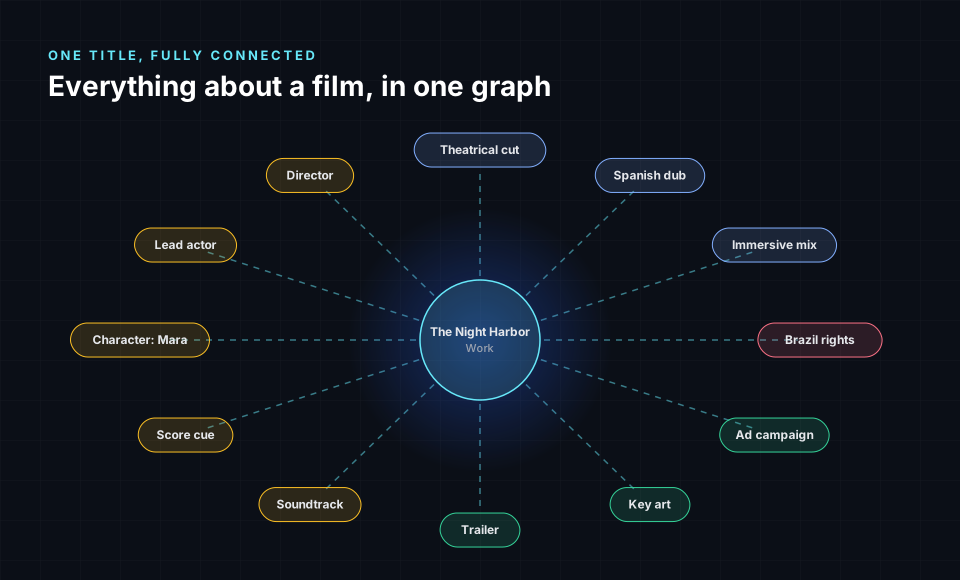
Look at what becomes answerable once those links exist:
- Which of our titles use score cue 7, and where is that cue cleared?
- Which versions of The Night Harbor have a Spanish dub but no immersive mix?
- Which trailers promote titles whose Brazil window opens in the next 30 days?
- Every title featuring this director's frequent collaborators, ranked by audience overlap.
Each of these questions crosses three to five systems. In a spreadsheet world, each one is a project. In a graph, each one is a query, and, as we will see, a task an AI agent can do on its own.
Identifiers: the joints of the graph
A knowledge graph is only as connected as its identifiers. Names are ambiguous ("The Office" is two different series), and internal keys mean nothing to partners. Industry identifiers are how your graph links to everyone else's.
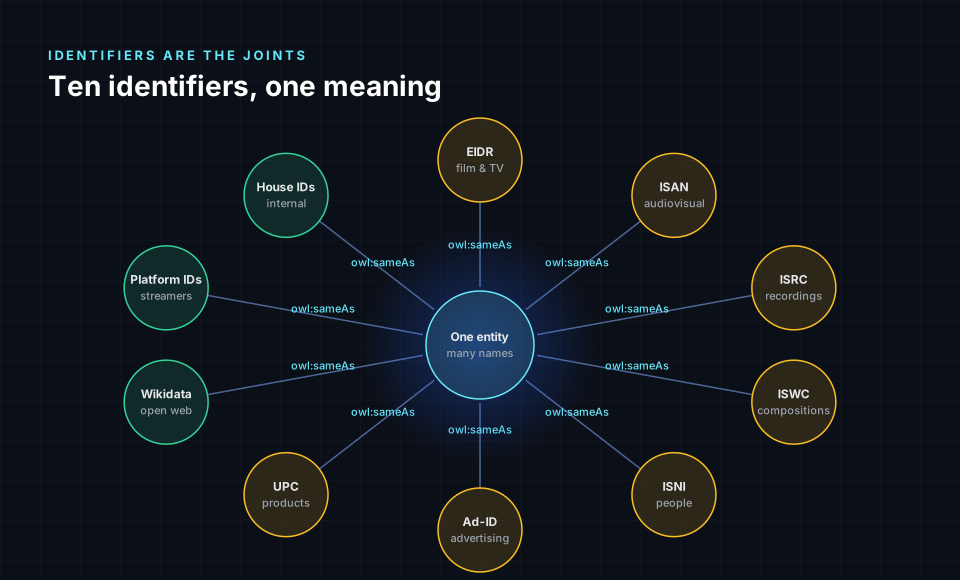
| Identifier | Identifies | Typical owner or registry |
|---|---|---|
| EIDR | Film and TV titles, edits, series, seasons, episodes | Entertainment ID Registry (built on the DOI system) |
| ISAN | Audiovisual works and versions | ISAN International Agency (ISO 15706) |
| ISRC | Sound and music video recordings | IFPI and national agencies (ISO 3901) |
| ISWC | Musical compositions | CISAC (ISO 15707) |
| ISNI | People and organisations | ISNI International Agency (ISO 27729) |
| Ad-ID | Advertising assets | Ad-ID (US advertising industry) |
| UPC / EAN | Products such as albums | GS1 |
| Wikidata QID | Almost any public entity | Wikimedia, open data |
EIDR alone shows how much the industry already invests here: in May 2025, the registry announced that it had catalogued its 10 millionth alternate identifier, meaning ten million links from EIDR records to other systems' IDs. That is a knowledge graph in all but name.
Standards you should reuse
The fastest way to build a good media ontology is to avoid building most of it. The industry has spent two decades agreeing on terms. Reusing them makes your graph interoperable with partners, platforms and, increasingly, the AI models that were trained on those standards.
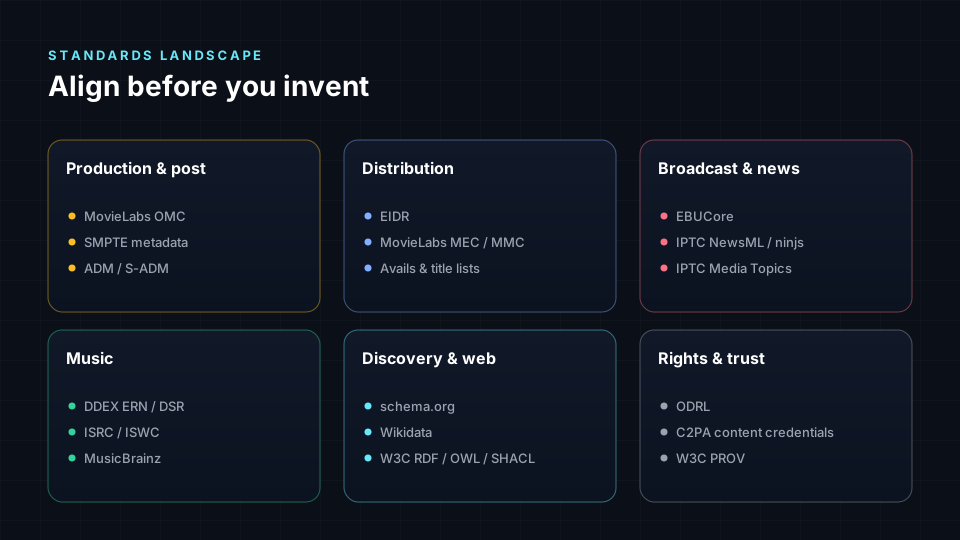
Production and post
The MovieLabs Ontology for Media Creation (OMC) is the most important development in production metadata in years. Created as part of the MovieLabs 2030 Vision, it defines connected concepts such as creative works, participants, tasks, assets, and the context that links them. MovieLabs released version 2.0 and, in December 2023, published RDF and JSON versions so it can be used directly in knowledge graphs and software. IMF (SMPTE ST 2067) defines how finished masters and their versions are packaged. ADM (ITU-R BS.2076) describes immersive audio programmes. C2PA content credentials record where a piece of media came from and how it was edited.
Distribution and avails
EIDR identifies titles and edits. MovieLabs' Media Entertainment Core (MEC) and Avails specifications describe title metadata and the windows during which titles may be offered. Together they cover most of what a streamer or distributor exchanges with partners.
Broadcast and news
EBUCore (EBU Tech 3293) is the European Broadcasting Union's metadata set, published as an ontology. IPTC Media Topics is the standard subject vocabulary for news. The BBC publishes its own ontologies for programmes, sport, news and more, hosted by IPTC.
Music
DDEX standards (such as the Electronic Release Notification) are how labels deliver releases and metadata to services. ISRC and ISWC separate the recording from the composition, a distinction that matters for every royalty. The Music Ontology and MusicBrainz offer open, linked models of artists, releases and recordings.
Discovery and the web
schema.org types such as Movie, TVSeries, TVEpisode, MusicRecording and Person are how search engines and AI answer engines understand media pages. Publishing them as JSON-LD is the simplest way to put your knowledge graph in front of Google, Bing and generative search.
{
  "@context": "https://schema.org",
  "@type": "Movie",
  "@id": "https://example.com/titles/the-night-harbor",
  "name": "The Night Harbor",
  "director": { "@type": "Person", "name": "A. Rivera", "sameAs": "https://isni.org/isni/0000000000000000" },
  "actor": [{ "@type": "Person", "name": "Ana Costa" }],
  "inLanguage": "en",
  "subtitleLanguage": ["es", "pt-BR"],
  "sameAs": ["https://doi.org/10.5240/0000-0000-0000-0000-0000-X"],
  "trailer": { "@type": "VideoObject", "name": "The Night Harbor official trailer" }
}
The identifiers in this example are placeholders; replace them with your real EIDR DOI and ISNI values.
Rights and trust
ODRL (W3C) expresses permissions, prohibitions and obligations in machine-readable form, which is exactly what a rights window is. PROV-O (W3C) records where each fact came from. SHACL (W3C) defines data quality rules that a graph can check automatically. SKOS manages controlled vocabularies such as genres and moods.
What industry leaders have already done
This is not theory. Some of the most respected names in media have run on ontologies and knowledge graphs for years.
The BBC: dynamic semantic publishing
For the 2010 FIFA World Cup, the BBC built what it called Dynamic Semantic Publishing. Rather than hand-building a page for every team, group and player, journalists tagged stories with concepts from a World Cup ontology, sports data feeds were converted to RDF and aligned with the same ontology, and pages were assembled automatically from a triple store. According to the technology vendor's published case study, the approach delivered more than 800 dynamically generated pages and served over a million SPARQL queries a day. The BBC extended the approach to the 2012 Olympics and its sport site, and its ontologies remain publicly available.
Netflix: Unified Data Architecture
In 2025, Netflix described UDA (Unified Data Architecture), an approach summed up as "model once, represent everywhere". Core business concepts are defined once as conceptual models in RDF, stored in a knowledge graph organised into named graphs, and automatically translated into the schemas engineers actually use, such as GraphQL, Avro, Iceberg and Java. The knowledge graph also records mappings from each concept to the concrete systems where its data lives. In other words, the ontology becomes the source of truth for what data means across the company.
MovieLabs: an ontology for the whole production chain
The major Hollywood studios' technology body made a connected ontology a pillar of its 2030 Vision for media creation. OMC lets different production tools, vendors and cloud services agree on what a shot, a take, an asset or a participant is, which is the precondition for automating handoffs across a production.
EIDR: an industry-wide identity graph
EIDR's registry of titles, edits and their alternate identifiers is a shared identity layer used across studios, distributors and platforms. Its growth shows that the industry already values connected, unambiguous identity, which is the first rung of any knowledge graph.
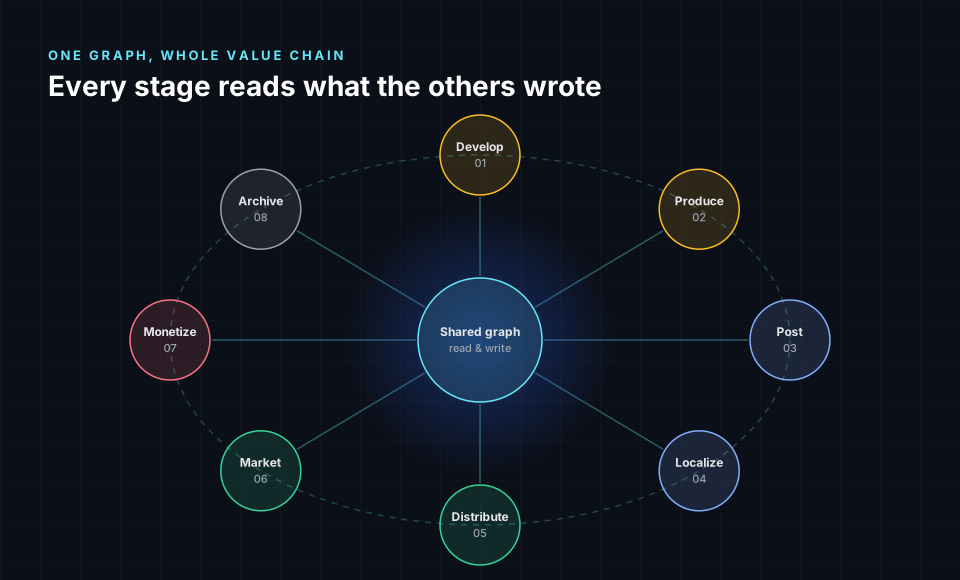
How agentic AI depends on knowledge graphs
Agentic AI is the shift from AI that answers to AI that acts. An agent receives a goal, plans steps, uses tools, checks results and keeps going until the goal is reached or it needs a person. Gartner predicts that by 2028, 33% of enterprise software applications will include agentic AI, up from less than 1% in 2024, and that at least 15% of day-to-day work decisions will be made autonomously. In the same June 2025 announcement, Gartner also predicted that more than 40% of agentic AI projects will be cancelled by the end of 2027, because of escalating costs, unclear business value or inadequate risk controls.
Both predictions point to the same lesson: agents create value only when they are grounded in reliable context and bounded by clear rules. In media and entertainment, that context and those rules live in the ontology and the knowledge graph.
What an AI agent actually is
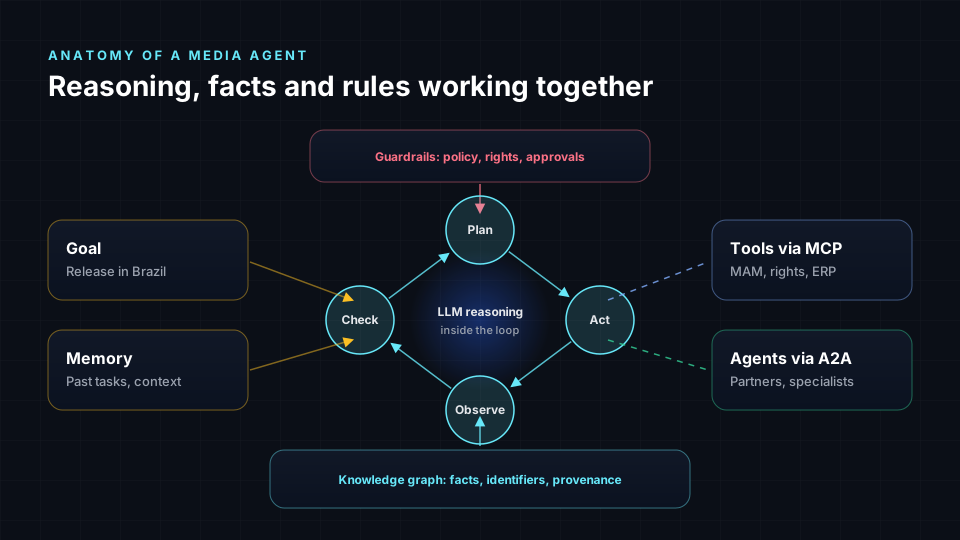
An agent has five parts:
- A goal, set by a person or another system: "prepare the Brazil launch of The Night Harbor".
- A reasoning loop, usually a large language model that plans, acts, observes and checks.
- Tools it can call: search the catalog, read a contract, order a dub, publish metadata.
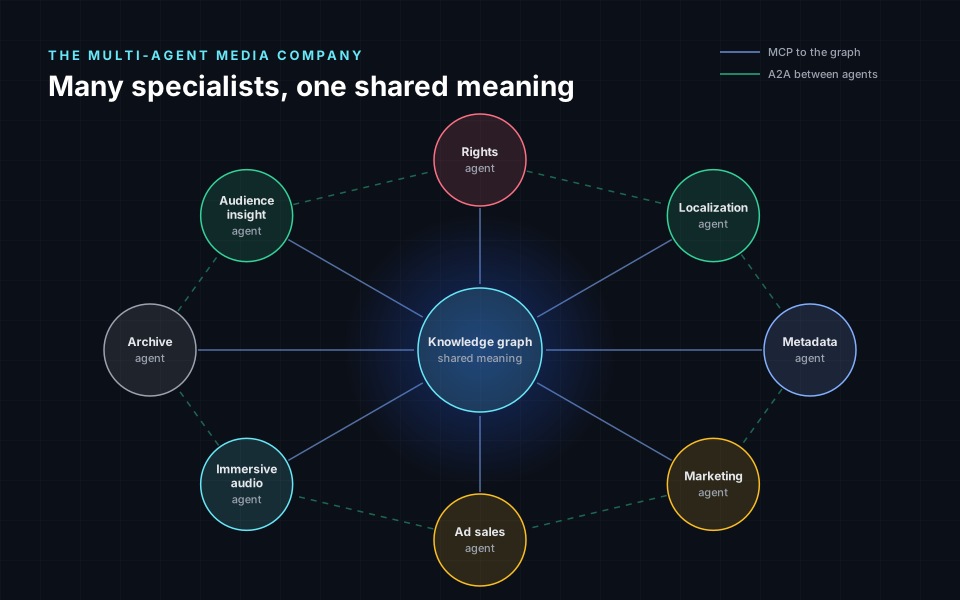
- Other agents it can delegate to: a rights agent, a localization agent, a marketing agent.
- Grounding and guardrails: the facts it is allowed to rely on and the rules it must not break.
The language model is the least company-specific part. Every competitor can license the same model. What makes an agent useful in your company is the quality of the context it receives and the precision of the actions it can take. That is the job of the knowledge graph.
Grounding: why vector search alone is not enough
The most common way to give a model company knowledge is retrieval-augmented generation (RAG): split documents into chunks, turn them into vectors, and fetch the chunks most similar to the question. It works well for "find me the paragraph about X". It struggles with questions whose answer is not written in any single paragraph, which describes most real operational questions in media.
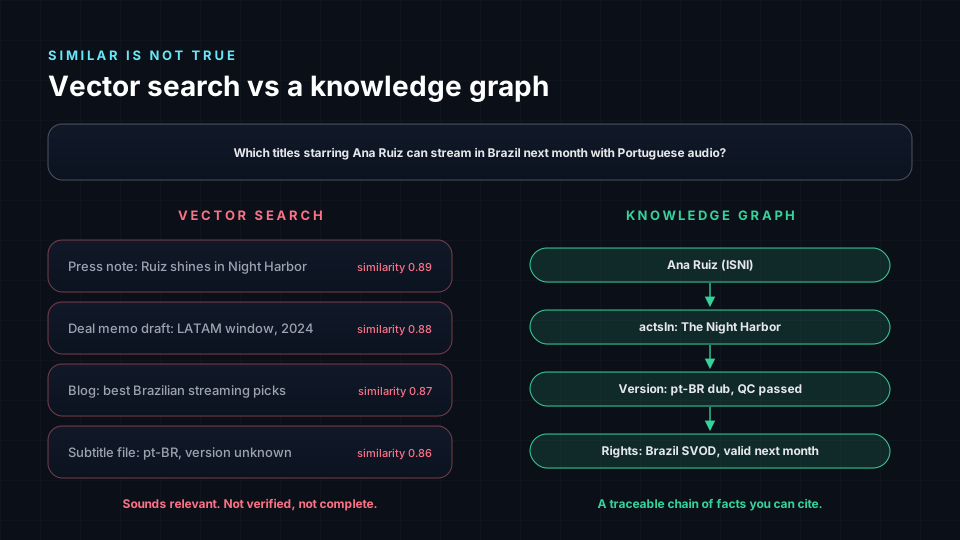
Microsoft Research's GraphRAG work (Edge and colleagues, 2024) showed that building a graph of entities and relationships from a corpus improves answers to broad, "global" questions compared with chunk-based retrieval. For media companies, the case is even stronger, because the most important facts (rights windows, versions, languages, credits) are already structured and do not need to be extracted from prose at all. They need to be modelled and connected.
| Capability | Vector RAG only | Knowledge graph | Hybrid (recommended) |
|---|---|---|---|
| Find relevant passages in documents | Strong | Weak | Strong |
| Multi-hop questions across systems | Weak | Strong | Strong |
| Exact dates, counts and windows | Unreliable | Exact | Exact |
| Explain where an answer came from | Partial (source chunk) | Full path of facts | Full path plus source text |
| Enforce business rules | No | Yes (rules over the graph) | Yes |
| Cost to keep current | Re-embed on change | Update the fact | Both, scoped |
The practical answer is a hybrid: use the graph for entities, relationships and rules; use vectors for unstructured text such as scripts, synopses, reviews and contracts; and link each document chunk to the graph entities it mentions.
Here is what the agent's question looks like when it is sent to the graph as a SPARQL query:
PREFIX me:  <https://example.com/media#>
PREFIX xsd: <http://www.w3.org/2001/XMLSchema#>

# Titles starring Ana Costa, licensed in Brazil next month, with a pt-BR audio track
SELECT DISTINCT ?work ?version ?windowEnd WHERE {
  ?person  me:name        "Ana Costa" .
  ?work    me:hasCredit   [ me:person ?person ; me:role me:Actor ] ;
           me:hasVersion  ?version .
  ?rights  me:licenses    ?version ;
           me:inTerritory me:BR ;
           me:windowStart ?windowStart ;
           me:windowEnd   ?windowEnd .
  FILTER (?windowStart <= "2026-12-01"^^xsd:date && ?windowEnd >= "2026-12-31"^^xsd:date)
  ?version me:realizedAs/me:hasTrack ?track .
  ?track   me:trackType   me:Audio ;
           me:language    "pt-BR" .
}
Every line of that query is a relationship from the ontology. Every result can be traced back through the same relationships. That traceability is what turns an AI answer into a business decision.
MCP and A2A: how agents reach the graph and each other
Two open protocols have become the standard plumbing for agents:
- The Model Context Protocol (MCP), released by Anthropic in November 2024, connects an AI application to tools and data. A knowledge graph exposed as an MCP server becomes a set of well-named tools such as find_titles, get_rights_window or list_tracks that any compatible agent can call.
- The Agent2Agent protocol (A2A), announced by Google in April 2025 and now a Linux Foundation project, lets one agent discover another, delegate a task and receive the result.
The ontology is what makes both protocols meaningful. An MCP tool that returns "title 4471" is useless to another system; one that returns a Version with an EIDR ID, linked to a Work and to Rights in a Territory, can be understood by any agent that shares the vocabulary. The same applies to A2A: when a release agent asks a rights agent "is Brazil SVOD cleared for December?", both must agree on what Brazil, SVOD, cleared and December mean.
{
  "name": "get_rights_window",
  "description": "Return the licensing windows for a version in a territory and media type. Dates are ISO 8601. Territory uses ISO 3166-1 alpha-2.",
  "inputSchema": {
    "type": "object",
    "properties": {
      "version_eidr": { "type": "string", "description": "EIDR edit ID of the version" },
      "territory":    { "type": "string", "pattern": "^[A-Z]{2}$" },
      "media_type":   { "type": "string", "enum": ["SVOD", "AVOD", "TVOD", "FreeTV", "PayTV", "Theatrical"] }
    },
    "required": ["version_eidr", "territory", "media_type"]
  }
}
Notice how the tool definition is the ontology in disguise: a Version identified by EIDR, a Territory from an ISO list, a media type from a controlled vocabulary. Agents work best when their tools are shaped by the same model as the data.
An agent at work
Here is what a realistic multi-step task looks like when an agent is grounded in a knowledge graph and coordinates with specialist agents.
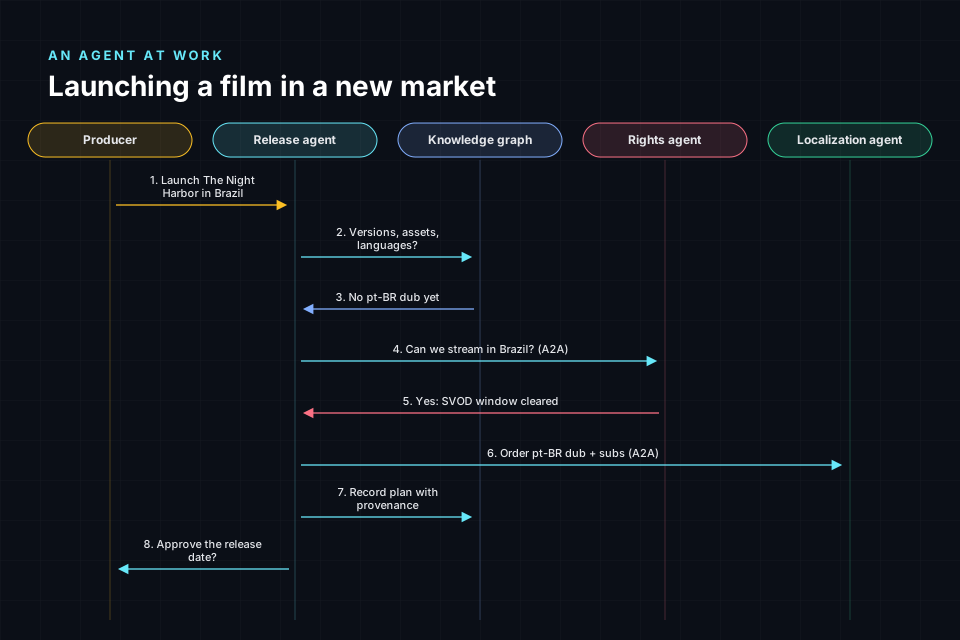
- A producer asks the release agent to launch The Night Harbor in Brazil on 1 December.
- The release agent queries the graph for versions, assets and tracks.
- The graph shows three versions and no Brazilian Portuguese audio.
- The release agent asks the rights agent whether Brazil SVOD is cleared for December.
- The rights agent confirms a window from 1 December to 31 March, but flags that music cue 7 needs renewal.
- The release agent orders a pt-BR dub and subtitles from the localization agent.
- It writes its plan back to the graph, with provenance: who decided what, when and why.
- It returns a plan with one item that needs human approval: the music renewal.
No step involved guessing. Every fact came from the graph or from an agent that owns that domain, and every action was recorded. This is what "AI-native operations" means in practice.
Use cases across the industry
| Segment | High-value use cases | Graph concepts involved |
|---|---|---|
| Studios and producers | Production tracking, asset handoffs, version control, talent and residuals | Work, Version, Asset, Person, Task (MovieLabs OMC) |
| Streamers | Avails and windowing, localization planning, personalised discovery, content acquisition analysis | Rights, Territory, Language, Audience, Platform |
| Broadcasters and news | Automated topic pages, archive reuse, rights-aware clip sales, election and sports data | Programme, Event, Topic (IPTC), Person, Rights |
| Music labels and publishers | Royalty matching, catalog enrichment, sync licensing, immersive catalog conversion | Recording (ISRC), Composition (ISWC), Release, Party (ISNI) |
| Games and interactive | Franchise and lore consistency, character and asset reuse, transmedia planning | Character, Franchise, Asset, Version |
| Sports and live events | Real-time stats pages, highlights, sponsorship tracking | Event, Team, Player, Moment, Sponsor |
| Advertising | Contextual and brand-safe placement, campaign-to-title links, ad asset rights | Ad asset (Ad-ID), Title, Audience, Topic |
Discovery, SEO and GEO
There is one use case every media company shares: being found. Search engines and generative answer engines build their own knowledge graphs of films, shows, artists and people. When your site publishes clean schema.org markup, consistent identifiers and sameAs links to EIDR, ISNI and Wikidata, you are feeding those graphs directly. That increases the chance that your titles appear correctly in rich results, knowledge panels and AI-generated answers, and decreases the chance that an assistant confuses your film with another of the same name.
Trust, rights and governance
Agents that act need limits. In media, the cost of a mistake is concrete: a title streamed outside its window, a music cue used without clearance, a minor's data used for targeting, a spoiler published early. A knowledge graph does more than answer questions. It defines what a valid answer and a permitted action look like.
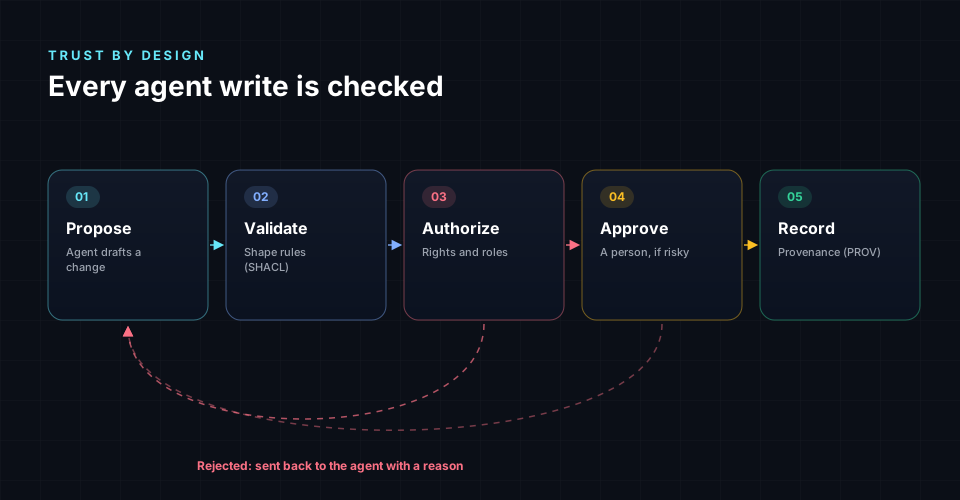
Rules can be written in SHACL and checked automatically before any change is accepted:
@prefix sh: <http://www.w3.org/ns/shacl#> .
@prefix me: <https://example.com/media#> .

# Every audio or subtitle track must declare exactly one valid language
me:TrackShape a sh:NodeShape ;
  sh:targetClass me:Track ;
  sh:property [
    sh:path me:language ;
    sh:minCount 1 ; sh:maxCount 1 ;
    sh:pattern "^[a-z]{2,3}(-[A-Z]{2}|-[0-9]{3})?$" ;
    sh:message "A track needs exactly one language code such as pt-BR or es-419." ;
  ] .

# A rights window must end after it starts
me:RightsShape a sh:NodeShape ;
  sh:targetClass me:Rights ;
  sh:sparql [
    sh:message "Window end must be after window start." ;
    sh:select """SELECT $this WHERE {
      $this <https://example.com/media#windowStart> ?s ;
            <https://example.com/media#windowEnd> ?e .
      FILTER (?e <= ?s) }""" ;
  ] .
Four practices keep agents safe:
- Least privilege. Each agent gets only the tools and graph areas its job requires. The marketing agent can read rights windows; it cannot change them.
- Validate before write. Every proposed change passes shape rules and policy checks. Rejections go back to the agent with a reason, so it can replan.
- Humans on the money and the law. Anything that commits spend, affects contracts or publishes externally waits for a person.
- Provenance on every fact. Record who or what asserted each fact, from which source, and when (PROV-O). It makes audits possible and lets you roll back an agent's mistakes precisely.
How to measure the value
Knowledge graph programmes fail when they are justified by elegance. They succeed when they are tied to business numbers. Pick two or three of these and measure them before and after.
| Metric | What it shows | How to measure |
|---|---|---|
| Time to answer a cross-system question | Operational speed | Minutes from request to verified answer, before and after |
| Agent answer accuracy | Whether grounding works | Share of agent answers that match a human-verified answer set |
| Metadata error rate | Data quality | Rule violations per thousand records, rejected deliveries |
| Integrations maintained | IT cost | Number of point-to-point feeds retired |
| Rights incidents | Risk | Titles offered outside windows, uncleared uses caught before release |
| Catalog utilisation | Revenue | Share of catalog offered in each territory and language |
| Discovery visibility | Marketing | Rich results, knowledge panel accuracy, appearances in AI answers |
Semantic maturity: where is your company?
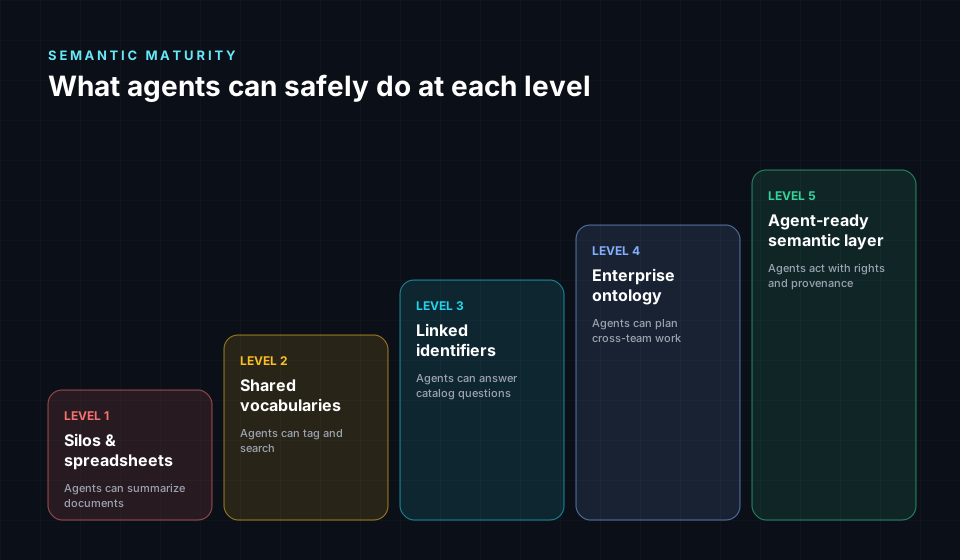
- Level 1, silos and spreadsheets. Each department has its own list. Agents can only chat and guess.
- Level 2, shared identifiers. EIDR, ISRC and house IDs are linked. Agents can look up a title reliably.
- Level 3, controlled vocabularies. Genres, territories, languages and media types come from managed lists. Agents can search and tag consistently.
- Level 4, ontology and knowledge graph. Core entities and relationships are modelled and connected. Agents can answer multi-step questions with citations.
- Level 5, agent-ready semantic layer. The graph is exposed through MCP tools, rules are enforced on writes, and agents coordinate through A2A. Agents can act safely across systems.
Most media companies today sit between levels 2 and 3. The jump to level 4 is where the return on AI investment starts to compound, because every new agent reuses the same foundation instead of building its own.
Agentic AI & A2A Maturity Assessment for Media & Entertainment
A free 50-question assessment across 10 weighted dimensions, built only for media and entertainment companies. Get your score, maturity level, A2A readiness index, roadmap and a premium PDF report.
A 90-day roadmap
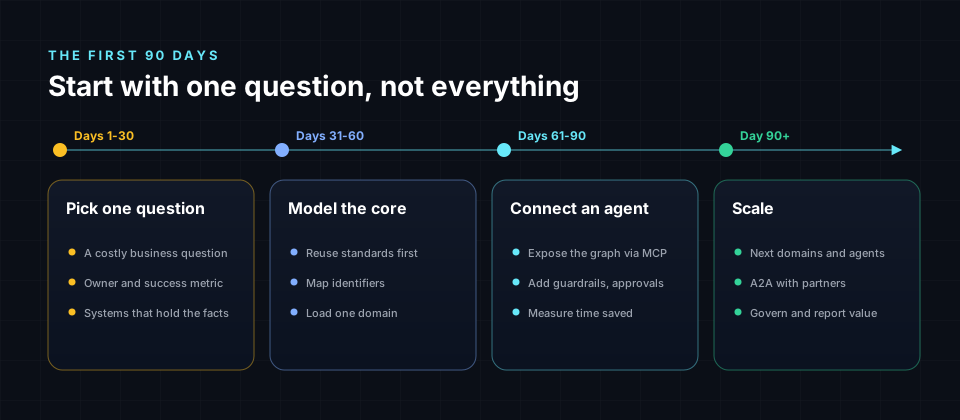
Days 1 to 30: pick one question
Choose a question that is asked often, crosses several systems and costs real money when it is answered late or wrong. "What can we offer in territory X next quarter, in which languages?" is a classic. List the systems that hold the answer and map the identifiers each one uses.
Days 31 to 60: model the core
Model only what the question needs, typically 20 to 40 classes, reusing EIDR, MovieLabs, EBUCore, DDEX and schema.org terms wherever they fit. Load one catalog slice, such as one genre, one year or one territory. Write the first quality rules.
Days 61 to 90: connect an agent
Expose the graph through a small set of MCP tools with clear names and strict input types. Connect one agent to answer the chosen question. Require human review on any write. Measure accuracy against answers verified by your own experts.
Day 90 and beyond: scale
Add the next domain (rights, ad sales, audience), invite partner agents through A2A, and start retiring the point-to-point integrations the graph has replaced.
Common mistakes
- Boiling the ocean. A model of everything, delivered in two years, is a model of nothing. Start from a question.
- Inventing what exists. Your Territory list should be ISO 3166, your languages BCP 47, your titles EIDR. Custom terms are a cost you pay forever.
- Confusing Work, Version and Asset. This one mistake causes most media data problems. Model all three from day one.
- Treating the graph as a project, not a product. It needs an owner, a roadmap and users. Data stewardship is a role, not a phase.
- Letting agents write without rules. An agent that can write invalid facts will, eventually. Validation and provenance are not optional.
- Vectors only. Embeddings are valuable for text, but they cannot represent a rights window or enforce a rule. Use both.
- Ignoring the outside world. Publish schema.org markup and sameAs links. External knowledge graphs, including those used by AI answer engines, will describe your catalog whether you help them or not.
How Spatial9 helps: lessons from running an agentic-native company
Spatial9 was built from day one as an agentic-native company. AI agents work beside our people in research, engineering, operations, marketing and support, and our products are agents themselves: an MCP server and an A2A agent that other companies' agents call, Agent Skills and enterprise pipelines on Databricks, Snowflake, Vertex AI and Bedrock. Building and running that, every day, taught us what this guide describes the hard way.
Five lessons we learned building it
- The model comes before the agent. Our agents only became reliable after we wrote down what a track, a stem, a placement and a deliverable are. Our spatial and immersive audio ontology is the reason a request means the same thing in our studio app, our API and every agent that calls us.
- One contract for every channel. The same operations, inputs and errors sit behind our app, REST API, MCP tools and A2A skills. Agents built by different teams, and by partners, cooperate because they share one contract, not because each integration was hand-built.
- People approve, agents prepare. Agents draft, check and execute; people set intent and sign off where money, rights or reputation are at stake. That is what let us move fast without losing control.
- Guardrails in layers. Identity, scoped permissions, quotas, audit trails and validation at every boundary. A single prompt instruction is never a control.
- Measure from the first workflow. Each agent workflow has a baseline and a target. If we could not measure it, we did not scale it.
The Agentic Enterprise Transformation service
We turned that operating model into a service for labels, publishers, studios, broadcasters, streamers, games and live entertainment companies. Agentic Enterprise Transformation runs in four stages:
- Diagnose. We interview leaders, map workflows and score your readiness across strategy, data and knowledge graph, rights and governance, agents, interoperability and value. You can start yourself with the free Agentic AI & A2A Maturity Assessment.
- Blueprint. We design your target operating model, including the ontology and knowledge graph layer described in this guide, with a costed business case (ROI and TCO) and a roadmap your board can approve.
- Prove. We put the first agent workflows into daily use on a secure foundation, connected to your graph through MCP and A2A, with value measured from day one.
- Scale. We extend what works across departments and partners, build agent-ready products and train your teams to run it themselves.
Immersive audio remains one proof point of the same approach: a release or localization agent can ask our agents to produce an immersive version as one step of a larger plan, and a Track in your catalog can point to its immersive elements and formats. For catalog projects, see our guide to planning a catalog conversion.
Download The Entertainment AI Blueprint (free white paper)
The Spatial9 playbook for moving media and entertainment companies from scattered AI tools to an agentic-native operating model.
- The six layers of an agentic-native media company
- Ontology, knowledge graph and identifier foundations
- Agent-to-agent operating model and governance
- Rights, provenance and AI risk controls
- Roadmap from pilot to enterprise scale
Share your name, company, email and phone to download the PDF.
Frequently asked questions
What is an ontology in media and entertainment?
An ontology in media and entertainment is a formal, machine-readable model of the things a media business works with, such as works, versions, assets, people, characters, rights, territories, languages, platforms and audiences, along with how they relate and the rules they must follow. It gives every system and AI agent the same meaning for words like "title" or "version".
What is the difference between an ontology and a knowledge graph?
An ontology is the model: the classes, relationships and rules. A knowledge graph is that model filled with real data, such as every title, version, contract and person in your catalog, connected by those relationships. The ontology is the blueprint; the knowledge graph is the building.
Why do AI agents need a knowledge graph?
AI agents use language models that reason well but do not know your catalog, contracts or versions. A knowledge graph supplies verified, connected facts, lets agents answer multi-step questions that no single document contains, and defines rules that stop agents from taking invalid actions. It makes agent answers traceable and agent actions safe.
Is GraphRAG better than standard RAG for media companies?
For questions that cross several systems, such as rights, versions and languages, graph-based retrieval is usually more accurate than vector search alone, because it follows explicit relationships instead of matching similar text. Most media companies benefit from a hybrid: a knowledge graph for entities, relationships and rules, and vector search for scripts, synopses, reviews and contracts.
Which media metadata standards should an ontology reuse?
Start with EIDR for film and TV identity, the MovieLabs Ontology for Media Creation and MEC for production and title metadata, EBUCore and IPTC for broadcast and news, DDEX, ISRC and ISWC for music, ISNI for people and organisations, schema.org for the web, and W3C RDF, OWL, SKOS, SHACL, PROV-O and ODRL for modelling, vocabularies, rules, provenance and rights.
How do MCP and A2A relate to knowledge graphs?
MCP connects AI agents to tools and data, so a knowledge graph can be exposed as MCP tools that agents call. A2A lets agents delegate tasks to each other. Both work best when the tools and messages use the same ontology, so every agent agrees on what a version, territory or rights window means.
How long does it take to build a media knowledge graph?
A focused first version that answers one valuable question with one connected agent can be delivered in about 90 days, by modelling 20 to 40 classes, reusing industry standards and loading one catalog slice. Coverage then grows domain by domain. Attempting to model the entire business before delivering value is the most common reason these programmes stall.
Do we need to replace our existing systems?
No. A knowledge graph usually sits alongside existing rights, asset management, scheduling and finance systems. It links their records through shared identifiers and gives them one shared meaning. Over time, it can replace point-to-point integrations, but the source systems remain.
How does a knowledge graph help SEO and generative search?
Search engines and AI answer engines maintain their own knowledge graphs of films, shows, artists and people. Publishing schema.org markup in JSON-LD with consistent identifiers and sameAs links to EIDR, ISNI and Wikidata helps them identify your titles correctly, which improves rich results, knowledge panels and the accuracy of AI-generated answers about your catalog.
How can Spatial9 help us build an ontology and agentic operating model?
Spatial9 runs its own company as agentic-native, with agents, an MCP server and an A2A agent in daily production. Our Agentic Enterprise Transformation service applies those lessons to media and entertainment companies in four stages: diagnose your readiness, design the blueprint and knowledge graph layer with a costed business case, prove the first agent workflows in daily operations, then scale across the company. A free maturity assessment is the quickest way to start.
Sources
- MovieLabs, Ontology for Media Creation, and the MovieLabs 2030 Vision blog, including "MovieLabs releases RDF and JSON versions of Ontology for Media Creation" (December 2023).
- Netflix Technology Blog, Model Once, Represent Everywhere: UDA (Unified Data Architecture) at Netflix, 2025.
- BBC Internet Blog, BBC World Cup 2010 dynamic semantic publishing, July 2010, and Sports Refresh: Dynamic Semantic Publishing, April 2012.
- Graphwise (formerly Ontotext), BBC case study: delivering 800+ pages for the FIFA World Cup.
- IPTC, BBC ontologies, hosted under agreement with the BBC.
- EIDR, Entertainment ID Registry, announcement of the 10 millionth alternate identifier, May 2025.
- Gartner, Gartner Predicts Over 40% of Agentic AI Projects Will Be Canceled by End of 2027, 25 June 2025.
- Edge, D. et al., "From Local to Global: A Graph RAG Approach to Query-Focused Summarization", Microsoft Research, 2024 (arXiv:2404.16130).
- Anthropic, Model Context Protocol specification, November 2024; Google, Agent2Agent (A2A) protocol, April 2025, now a Linux Foundation project.
- EBU Tech 3293, EBUCore metadata set; IPTC Media Topics; DDEX Electronic Release Notification standard.
- ISO 3901 (ISRC), ISO 15707 (ISWC), ISO 15706 (ISAN), ISO 27729 (ISNI); SMPTE ST 2067 (IMF); ITU-R BS.2076 (Audio Definition Model); C2PA specification.
- W3C Recommendations: RDF 1.1, OWL 2, SKOS, SHACL, PROV-O, ODRL 2.2, JSON-LD 1.1 and the Ontology for Media Resources 1.0; schema.org vocabulary.
- Raimond, Abdallah, Sandler and Giasson, "The Music Ontology", ISMIR 2007.