How to Assess Agentic AI Maturity in Media and Entertainment
Spatial9 Research Team · · 6 min read
Key takeaways
- Agentic AI maturity measures whether a media company can run AI agents that plan, act and collaborate with each other and with partners, not just whether people use AI tools.
- In media and entertainment, maturity depends on industry-specific foundations: identifiers such as EIDR, ISRC and DDEX, rights and talent consent, and a connected catalog or knowledge graph.
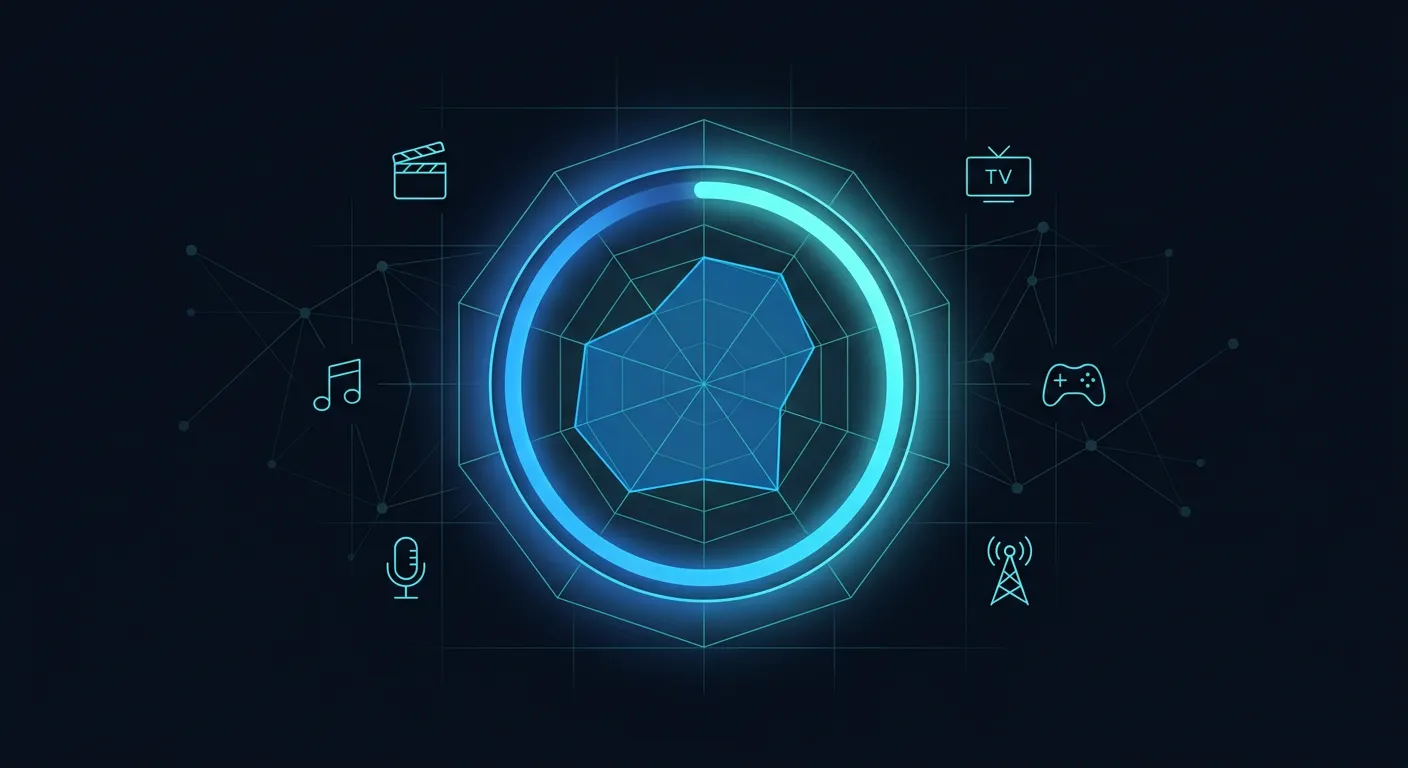
- The Spatial9 model scores 50 questions across 10 weighted dimensions and places a company on five levels: Exploring, Experimenting, Operationalizing, Orchestrating and Agentic-native.
- A separate A2A readiness index shows whether your agents can safely exchange work with partner and platform agents through A2A and MCP.
- Data, governance, rights and provenance carry the highest weight, because they are what stop pilots from scaling.
- The free assessment takes about 15 minutes and returns a score, risks, an 18-month roadmap and a PDF report.
- The model reflects what Spatial9 learned running its own company agentic-native, and the score feeds directly into the Agentic Enterprise Transformation roadmap: diagnose, blueprint, prove and scale.
At a glance
- What it measures: readiness to run AI agents that act across workflows and with partners, not tool adoption.
- Who it is for: film and TV studios, broadcasters and streamers, music labels and publishers, games, live events and sports, post-production and localization, news and podcasts, collecting societies and M&E agencies.
- How: 50 questions, 10 weighted dimensions, five levels, plus a separate A2A readiness index.
- What you get: a score out of 100, your level, risks, recommendations per dimension, an 18-month roadmap and a premium PDF report.
Why generic AI maturity models fall short in media
Most AI maturity models were written for banks, retailers or manufacturers. They ask about data lakes and model governance, but not about what actually blocks agents in a media business:
- Identity of content. An agent cannot clear a title for a territory if it cannot tell the theatrical cut from the airline edit. Identifiers such as EIDR, ISAN, ISRC and ISWC, and exchange standards such as DDEX, decide whether agents act on the right asset.
- Rights and consent. Windows, territories, talent likeness, voice and music clearances are contract facts. Agents must read them before they act, or they create legal exposure at machine speed.
- A connected catalog. One title fans out into versions, languages, artwork, credits and campaigns stored in many systems. Our guide to ontologies and knowledge graphs in media and entertainment explains why this layer is what lets agents reason instead of guess.
- Partner ecosystems. Distributors, platforms and vendors are starting to expose agents of their own. Readiness for A2A and MCP decides whether you can join those exchanges safely.
Gartner predicted in June 2025 that over 40% of agentic AI projects will be canceled by the end of 2027, mainly because of cost, unclear value and weak risk controls. A media-specific assessment exposes those gaps before you invest.
The 10 dimensions we score
| Dimension | What we look for | Weight |
|---|---|---|
| Strategy and leadership | An owned agentic strategy tied to business outcomes and funding | 1.1 |
| Data foundation, ontology and knowledge graph | Connected, governed data that agents can query | 1.2 |
| Metadata, identifiers and catalog integrity | Industry identifiers, clean versions and lineage | 1.0 |
| Content supply chain | Automated ingest, localization, packaging and delivery | 1.0 |
| Agent deployment and autonomy | Agents in production with clear limits and human review | 1.1 |
| A2A, MCP and ecosystem interoperability | Agent identity, tool interfaces and partner exchanges | 1.1 |
| Governance, rights and provenance | Rights checks, consent, provenance (such as C2PA) and audit | 1.2 |
| Technology platform, security and AI operations | Secure, observable, cost-controlled AI platform | 1.0 |
| Talent, culture and operating model | Skills, roles and human-agent teams | 1.0 |
| Value measurement and monetization | Measured savings and new AI revenue | 1.0 |
Each question offers five concrete statements, from "not in place" to "industry-leading", so the answer describes what exists today, not an opinion.
The five maturity levels
- Exploring (0 to 20). Individuals use AI tools without strategy, data foundations or governance.
- Experimenting (21 to 40). Pilots exist but are disconnected; data and rights gaps stop them from scaling.
- Operationalizing (41 to 60). A strategy, platform and first production workflows are in place.
- Orchestrating (61 to 80). Agents work across functions on shared data, with governance and measured value.
- Agentic-native (81 to 100). Human-agent teams, A2A partner networks and continuously measured value define the operating model.
Agentic AI & A2A Maturity Assessment for Media & Entertainment
A free 50-question assessment across 10 weighted dimensions, built only for media and entertainment companies. Get your score, maturity level, A2A readiness index, roadmap and a premium PDF report.
How to run the assessment well
- Pick the right respondents. Answer with a small group: a technology or data leader, an operations or supply chain lead, and someone from legal or rights. Different views produce a more honest score.
- Answer for the whole company. Score what is true across the business, not your best team.
- Read the gaps, not only the score. The two or three weakest dimensions usually explain why pilots stall. Low governance with high agent deployment is a risk signal, not a strength.
- Check the A2A index separately. A company can be strong internally and still be unready to exchange work with partner agents.
- Reassess every six to twelve months. Maturity moves as foundations land; tracking it shows progress to leadership.
Why Spatial9 built this assessment
Spatial9 is best known for spatial audio, but the way we build it matters more here: we run the company agentic-native. Agents work beside our people in research, engineering, operations, marketing and support, and our products are agents that other companies call through MCP and A2A. The 10 dimensions come from what we had to get right ourselves:
- A shared model of our domain first, so every agent means the same thing by a track, a stem or a deliverable.
- One contract behind every channel (app, API, MCP tools and A2A skills), so internal and partner agents cooperate without custom integrations.
- People approve, agents prepare, with sign-off wherever money, rights or reputation are at stake.
- Guardrails in layers: identity, scoped permissions, quotas, audit trails and validation, never a prompt alone.
- Value measured from the first workflow, so only what pays off gets scaled.
The assessment checks whether your company has the same foundations, in the language of media and entertainment.
From score to roadmap: blueprint and services
The assessment is the first step of a simple path:
- Assess. Take the free assessment to get your score, risks and a staged roadmap: Mobilize, Prove and Scale.
- Plan. Download The Entertainment AI Blueprint, our white paper on the layers of an agentic-native media company, and compare it with your weakest dimensions.
- Build. Our Agentic Enterprise Transformation service turns the roadmap into working foundations in four stages: Diagnose (leader interviews and workflow mapping on top of your score), Blueprint (target operating model, knowledge graph layer and a costed ROI and TCO case), Prove (first agent workflows in daily use, measured from day one) and Scale (across departments and partners, with your teams trained to run it).
Download The Entertainment AI Blueprint (free white paper)
The Spatial9 playbook for moving media and entertainment companies from scattered AI tools to an agentic-native operating model.
- The six layers of an agentic-native media company
- Ontology, knowledge graph and identifier foundations
- Agent-to-agent operating model and governance
- Rights, provenance and AI risk controls
- Roadmap from pilot to enterprise scale
Share your name, company, email and phone to download the PDF.
Frequently asked questions
What is an agentic AI maturity assessment?
It is a structured diagnostic that measures how ready a company is to run AI agents that plan, act and collaborate with each other and with partners. It looks at foundations such as data, governance and interoperability, not only at how many people use AI tools.
Why does media and entertainment need its own maturity model?
Because agents in media depend on industry-specific foundations: content identifiers, version control, rights windows, talent consent, royalties and partner delivery standards. Generic models do not ask about these, so they overestimate readiness.
What is A2A readiness?
A2A (agent-to-agent) readiness is the ability of your agents to identify themselves, expose tools through interfaces such as MCP, and exchange tasks with partner and platform agents under clear permissions. Spatial9 reports it as a separate index.
How long does the Spatial9 assessment take, and is it free?
About 12 to 15 minutes, and it is free. After you verify your email, you get your score, level, recommendations, roadmap and a PDF report.
Can companies outside media and entertainment use it?
No. The questions, scoring and peer reference are built for media and entertainment companies only.
Sources
- Gartner, "Gartner Predicts Over 40% of Agentic AI Projects Will Be Canceled by End of 2027", press release, 25 June 2025.
- Anthropic, Model Context Protocol specification, November 2024; Google, Agent2Agent (A2A) protocol, April 2025, now a Linux Foundation project.
- MovieLabs, "The Evolution of Media Creation: 2030 Vision" and Ontology for Media Creation (OMC).
- EIDR (Entertainment Identifier Registry); DDEX Electronic Release Notification standard; ISO 3901 (ISRC) and ISO 15707 (ISWC).
- C2PA (Coalition for Content Provenance and Authenticity) technical specification.