
Space Sonification and Spatial Audio: NASA, NAMM and Spatial9
Spatial9 Team · · 12 min read
Key takeaways
- Sonification turns data into sound. NASA uses it to share telescope images, plasma waves and black hole data, including the 2022 Perseus black hole sound scaled up 57 octaves.
- Sound behaves differently on other worlds: roughly 240 m/s on Mars, 410 m/s at the surface of Venus and 194 m/s on Titan, compared with 343 m/s on Earth.
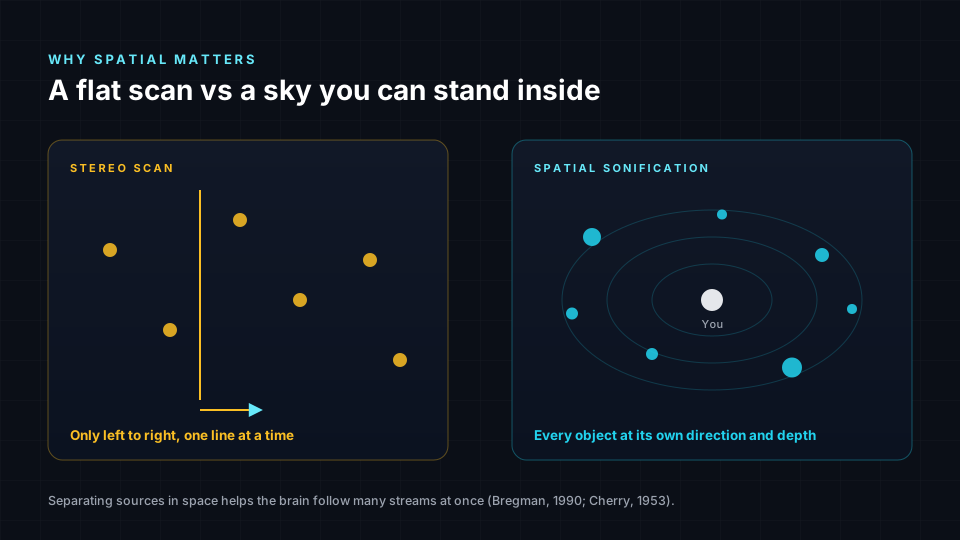
- Most space sonifications are stereo left-to-right scans. Spatial audio places each data source at its own direction, height and distance, which helps listeners follow more streams at once.
- At NAMM 2026, Spatial9 co-founder and CTO Alan Silva joined an A3E panel on sonification and spatial sound, presenting how GravityLLM, IFS and the open IAMF format can turn any data stream into an immersive mix.
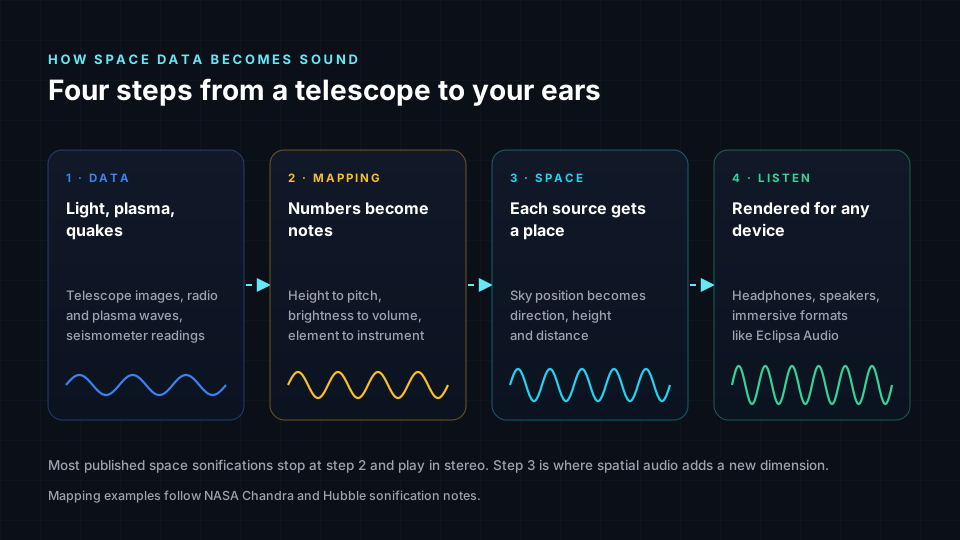
Short answer: Space is almost silent to human ears, because sound needs air or another medium to travel through. Yet NASA and other space agencies now publish hundreds of "sounds of space". They are made through sonification (sometimes spelled "soundification"): translating data such as light, radio waves, plasma vibrations or quakes into sound. Most of these pieces play in stereo, scanning an image from left to right. Spatial9 adds the missing dimension. Our technology places every data source at its own position around the listener, so a galaxy, a nebula or a planet's magnetic field becomes a 3D scene you can stand inside. At the 2026 NAMM Show, our co-founder and CTO Alan Silva joined a panel on exactly this topic.
What is sonification?
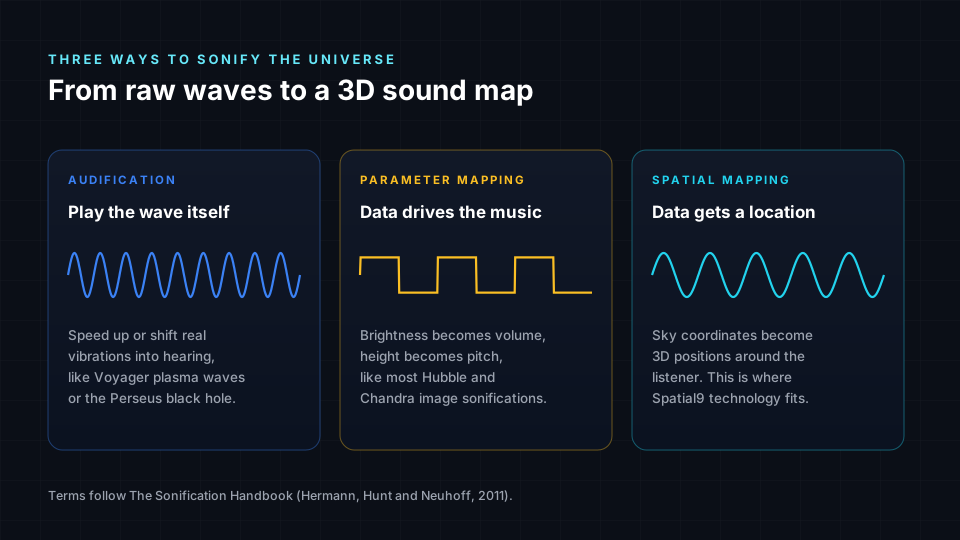
Sonification is the use of sound, other than speech, to communicate information. A Geiger counter's clicks are a simple example: the more radiation, the faster the clicks. The field has its own research community, the International Community for Auditory Display, and a standard reference, The Sonification Handbook, edited by Thomas Hermann, Andy Hunt and John Neuhoff.
Researchers usually describe three approaches:
- Audification: playing real vibrations directly, shifted into the range of human hearing. Spacecraft plasma wave recordings are often presented this way.
- Parameter mapping: using data to control musical features, such as making brighter stars louder or higher objects higher in pitch.
- Spatial mapping: using data to control where a sound appears around the listener. This is the area where Spatial9 works.
How NASA turns the universe into sound
Voyager: the first sounds from deep space
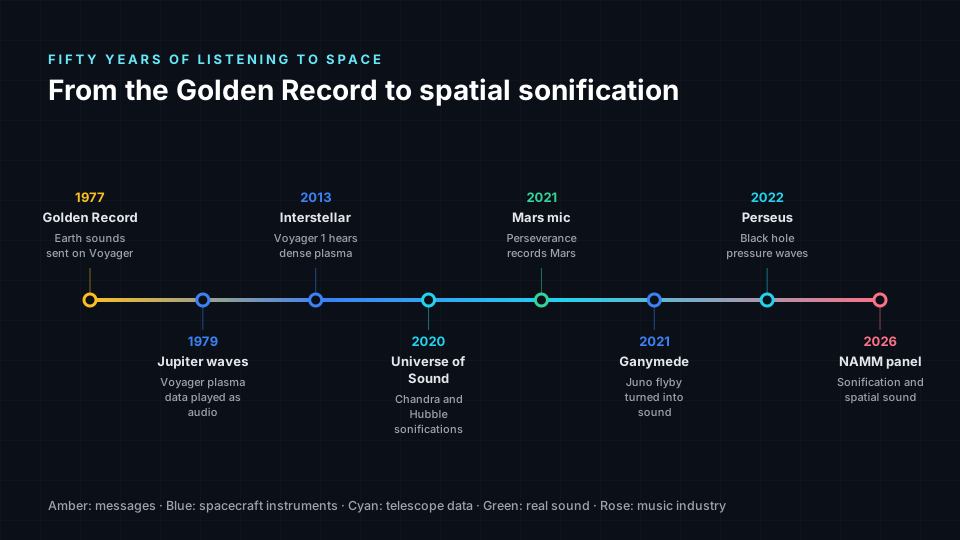
NASA's twin Voyager spacecraft, launched in 1977, carried the Golden Record, a disc of music, greetings and sounds from Earth intended for anyone who might find it. Voyager also carried a plasma wave instrument. Electrically charged gas in space vibrates at frequencies that happen to fall in or near the range of human hearing, so scientists led by Donald Gurnett at the University of Iowa could play the data as sound. In 2013 they reported in Science that the pitch of these vibrations rose sharply as Voyager 1 entered the denser plasma between the stars, evidence that it had left the bubble of the Sun's influence. They literally heard the spacecraft cross into interstellar space.
Chandra and Hubble: the Universe of Sound
Since 2020, NASA's Chandra X-ray Center, led on this project by Kimberly Arcand, has worked with astronomer and musician Matt Russo and musician Andrew Santaguida of SYSTEM Sounds to sonify telescope images. NASA's Hubble sonifications page explains the typical mappings. In one, the data is "scanned from left to right", with vertical position mapped to pitch and brightness mapped to volume. In another, red light is assigned lower pitches and blue light higher ones, because light frequency rises from red to blue just as sound frequency rises from low to high.
These pieces matter for more than outreach. Astronomer Wanda Díaz-Merced, who lost her sight as a student, showed in her doctoral research at the University of Glasgow that listening to data can reveal patterns that are easy to miss visually. Sonification makes astronomy accessible to blind and low-vision people, and it gives everyone a second way to notice what is in the data.
The black hole that sings 57 octaves too low
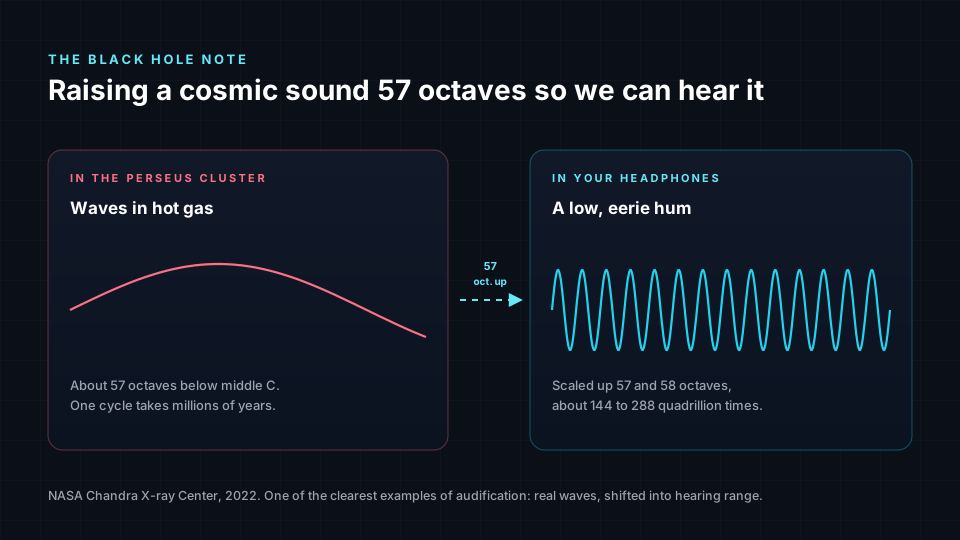
In 2022 NASA released one of its most shared sounds. In the Perseus galaxy cluster, about 240 million light-years away, a supermassive black hole sends pressure waves through the surrounding hot gas. These are real sound waves, but their pitch is about 57 octaves below middle C, far beyond any instrument. The Chandra team shifted them up by 57 and 58 octaves, raising the frequency by roughly 144 and 288 quadrillion times, so human ears could hear them. The result is a deep, eerie hum.
Juno and the sound of Ganymede
In 2021, NASA's Juno spacecraft flew past Ganymede, Jupiter's largest moon. Its Waves instrument recorded electric and magnetic radio waves, which the team shifted into audio. The sound changes abruptly halfway through, as Juno passes from one region of Ganymede's magnetic environment into another. Again, the ear is used as a scientific instrument.
Interplanetary sound: why other worlds sound different
Real sound, the kind carried by air, also exists beyond Earth wherever there is an atmosphere. How it behaves depends on the gas, its density and its temperature. Researchers Andi Petculescu and Richard Lueptow modelled the acoustics of Mars, Venus and Saturn's moon Titan in 2007, and in 2021 NASA's Perseverance rover gave us the first real recordings from another planet.
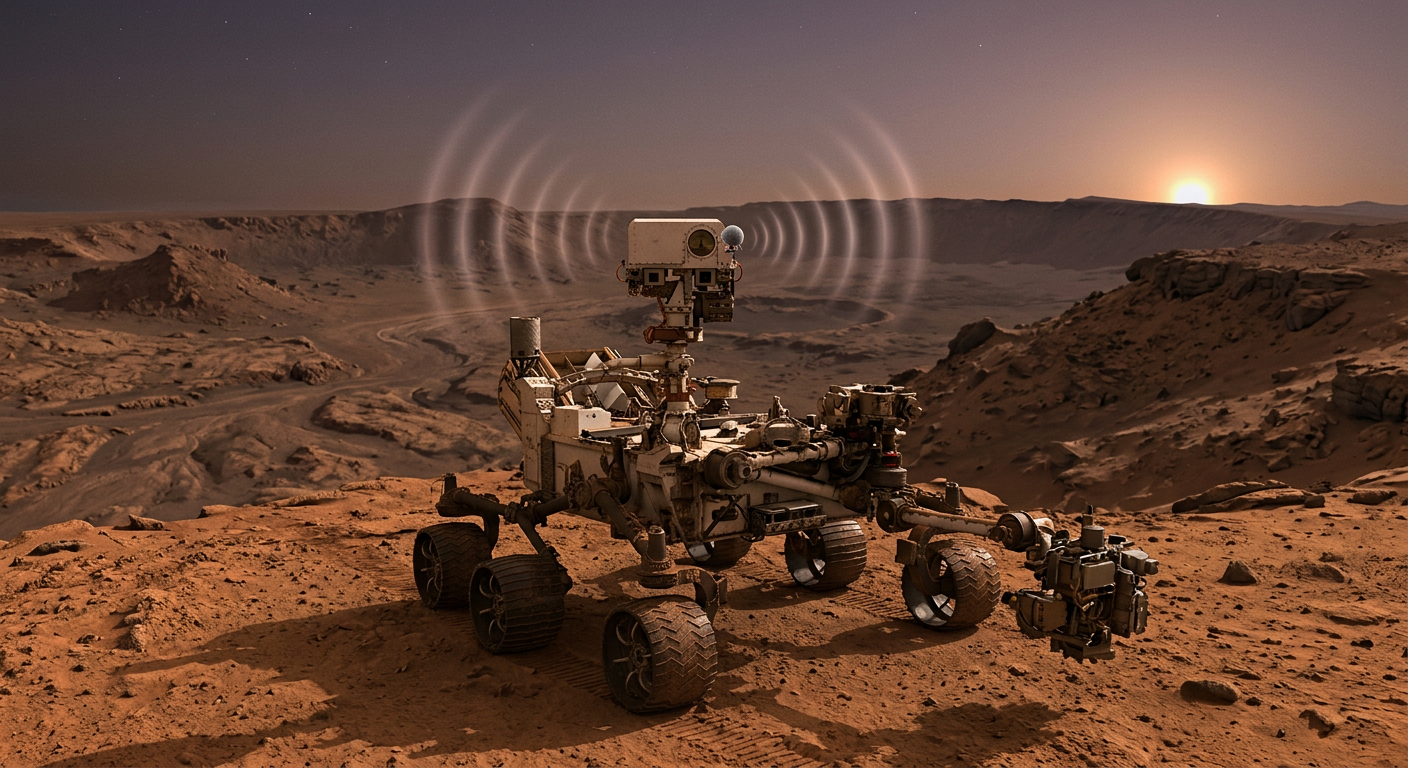
In 2022 a team led by Sylvestre Maurice published the results in Nature. Mars is very quiet, because its thin carbon dioxide air carries sound poorly. The speed of sound there is about 240 metres per second, compared with 343 on Earth. Surprisingly, higher-pitched sounds above about 240 Hz travel slightly faster, at about 250 metres per second. That means a complex sound, like music, could reach a listener on Mars with its high notes arriving fractionally before its low ones.
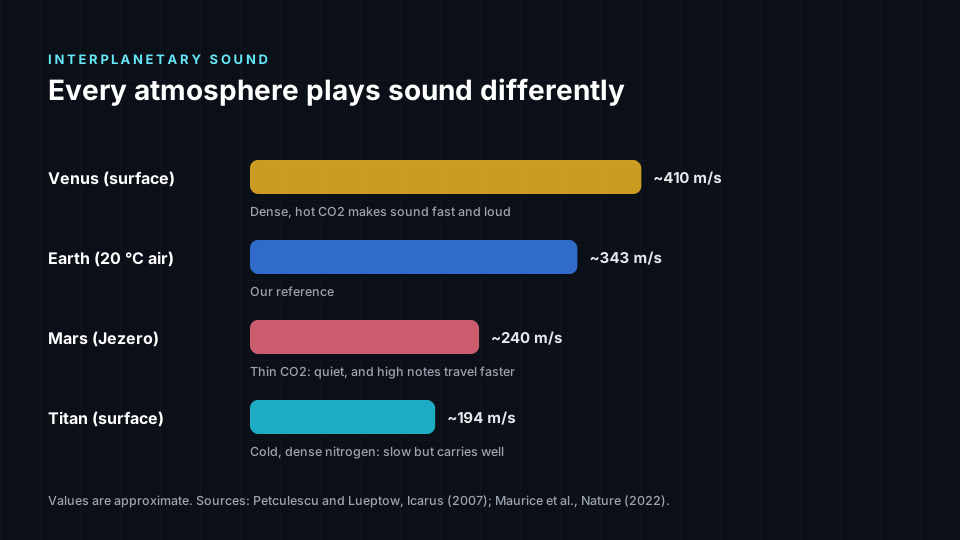
| World | Approximate speed of sound | What you would notice |
|---|---|---|
| Venus (surface) | ~410 m/s | Dense, hot air: loud, fast sound and lower-sounding voices |
| Earth (20 °C) | ~343 m/s | Our everyday reference |
| Mars | ~240 m/s, ~250 m/s for high notes | Very quiet; high notes arrive slightly early |
| Titan (surface) | ~194 m/s | Cold, dense nitrogen: slow sound that carries well |
This is what we mean by interplanetary sound modulation: the same sound changes in loudness, timing and tone depending on the world it travels through. For musicians and sound designers this is a creative palette. For a spatial audio engine it is a set of rules: speed, absorption and distance affect how an object should sound depending on where it is placed.
The NAMM 2026 panel: sonification meets spatial sound
At the 2026 NAMM Show in Anaheim, the A3E (Artists + Advanced Applications Exchange) programme hosted the session "Expanding the Creative Toolkit: Unlocking New Dimensions of Musical Expression Through Sonification & Spatial Sound". It brought together people from music technology, applied AI and scientific research. Spatial9 co-founder and CTO Alan Silva represented Spatial9 on the panel.
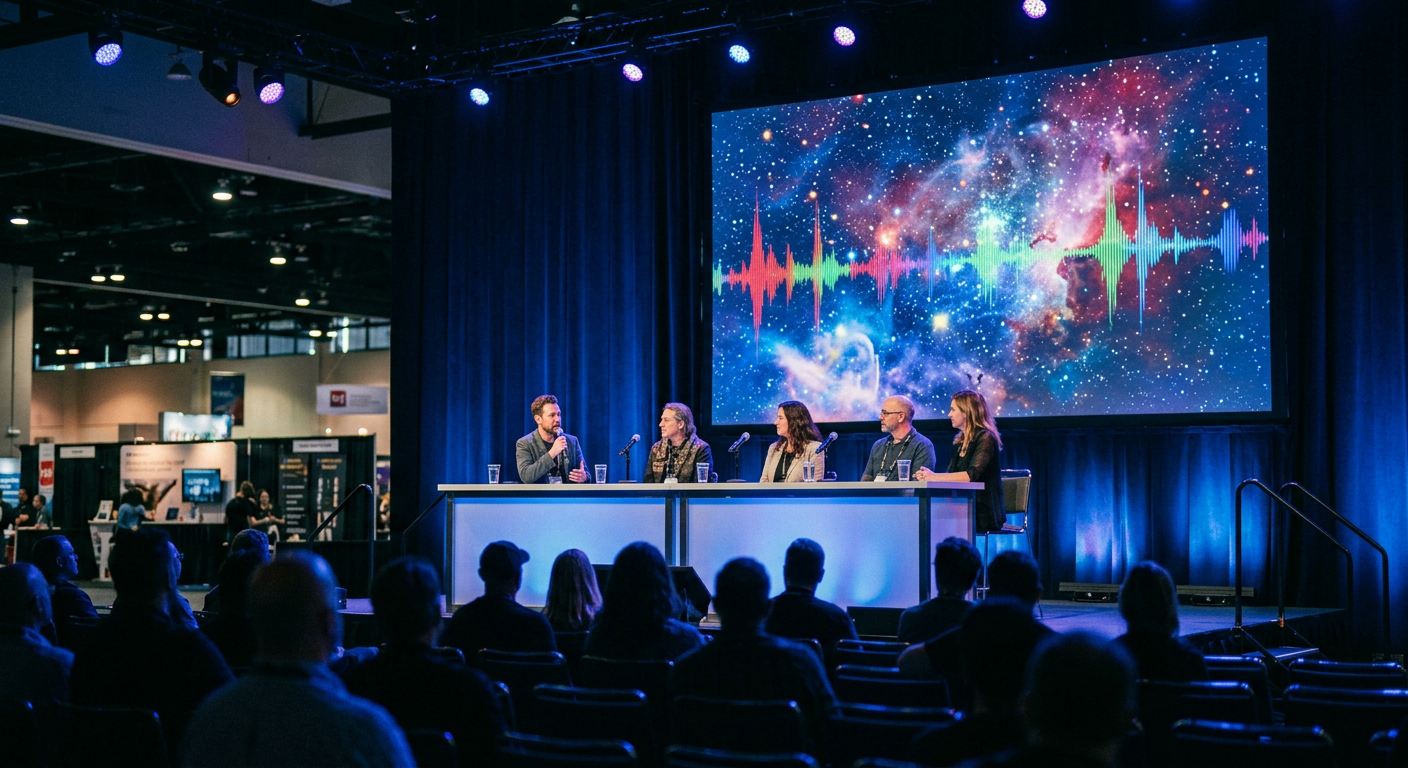
The core idea Spatial9 brought to the conversation is simple: sonification has been held back by stereo. A left-to-right scan can only show one dimension of position at a time. The universe is three-dimensional, and so is human hearing. When each star, galaxy or data stream is given its own place around the listener, several things happen:
- More streams can be followed at once. Since Colin Cherry's 1953 work on the cocktail party problem and Albert Bregman's research on auditory scene analysis, we have known that the brain separates sounds far more easily when they come from different directions.
- Position becomes information. Sky coordinates can map directly to direction and height, and distance can map to depth, so listeners "hear where" something is.
- The piece becomes a musical work, not just a chart. Artists can compose with data as raw material and publish the result in the same immersive formats as their music.
The same week, Spatial9's founders, Luiz Zanardo (CEO), Alan Silva (CTO) and Carlos Freitas (Chief Music Officer), also led the A3E workshop "The Dawn of Generative Spatial Audio". Spatial9 was also named one of the Best in Show at NAMM 2026 by eCoustics.
How Spatial9 makes spatial sonification
Spatial9 was built to turn stereo music into immersive mixes. The same engine works for data, because to it every input is a set of sound objects that need a place, a distance and a motion path.
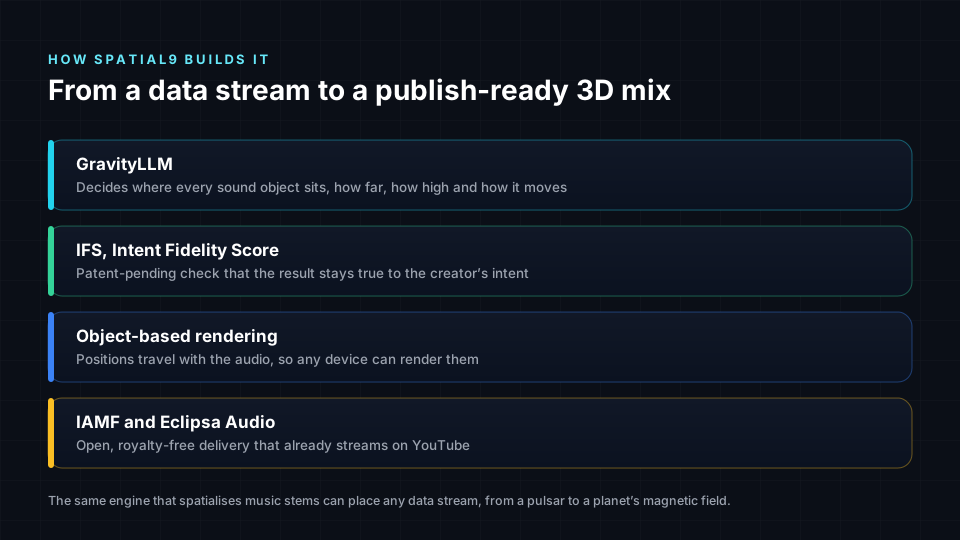
- Separate the sources. A music track is split into stems such as vocals, drums and bass. A sonification is made of layers, such as each wavelength of a telescope image, each instrument on a spacecraft or each object in a star field.
- Place them with GravityLLM. Our AI model, GravityLLM, learned from real studio sessions where each sound should sit, how far away, how high and how it moves. For data, positions can come straight from the source, such as sky coordinates, with GravityLLM handling the musical balance around them.
- Check the intent with IFS. Our patent-pending Intent Fidelity Score measures how closely a rendered mix matches what the creator meant. For a sonification, that means the spatial picture should stay faithful to the data, not just sound impressive.
- Deliver it in an open format. Spatial9 outputs object-based immersive audio, including IAMF, the open and royalty-free format behind Eclipsa Audio. The positions travel with the sound, so it plays correctly on headphones, phones, TVs and speaker systems. Read why we believe in open immersive standards.
- Render for any listener. On headphones, Spatial9 uses binaural rendering based on how the ears filter sound from each direction. The research behind it is covered in our article on MIT psychoacoustics hacks.
How advanced is Spatial9?
Spatial9 has presented its technology on the industry's main stages, alongside the companies defining the next generation of immersive audio:
- CES 2025: with Google and Music AI, Spatial9 debuted the first music rendered in Eclipsa Audio, now streaming on YouTube.
- AES Show 2025: we presented GravityLLM and the IFS model on stage alongside Google, Meta and Samsung Research America.
- NAMM 2026: two A3E sessions, including the sonification and spatial sound panel, and a Best in Show mention.
- IEEE ICASSP 2026: a panel with Google and Meta on open audio codecs for immersive media.
- Alliance for Open Media: Spatial9 is a [member](http://aomedia.org/press%20releases/Spatial9-Joins-the-Alliance-for-Open-Media), helping shape the IAMF specification.
Few teams combine an AI model trained on real spatial mixing decisions, a measurable quality score, and delivery in an open standard already streaming at global scale. That combination is what makes spatial sonification practical rather than a one-off experiment.
What spatial sonification can be used for
- Science communication: planetariums, museums and documentaries where audiences hear the structure of a galaxy around them.
- Accessibility: giving blind and low-vision people a richer, three-dimensional way to explore space data.
- Research: listening to several instrument streams at once, each from its own direction, to notice events that coincide.
- Music and art: composing with real cosmic data and releasing it in the same immersive formats as any other track.
- Education: classes where students hear how sound would travel on Mars or Titan. Teachers can start with Spatial9 for Education.
You can hear what spatial placement does to a mix on the Spatial9 demo, and learn the basics in how we hear in 3D.
Frequently asked questions
What is space sonification?
Space sonification is the translation of astronomical or spacecraft data into sound. Telescope images, radio waves, plasma vibrations and seismic readings are turned into pitch, volume, rhythm and, with spatial audio, position around the listener.
Is there sound in space?
Not in the way we hear it on Earth, because sound needs a medium to travel through. However, sound does travel through planetary atmospheres such as those of Mars, Venus and Titan, and very low pressure waves exist in the hot gas of galaxy clusters such as Perseus.
Is it "sonification" or "soundification"?
The scientific term is sonification. "Soundification" is a common alternative spelling with the same meaning: turning data into sound.
How does NASA create sonifications?
NASA teams map data to sound. A common method scans an image from left to right, mapping height to pitch and brightness to volume. For some data, such as plasma waves or the Perseus black hole, they shift real vibrations into the range of human hearing.
What does Mars sound like?
Mars is very quiet because its atmosphere is thin. Perseverance's microphones showed sound travels at about 240 metres per second there, and higher-pitched sounds travel slightly faster, at about 250 metres per second.
How does spatial audio improve sonification?
Spatial audio gives each data source its own direction, height and distance. Because the brain separates sounds from different directions more easily, listeners can follow more streams at once, and position itself carries information.
What did Spatial9 present at NAMM 2026?
Spatial9 co-founder and CTO Alan Silva took part in the A3E panel on sonification and spatial sound, and the founding team led a workshop on generative spatial audio. Spatial9 was also named one of the Best in Show at NAMM 2026 by eCoustics.
Sources
- NASA Science: Hubble sonifications.
- NASA Chandra X-ray Center: A Universe of Sound, including the 2022 Perseus black hole sonification.
- NASA JPL: The Voyager Golden Record.
- Gurnett, D. A., Kurth, W. S., Burlaga, L. F. and Ness, N. F. (2013). In situ observations of interstellar plasma with Voyager 1. Science, 341(6153), 1489-1492.
- Maurice, S. et al. (2022). In situ recording of Mars soundscape. Nature, 605, 653-658.
- Petculescu, A. and Lueptow, R. M. (2007). Atmospheric acoustics of Titan, Mars, Venus, and Earth. Icarus, 186(2), 413-419.
- Hermann, T., Hunt, A. and Neuhoff, J. G. (Eds.) (2011). The Sonification Handbook. Logos Verlag, Berlin.
- Kramer, G. (Ed.) (1994). Auditory Display: Sonification, Audification, and Auditory Interfaces. Addison-Wesley.
- Bregman, A. S. (1990). Auditory Scene Analysis: The Perceptual Organization of Sound. MIT Press.
- Cherry, E. C. (1953). Some experiments on the recognition of speech, with one and with two ears. Journal of the Acoustical Society of America, 25(5), 975-979.
- Díaz-Merced, W. L. (2013). Sound for the exploration of space physics data. PhD thesis, University of Glasgow.
- Arcand, K. K. et al. (2024). A Universe of Sound: processing NASA data into sonifications to explore participant response. Frontiers in Communication.
- The 2026 NAMM Show: Expanding the Creative Toolkit, Unlocking New Dimensions of Musical Expression Through Sonification & Spatial Sound (A3E).
- The 2026 NAMM Show: A3E Workshop, The Dawn of Generative Spatial Audio.
- eCoustics: Best in Show at NAMM 2026.
- PR Newswire: Google, Spatial9 and Music AI debut Eclipsa Audio immersive format at CES 2025.
- EIN Presswire: Spatial9 at AES Show 2025.
- [Alliance for Open Media: Spatial9 joins the Alliance for Open Media.](http://aomedia.org/press%20releases/Spatial9-Joins-the-Alliance-for-Open-Media)